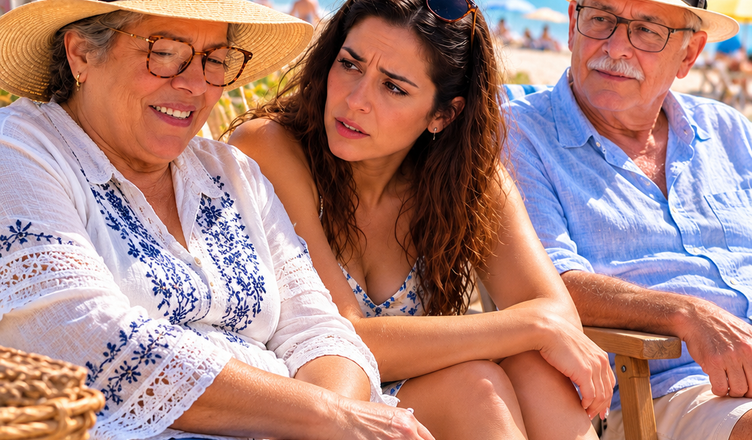
When everyone else wore T-shirts and sleeveless dresses, she chose lightweight blouses that covered her arms completely. At family barbecues, she would sit beneath an umbrella in long sleeves even when the temperature climbed unbearably high. At the beach, she wore a loose shirt over her swimsuit and rarely took it off.
As a child, I accepted it as one of her peculiar habits.
As a teenager, I became curious.

As an adult, I began to wonder whether there was something she was deliberately hiding.
Whenever I asked, she had an explanation ready.
She burned easily in the sun. She disliked showing too much skin. She felt cold even in warm weather.
None of the answers seemed impossible. Yet there was something about the speed with which she gave them that bothered me.
Then, one evening, I asked the question I had been afraid to ask for years.
“Mom, did Dad ever hurt you?”
Her reaction told me immediately that I had touched a secret.
But the truth was nothing like what I had imagined.
The Family Everyone Thought They Knew
My parents, Helen and Michael, had been married for more than thirty years.
From the outside, theirs looked like an ordinary marriage. They argued occasionally about bills, household chores and my father’s habit of forgetting appointments, but I never witnessed violence between them.
My father wasn’t particularly expressive, yet he was dependable. He fixed things around the house, drove me to school when I missed the bus and called my mother every evening when he worked late.
That didn’t mean I knew everything about their marriage.
Children rarely do.
By the time I reached my twenties, I had learned enough about the world to understand that appearances can be misleading. Families can hide painful histories behind perfectly normal photographs.
And there was one detail I couldn’t ignore.
My mother’s arms.
Once, when I was about fourteen, I walked into her bedroom without knocking. She was changing clothes, and for perhaps two seconds I saw part of her upper arm.
There were marks on her skin.
She immediately pulled on her blouse.
I apologized and left.
We never discussed it.
But I never forgot.
The Question I Finally Asked
Years later, during a visit home, Mom and I spent an evening together while Dad was away helping my uncle repair his roof.
It was unusually hot.
Even with the windows open, the house felt stuffy.
Mom was wearing a pale blue shirt buttoned at the wrists.
I watched her wipe perspiration from her forehead.
“You know you can wear a T-shirt,” I said.
She smiled.
“I’m comfortable.”
I don’t know why that particular evening made me brave enough to continue.
Maybe it was because I was old enough to recognize that avoiding difficult questions doesn’t make them disappear.
“Mom,” I said, “can I ask you something serious?”
She looked at me.
“What?”
I hesitated.
Then I asked it.
“Did Dad ever do something to you?”
Her smile vanished.
For several seconds, she didn’t move.
I immediately regretted asking.
“I don’t mean to accuse him,” I added quickly. “I’ve just wondered about your arms for years.”
Mom’s face became pale.
She stood, walked to the door and locked it.
That frightened me more than anything.
Then she returned and sat beside me.
“You think your father did this?”
She touched her left sleeve.
I didn’t answer.
Slowly, she began rolling the fabric upward.
The Scars
There were scars across her forearm.
Some were thin and pale. Others were larger, irregular patches that continued toward her elbow.
I had expected marks.
I hadn’t expected so many.
My stomach tightened.
“Mom…”
She raised a hand.
“Your father didn’t do this.”
The relief I felt lasted only a moment.
Because if Dad hadn’t caused those injuries, somebody or something else had.
She pulled the sleeve higher.
The scarring continued.
Then she told me a story I had never heard.
It had happened years before I was born.
The Night of the Fire
When my mother was nineteen, she lived with her parents and her younger brother, David.
Their house was small and old, with narrow stairs leading to the bedrooms on the second floor.
One winter night, everyone went to sleep as usual.
Sometime after midnight, my mother woke to shouting.
Smoke had already reached the upstairs hallway.
The exact cause of the fire was never something she liked discussing, and after so many years she said some details remained blurred by panic. What she remembered clearly was hearing her brother crying from another room.
My grandparents were downstairs.
David was upstairs with her.
Mom tried to reach him.
The hallway was filling with smoke, and heat was spreading through the house.
She could have gone toward a window immediately.
Instead, she moved toward her brother’s bedroom.
When she grabbed the door handle, the metal was hot.
She burned her hand.
She tried again using part of her nightclothes to protect herself.
Inside, she found David terrified and struggling to understand what was happening.
Mom got him toward a window.
Neighbors had already noticed the fire.
Help was coming.
But getting out wasn’t simple.
In the confusion, my mother suffered serious burns on her arms while trying to shield her brother from heat and broken material.
Both survived.
But the injuries left permanent scars.
Why Had Nobody Told Me?
I stared at her.
I had grown up knowing Uncle David as the cheerful man who brought ridiculous birthday presents and told embarrassing stories about my father.
No one had ever mentioned a fire.
No one had told me my mother had been injured saving him.
“Why didn’t you tell me?”
Mom shrugged.
“What would it have changed?”
“Everything.”
“No,” she said. “That’s exactly why I didn’t tell you.”
I didn’t understand.
She explained that after the accident, people treated her differently.
Some stared.
Some asked intrusive questions.
Others praised her as though everything she did afterward had to be connected to that single night.
She hated both reactions.
She didn’t want to be someone’s tragedy.
She didn’t want to be someone’s inspirational story either.
She wanted to live.
Eventually, covering the scars became easier than explaining them.
Long sleeves prevented strangers from asking questions.
Over time, the habit became automatic.
There Was Another Secret
I thought the story was over.
It wasn’t.
“Your father knows,” Mom said.
Of course he did. They had been married for decades.
But there was something else.
When my parents first met, my mother had still been deeply self-conscious about her scars.
She avoided swimming pools. She hated changing rooms. She assumed any man who saw her arms would eventually look at her differently.
Dad discovered the scars early in their relationship.
Mom expected questions.
Instead, according to her, he simply waited until she was ready to explain.
That patience was one of the reasons she trusted him.
Then she said something that made me feel ashamed of the assumption I had carried for years.
“Your father has spent half our marriage trying to convince me I don’t need these sleeves.”
I looked toward the locked door.
Suddenly, dozens of tiny memories rearranged themselves.
Dad suggesting sleeveless dresses while shopping.
Mom refusing.
Dad telling her she would be more comfortable without her cardigan.
Mom laughing him off.
Things I had interpreted as meaningless domestic exchanges now had an entirely different context.
Why Secrets Change Shape
That evening taught me something uncomfortable about family history.
When information is missing, we fill the empty space ourselves.
Sometimes we are right.
Sometimes we are dangerously wrong.
I had seen scars, noticed secrecy and constructed an explanation.
It wasn’t unreasonable to wonder whether someone had hurt her. Visible injuries combined with reluctance to discuss them can understandably raise concern.
But suspicion isn’t evidence.
My mother’s silence had allowed me to imagine one story while she had been carrying another for decades.
At the same time, I understood why she hadn’t explained herself earlier.
Her body belonged to her.
So did her history.
Being someone’s daughter didn’t automatically give me the right to every painful chapter of her life.
She told me because she decided she was ready.
That distinction mattered.
A Conversation With My Father
Dad returned the following afternoon.
For several hours, I behaved normally.
Eventually, I found him in the garage.
“Mom told me about the fire,” I said.
He stopped what he was doing.
“All of it?”
“I think so.”
He nodded.
Neither of us spoke for a moment.
Then I admitted what had been troubling me.
“I thought maybe you had hurt her.”
I expected him to become angry.
Instead, he looked genuinely sad.
“I wondered if you’d eventually think that.”
That surprised me.
“Why?”
“Because children notice more than parents realize.”
He wasn’t offended that I had asked my mother.
He said that if I had ever seriously believed she might be unsafe, asking privately had been better than pretending not to notice.
But he also reminded me that complicated situations deserve care.
People shouldn’t be condemned on assumptions alone.
That conversation stayed with me almost as strongly as the one with Mom.
The First Summer Without the Sleeves
Nothing changed immediately.
Mom continued wearing long sleeves.
I never asked her to stop.
After learning the truth, I understood that telling someone to expose scars can be another way of making those scars the center of attention.
Almost a year later, however, something small happened.
We were having lunch in my parents’ backyard.
It was one of the hottest days of summer.
Mom disappeared inside and returned wearing a short-sleeved white shirt.
I noticed instantly.
Dad noticed too.
Neither of us said anything.
That may have been the most important part.
She sat at the table, poured herself lemonade and continued the conversation as though nothing unusual had happened.
Her scars were visible.
The world did not stop.
Nobody stared.
Nobody asked for the story.
She was simply my mother, sitting in her own garden on a hot afternoon.
Later, when we were alone, she caught me looking at her arm.
“Still strange?” she asked.
I shook my head.
“No. Just new.”
She smiled.
What I Understand Now
For years, I thought my mother’s long sleeves were hiding something shameful.
In reality, they were protecting a part of her past that she didn’t want to explain repeatedly.
The scars weren’t evidence of weakness.
Nor did they need to become proof of heroism every time someone saw them.
They were simply part of her body and part of a difficult history.
I also learned not to romanticize silence.
There are situations in which asking questions matters, particularly when we genuinely fear someone may be in danger.
But questions can be asked with care.
Concern doesn’t require accusation.
And when someone finally chooses to speak, listening can be more valuable than immediately trying to interpret, judge or fix what happened.
My mother still wears long sleeves sometimes.
She also wears short sleeves now.
The difference is that I no longer wonder what she’s hiding.
I know the story.
More importantly, I understand that knowing it was never something I was automatically owed.
That night, when she locked the door and rolled up her sleeve, I expected to discover something terrible about my father.
Instead, I discovered an entire chapter of my mother’s life that had existed long before I did.
And for the first time, I saw her not only as my mother, but as a woman who had survived fear, pain and years of unwanted attention, then quietly built a life beyond all of it.
The scars had always been there.
What changed was the story I had placed around them.