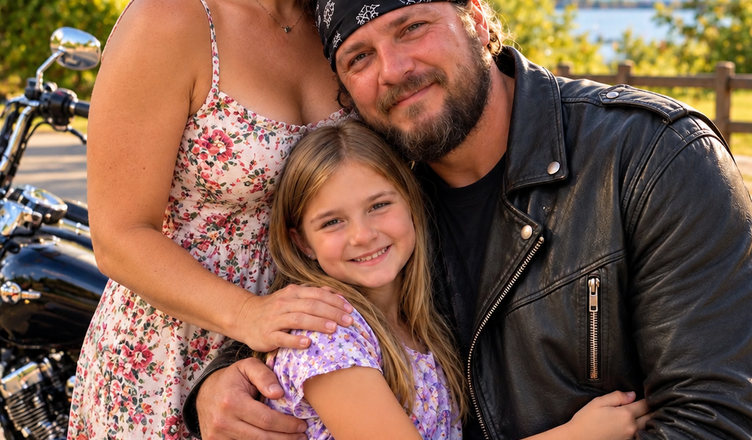
For nearly three weeks, nine-year-old Emma had stopped asking her mother to pick her up from school.
At first, Laura considered it a small sign of independence. Their house was less than fifteen minutes away on foot, and most of the route passed through a quiet residential neighborhood. Emma knew the streets well. She had walked them with her parents countless times.
Then Laura noticed something unusual.
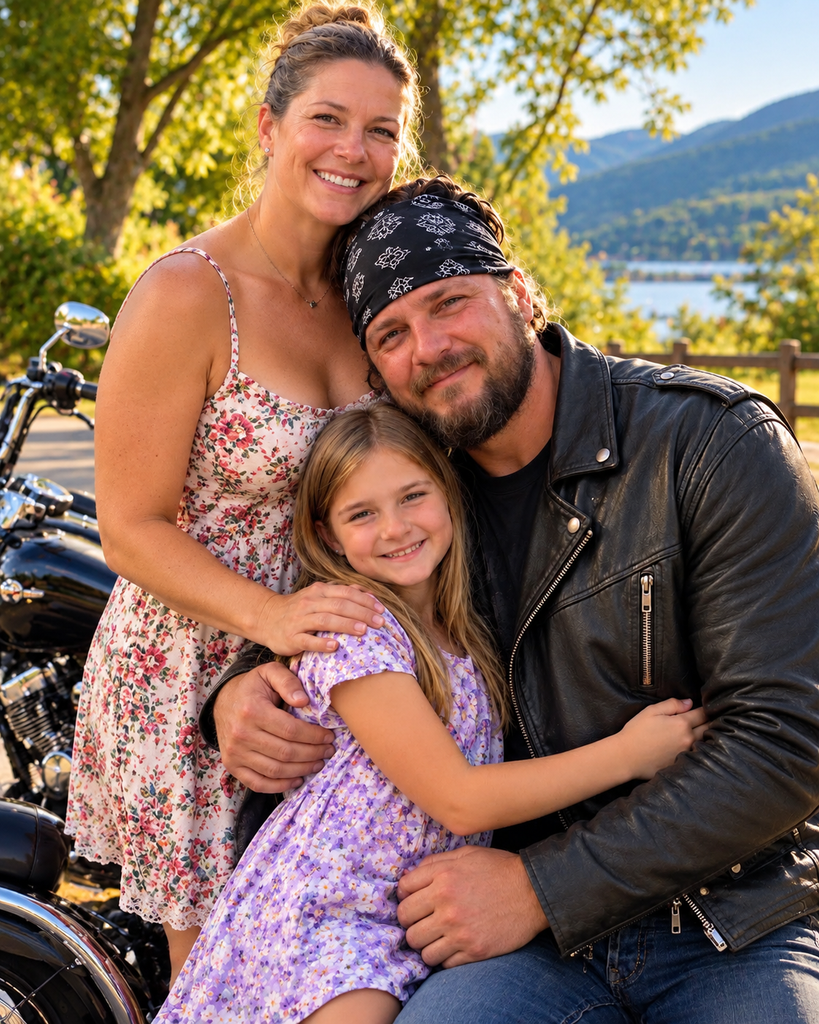
Every afternoon, when Emma reached the end of their street, a motorcycle would appear behind her.
The rider was their neighbor, Daniel.
He lived four houses away in a small brick home with an untidy front garden and an old motorcycle that could be heard before it was seen. Daniel was in his forties, usually wore dark clothes and heavy boots, and rarely stayed outside long enough for conversation.
Laura knew almost nothing about him.
Her husband, Mark, liked the situation even less.
“Why is he following her?” he asked one evening.
“He isn’t following her,” Laura replied. “Maybe they’re just coming home at the same time.”
“Every day?”
Laura had no answer.
The next afternoon she deliberately stood near the living-room window shortly before Emma was due home.
Several minutes later, her daughter appeared at the corner.
Behind her came Daniel’s motorcycle.
He wasn’t riding beside Emma. He stayed some distance behind, moving unusually slowly. When Emma reached the house, Daniel continued down the street and disappeared around the corner.
Mark had seen it too.
“That is not normal,” he said.
Laura tried to calm him. There could be a perfectly ordinary explanation. Perhaps Daniel finished work at the same time school ended. Perhaps their routes simply overlapped.
But Mark wasn’t convinced.
The following evening, he questioned Emma.
“Does Mr. Daniel talk to you after school?”
Emma hesitated.
“Sometimes.”
“What does he say?”
“Not much.”
“Did he tell you to walk with him?”
“No.”
“Then why is he always behind you?”
Emma looked down at her plate.
“I don’t know.”
The answer made Mark even more suspicious.
He told Laura he wanted to speak to Daniel immediately. Laura persuaded him to wait until they understood what was actually happening. She worried that confronting a neighbor without evidence could turn an innocent coincidence into an ugly dispute.
Still, she began watching more carefully.
And once she did, she noticed something else.
Emma had changed.
She no longer stopped at the small playground on her way home. She didn’t visit the corner shop where she used to spend her pocket money on sweets. Most importantly, she had stopped walking with her best friend, Sophie.
Whenever Laura asked why, Emma gave vague answers.
Sophie had gone another way.
Sophie had stayed late.
Sophie had been picked up.
Nothing sounded particularly alarming on its own, but together the explanations felt incomplete.
Then, on Thursday afternoon, Laura’s phone rang.
The caller was Emma’s teacher, Mrs. Bennett.
“Is this a good time to talk?”
Something in the teacher’s voice made Laura sit down.
“Yes. Is Emma all right?”
“She is. But there’s something I think you should know.”
Laura immediately imagined Daniel.
Mrs. Bennett continued.
“It concerns the gentleman on the motorcycle who has been near Emma after school.”
Laura felt her stomach tighten.
“You’ve seen him?”
“Yes. And I spoke to him yesterday.”
For several seconds Laura couldn’t answer.
“What did he want?”
Mrs. Bennett paused.
“He wanted to make sure someone at the school knew what had been happening.”
Laura was confused.
“What had been happening?”
The teacher’s explanation was nothing like what Laura expected.
About three weeks earlier, several older children had begun gathering near a narrow pedestrian passage Emma used on her way home. The passage ran between a row of garages and a fenced sports field. It saved nearly ten minutes compared with walking along the main road.
According to Mrs. Bennett, Emma had been repeatedly intimidated there.
At first it had apparently been childish teasing. Then the behavior escalated.
The older children blocked the path, mocked Emma, grabbed at her schoolbag and once scattered some of her belongings onto the pavement. Emma hadn’t reported it to her parents or teacher.
She had simply started trying to avoid them.
Daniel discovered what was happening by accident.
One afternoon, while returning home, he saw Emma standing at the entrance to the passage instead of walking through it. She waited several minutes, looking toward a group of older children.
When she finally turned around and took the longer route, Daniel understood that something was wrong.
The next day, he saw the same thing.
This time he stopped his motorcycle at a distance and asked whether Emma needed help.
She insisted she was fine.
But when she began walking, Daniel remained behind her until she reached their street.
That became the pattern.
He never asked her to get onto his motorcycle. He never tried to take her anywhere. He simply traveled slowly behind her during the part of the route where she felt unsafe.
“Why didn’t he tell us?” Laura asked.
Mrs. Bennett said she had asked him exactly that.
Daniel apparently believed Emma should have the opportunity to tell her parents herself. He was also concerned that approaching the family directly might embarrass her or make the situation worse.
But after several days passed and the problem continued, he decided an adult at the school needed to know.
That was why he had spoken to Mrs. Bennett.
Laura felt relief, followed almost immediately by guilt.
For days, she and Mark had been watching Daniel as though he were the danger.
In reality, he had noticed the danger before they had.
That evening, Laura waited until Emma was ready to talk.
She didn’t begin with accusations or questions about why she had kept the problem secret. Instead, she told her daughter that Mrs. Bennett had called.
Emma’s expression changed instantly.
“Am I in trouble?”
“No.”
“Is Daniel?”
“No.”
The child was silent for a moment.
Then she began to cry.
The story came out slowly.
Emma had originally believed the older children would get bored and leave her alone. When they didn’t, she became afraid that telling her parents would cause a confrontation.
She knew how protective her father was.
“I thought Dad would go there and shout at them,” she admitted.
She was probably right.
But there was another reason.
Emma was embarrassed.
She thought being frightened meant she had failed somehow. She worried that adults would ask why she hadn’t defended herself or simply walked away.
So she tried to solve the problem alone.
Daniel had noticed.
“He didn’t ask lots of questions,” Emma said. “He just said he’d ride behind me until I got home.”
For Mark, hearing that was difficult.
His first instinct had been to protect his daughter from Daniel. Yet Daniel had been protecting her from something Mark didn’t even know existed.
The next morning, Laura and Mark met with the school.
The adults focused on the actual behavior rather than assumptions about who was responsible. The school reviewed what had happened, contacted the families involved and arranged additional supervision near the routes students commonly used after classes.
Laura also changed one household rule.
Emma would no longer be expected to handle frightening situations alone simply because she was becoming more independent.
Walking home independently was one thing. Keeping a serious problem secret was another.
Later that weekend, Mark walked down the street and knocked on Daniel’s door.
The conversation was awkward at first.
Mark admitted that he had misunderstood what he had seen.
Daniel didn’t seem offended.
“If she were my kid,” he said, “I’d probably wonder too.”
Mark thanked him.
It would have been easy to make Daniel into either a villain or a hero, but the reality was more ordinary. He was simply a neighbor who had noticed that a child was frightened and decided not to ignore it.
That distinction mattered.
Adults often tell children to seek help when they feel unsafe, yet children do not always behave the way adults expect. Fear can look like silence. Embarrassment can look like avoidance. A child who says “nothing happened” may simply not know how to explain what happened.
The episode also taught Laura something about appearances.
Mark’s suspicion had not been irrational. Parents have every reason to pay attention when an unfamiliar adult begins appearing repeatedly around their child. Asking questions was appropriate.
The mistake would have been deciding on the answer before learning the facts.
Daniel’s leather jacket, motorcycle and quiet personality had made it easy to build a story around him. Once that story existed, every new observation seemed to confirm it.
The motorcycle behind Emma became evidence.
His silence became evidence.
His distance from other neighbors became evidence.
Yet none of those details explained what was actually happening.
Emma’s behavior provided the more important clues: changing her route, abandoning familiar habits, separating from a friend and becoming uncomfortable when asked about the walk home.
Those signs didn’t automatically prove something serious was happening, but they deserved attention.
In the weeks that followed, Emma gradually became comfortable walking home again.
Sometimes Laura met her halfway. Sometimes she walked with friends. On other days she took the longer, busier route.
Daniel stopped following behind her once the problem had been addressed.
But the sound of his motorcycle no longer made Mark rush toward the window.
One afternoon, Emma was helping her father carry groceries inside when Daniel rode past.
She raised her hand.
Daniel waved back.
Mark did the same.
It was a small gesture, almost meaningless to anyone who didn’t know the story.
But Laura understood what had changed.
Their family had spent days looking toward the obvious stranger because he looked like the easiest explanation. Meanwhile, the real problem had been hidden in their daughter’s silence.
And perhaps that was the most important lesson of all.
Protecting a child does not always mean identifying the person who looks most suspicious. Sometimes it means paying attention to small changes, asking questions without frightening them, listening before judging and making sure they know that asking for help is never something to be ashamed of.
Daniel had understood one part of that before anyone else.
He didn’t force Emma to explain herself on the sidewalk.
He didn’t demand that she prove she was in danger.
He simply saw a frightened child walking home and made sure, from a respectful distance, that she reached her front door safely.
I can also turn this story into a more dramatic Facebook-style version with a stronger opening and cliffhanger while keeping the full article natural and coherent.