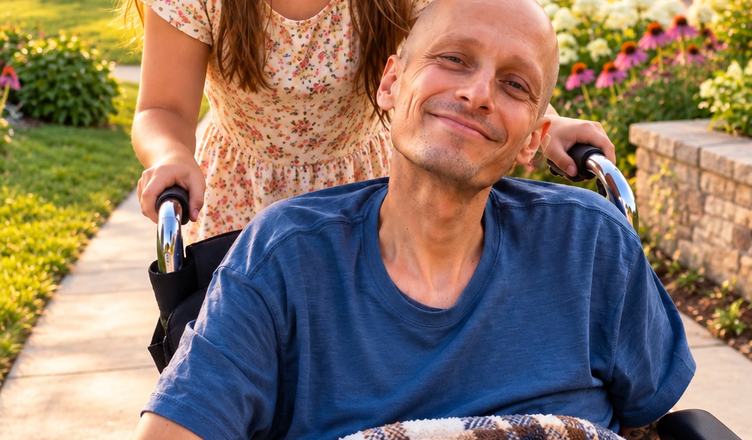
The day seven-year-old Lily became my daughter legally, she asked a question that almost broke me.
“Does this mean you’re my mom forever now?”
We were standing outside the courthouse. My fiancé, Daniel, was beside us, holding a folder filled with documents that had taken months to complete.
I knelt in front of Lily.
“Yes,” I told her. “Forever.”
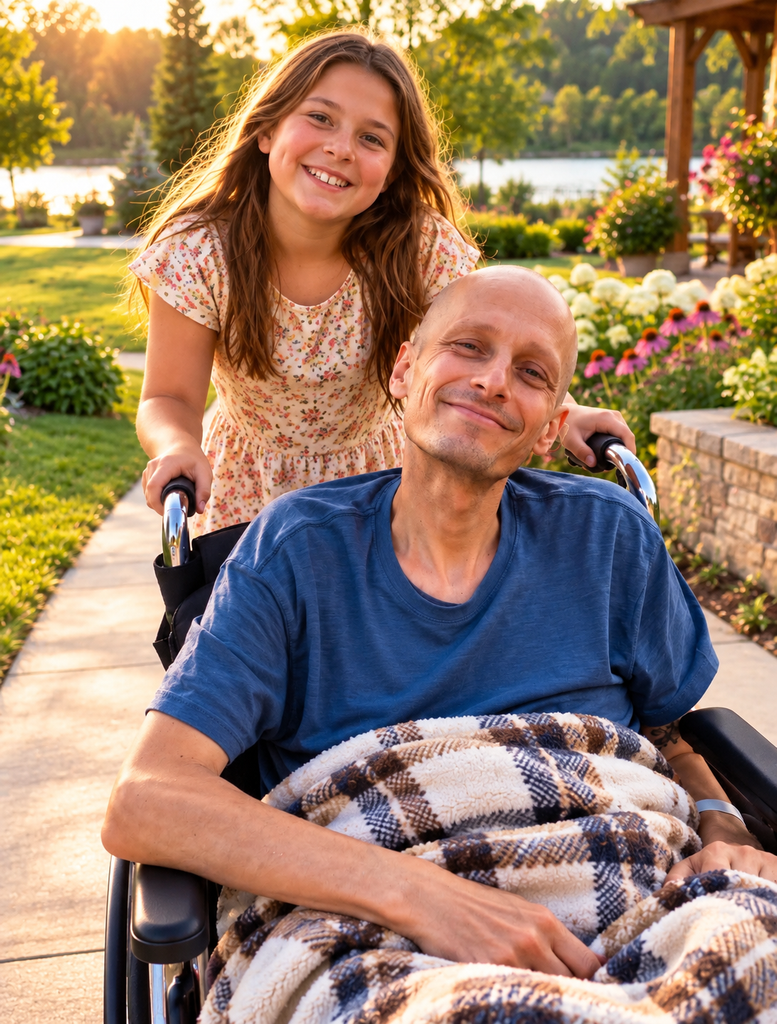
She wrapped her arms around my neck.
What she didn’t know was that I had spent the previous several weeks wondering how much of that forever I had left.
My name is Rachel. I was thirty-four when doctors found an abnormal mass during an examination that had originally been ordered because of persistent pain and fatigue.
What followed was a blur of appointments, scans and frightening medical language.
The possibility of serious illness was raised early.
Additional testing was necessary before anyone could tell me exactly what was happening, but fear doesn’t wait for certainty. Once I heard that the doctors were concerned, every unfinished part of my life suddenly seemed urgent.
I began preparing for the worst before I actually knew what the worst was.
And there was one person I couldn’t stop thinking about.
Lily.
The Little Girl Who Had Already Chosen Me
Daniel and I had been together for nearly four years.
His first wife, Lily’s mother, had died when Lily was very young. Daniel never tried to erase her from their lives. Photographs remained in Lily’s bedroom, and he spoke about her whenever Lily asked questions.
When I entered their family, I understood that I wasn’t arriving to replace anyone.
At first Lily called me Rachel.
Then she began leaving drawings on my pillow.
Later she started asking me to braid her hair before school. When she had nightmares, sometimes she came to me instead of Daniel.
One evening, when she was six, she accidentally called me Mom.
She immediately looked embarrassed.
I didn’t make a big deal of it.
Neither did Daniel.
A few weeks later, she did it again.
Eventually it became natural.
Daniel and I discussed adoption long before my medical problems began. He wanted it. I wanted it. Most importantly, Lily wanted it too.
But we kept postponing the legal process.
There always seemed to be time.
Then suddenly I wasn’t sure there was.
Fear Changed the Calendar
After the concerning test results, I became obsessed with finishing things.
I updated paperwork.
I organized photographs.
I wrote passwords and account information in a notebook for Daniel.
At night, after everyone went to sleep, I wrote letters to Lily.
One for her tenth birthday.
Another for her first day of high school.
One for graduation.
One simply titled “For a Day When You Miss Me.”
I hated writing them.
But I hated the idea of leaving her without them even more.
Daniel found me one night at the kitchen table surrounded by envelopes.
He sat across from me.
“You don’t know that you’re dying.”
“I know.”
“Then stop acting like the decision has already been made.”
“I can’t.”
That was the truth.
Intellectually, I understood that we didn’t yet have a final diagnosis. Emotionally, I had already traveled years into a future in which Daniel raised Lily alone.
The adoption became the most important unfinished task.
I didn’t want Lily someday wondering whether she had really been my daughter.
I wanted the answer documented somewhere beyond photographs and memories.
Signing My Name
The legal process moved faster than I expected because much of the preparation had already begun.
There were interviews, documents and conversations designed to make sure everyone understood what adoption meant.
The day the final papers were approved, Lily wore a yellow dress she had chosen herself.
She was more excited about getting pancakes afterward than about anything happening inside the courthouse.
For me, the experience felt enormous.
When I signed my name, my hand shook.
Daniel noticed.
He placed his hand over mine after I put down the pen.
Neither of us said anything.
There was nothing useful to say.
Outside, Lily asked whether I was her mother forever.
I told her yes.
And for the first time in weeks, I felt peaceful.
Whatever happened to me medically, I had done the one thing that mattered most.
Or so I thought.
Four days later, my phone rang.
It was the hospital.
“We Need You to Come In”
The nurse asked whether I could return that afternoon.
“Is something wrong?”
“The doctor needs to discuss your results with you.”
Those words were enough.
By then I had learned that medical professionals rarely gave complicated results over the phone. My mind immediately supplied the darkest explanation.
I called Daniel.
He offered to leave work and come with me, but I told him not to. Lily had an event at school that evening, and I didn’t want both of us arriving there terrified.
I drove to the hospital alone.
During the entire journey, I imagined how I would tell them.
Would we tell Lily immediately?
Would we wait until we had a treatment plan?
How much should a seven-year-old know about serious illness?
By the time I reached the examination room, I had mentally planned conversations that had never happened.
My doctor entered carrying a folder.
He sat down instead of remaining near the door.
That frightened me even more.
“There is something we need to clarify,” he said.
I gripped the edge of the chair.
Then he placed several reports on the desk.
“What I’m about to tell you should have been explained much more clearly from the beginning.”
I stared at him.
He continued.
The earlier findings had indeed required investigation. That part had been real.
But the initial concern was not the same thing as a confirmed diagnosis.
The subsequent testing had provided a very different picture.
The mass did not show the characteristics doctors had initially feared.
Further evaluation would still be necessary, and monitoring was important, but the evidence available at that point did not support the catastrophic conclusion I had already built my life around.
I wasn’t being told that I had only months left.
I wasn’t even being told that I definitely had the disease I had spent weeks believing I had.
I began crying before he finished explaining.
The Difference Between “Possible” and “Certain”
The doctor wasn’t telling me that nothing was wrong.
That distinction mattered.
There was still a medical issue that needed appropriate follow-up. There were questions that required answers, and no responsible physician could promise me a perfectly healthy future.
But somewhere during the earlier appointments, I had heard concern and translated it into certainty.
Medical language can be difficult when fear is involved.
Words such as “suspicious,” “abnormal,” “possible” and “needs further investigation” may sound almost identical to a frightened patient.
They aren’t.
A preliminary finding is not always a diagnosis.
A test can identify something unusual without establishing exactly what it is. Additional imaging, laboratory work, pathology or specialist review may substantially change the picture.
My doctor acknowledged that communication during my first appointments could have been clearer.
I also had to acknowledge something about myself.
I had stopped asking questions.
Once I became frightened enough, I heard every sentence through the same filter.
How long do I have?
Even when nobody had actually answered that question.
Calling Daniel
I sat in my car for nearly twenty minutes before calling him.
He answered immediately.
“Well?”
I couldn’t speak at first.
“Rachel?”
“They don’t think it’s what we thought.”
Silence.
“What does that mean?”
I repeated what the doctor had told me as carefully as possible.
Daniel kept asking the same question in different forms.
“So you’re okay?”
“I still need follow-up.”
“But you’re not dying?”
“Not from what they’re seeing now.”
He began crying.
I had heard Daniel cry only twice before.
That afternoon became the third.
Then he laughed.
I laughed too.
For several minutes we probably sounded completely irrational, switching between tears and laughter while trying to understand how the future we had been mourning had suddenly reopened.
That evening, Lily ran toward me after her school event.
I hugged her so tightly that she complained.
“Mom, I can’t breathe.”
Mom.
The word felt different now.
Not because the adoption had become more important.
Because I finally allowed myself to imagine hearing it thousands more times.
The Papers Had Never Been About Death
In the days that followed, I experienced an emotion I hadn’t expected.
Embarrassment.
Had I overreacted?
Had I frightened Daniel unnecessarily?
Had we rushed the adoption because I misunderstood what doctors were telling me?
Eventually I realized those were the wrong questions.
The adoption wasn’t a mistake.
It was something we had wanted before my health scare.
Fear merely forced us to stop postponing it.
I hadn’t become Lily’s mother because I expected to die.
I had already become her mother through ordinary life: packing lunches, checking homework, sitting beside her when she was sick, arguing about bedtime and listening to stories that took twenty minutes because she refused to skip a single detail.
The court papers simply gave legal recognition to a relationship that already existed.
My medical scare changed something else too.
I became much more careful about communication with doctors.
I started bringing written questions to appointments. If I didn’t understand a term, I asked for an explanation. I requested clarification about what was known, what was suspected and what remained uncertain.
Fear thrives in the spaces where information is missing.
Sometimes those spaces cannot be eliminated. Medicine does not always provide immediate certainty.
But patients deserve to understand which conclusions are established and which are still possibilities.
A Different Kind of Forever
Months later, I found the letters I had written to Lily.
They were still hidden in the back of my desk.
For a moment I considered destroying them.
Instead, I opened the one intended for her tenth birthday.
The woman who had written it believed she might never see that day.
She had tried to fit years of love into a few pages.
I decided to keep the letters.
Not as farewell messages.
As reminders.
None of us actually knows how much time we have. Most people simply have the luxury of not thinking about that fact every morning.
My health scare temporarily took that luxury away from me.
But it also showed me how often we postpone meaningful decisions because we assume there will always be a better time.
There will be another weekend.
Another holiday.
Another year.
Another opportunity to say what matters.
Sometimes there is.
Sometimes there isn’t.
I still attend follow-up appointments. I still feel nervous before certain tests. I no longer pretend that one reassuring conversation guarantees an uncomplicated future.
But I also no longer live as though the worst possible outcome has already happened.
The most important change is surprisingly ordinary.
I make breakfast.
I drive Lily to school.
Daniel leaves coffee beside my laptop when I’m working.
We argue about whose turn it is to empty the dishwasher.
We plan vacations months ahead.
And whenever Lily introduces me as her mother, I remember that afternoon outside the courthouse.
“Does this mean you’re my mom forever now?”
At the time, I thought I was promising her something I might not live long enough to fulfill.
Now I understand the promise differently.
Forever was never about knowing how many years I would have.
It was about making sure that, however many there were, she would never have to wonder whether she was truly my daughter.
Strengthen the medical revealClarify the diagnosis timelineAdd a sharper opening hook