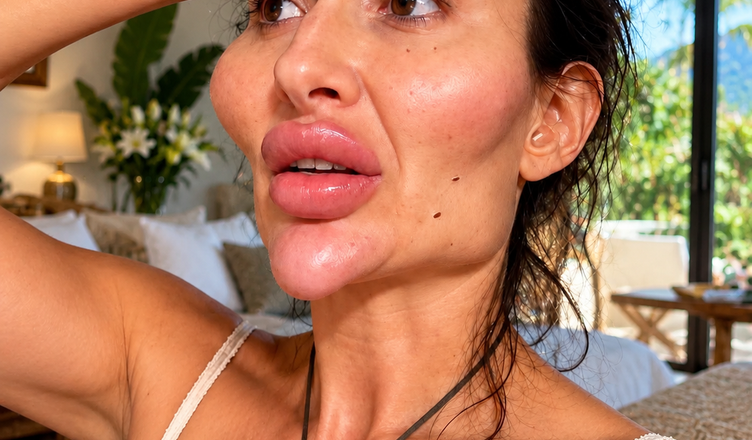
Today, the conversation unfolds in front of millions of strangers. A single photograph can travel across social media within hours, attracting admiration, criticism, speculation, and arguments from people who know almost nothing about the person they are examining.
That is exactly what happens when an unusual or striking face captures the internet’s attention.
Some viewers immediately describe what they see as beautiful and distinctive. They appreciate features that stand apart from familiar standards and argue that individuality is precisely what makes someone memorable. Others react in the opposite way. They may find the appearance excessive, artificial, or simply too different from what they personally consider attractive.

Within hours, one woman’s face can become a public debate.
But underneath all those comments lies a more interesting question: when did we become so confident that beauty has a single correct form?
A Photograph Can Tell Us Less Than We Think
The first mistake people often make online is assuming that a photograph explains everything.
It does not.
An image captures one moment under particular conditions. Lighting can dramatically change facial contours. The position of the camera can make certain features appear larger or smaller. Makeup can emphasize the eyes, lips, cheekbones, or brows. Even the expression someone makes at the exact moment a photograph is taken can affect how we perceive their entire face.
Modern phones complicate the situation further. Cameras automatically process images, adjusting contrast, sharpness, exposure, and color. Social media platforms may compress images, while users can apply filters ranging from barely noticeable corrections to dramatic transformations.
So when strangers look at one photograph and confidently announce exactly why someone looks the way she does, they may be working with surprisingly little reliable information.
Without verified information from the person herself, claims about cosmetic procedures or other changes to her appearance remain speculation.
A face alone is not evidence of someone’s medical or cosmetic history.
Why Unusual Faces Attract So Much Attention
Human beings are remarkably good at recognizing faces. We notice tiny differences in proportion, expression, symmetry, and movement.
That ability helps explain why a distinctive appearance can become so memorable.
If someone has features that differ from what viewers commonly encounter in advertising or entertainment, the brain notices immediately. That difference can create fascination.
Importantly, fascination is not the same thing as attraction.
A person can find a face interesting without considering it beautiful. Another person can find exactly those same features extraordinarily attractive. A third may feel uncomfortable simply because the appearance is unfamiliar.
This is where online arguments begin.
People frequently treat their personal reaction as though it were an objective measurement.
“I like this” becomes “This is beautiful.”
“I dislike this” becomes “This looks wrong.”
Yet those are not the same statements.
The first describes a preference. The second claims a universal rule that may not exist.
Beauty Standards Have Never Been Fixed
A quick look at history makes one thing obvious: ideas about beauty change constantly.
Different periods have favored different body shapes, hairstyles, eyebrow shapes, complexions, clothing, and facial proportions. Features celebrated during one generation may be considered unfashionable during another, only to return decades later.
Geography matters as well.
Beauty standards are influenced by culture, social class, media, economics, and local traditions. An appearance praised in one community may attract little attention somewhere else.
Even within the same society, preferences vary enormously from person to person.
This should make us cautious whenever someone claims that a particular face is objectively beautiful or objectively unattractive.
There may be patterns in what populations tend to prefer, but individual attraction remains far more complicated than a checklist of ideal proportions.
Social Media Has Made Beauty More Extreme
There is another reason these debates have become so intense: social media rewards attention.
Moderate reactions rarely travel as quickly as extreme ones.
A person who thinks, “She looks fine, but her style isn’t really for me,” may continue scrolling without leaving a comment.
Someone who thinks she is the most beautiful woman they have ever seen may comment immediately.
So may someone who strongly dislikes her appearance.
The result is a distorted conversation dominated by the loudest reactions.
Algorithms can amplify the effect. Content that generates arguments, comments, shares, and repeated viewing may circulate more widely. A photograph becomes popular not necessarily because most people agree about it, but because they disagree intensely.
Controversy itself becomes distribution.
Soon thousands of people are debating the appearance of a stranger who may never have expected such scrutiny.
The Meaning of “Natural” Has Become Complicated
Online beauty discussions often divide appearances into two categories: natural and artificial.
Reality is much less simple.
Someone may wear dramatic makeup while never having undergone a cosmetic procedure. Another person may use almost no makeup but follow an extensive skincare routine. Others may choose cosmetic treatments ranging from subtle to significant.
There is no reliable way to reconstruct someone’s complete history simply by studying a photograph.
More importantly, describing someone as “natural” is not automatically praise, just as describing an appearance as altered does not automatically justify criticism.
Adults make countless choices about presentation.
People dye their hair, straighten their teeth, wear contact lenses, remove body hair, get tattoos, build muscle, lose weight, use makeup, change hairstyles, and select clothes designed to alter how their proportions appear.
Society accepts many forms of appearance modification without hesitation while reacting strongly to others.
The dividing line is often cultural rather than logical.
Why We Care So Much About Other People’s Faces
Perhaps the more interesting mystery is not the woman’s appearance at all.
It is the intensity of the audience’s reaction.
Why can strangers spend hundreds of comments debating a face belonging to someone they have never met?
Part of the answer is that appearance provides immediate information. It requires almost no context. We can react to a photograph in seconds.
Personality takes time to understand.
Character requires observation.
Kindness, intelligence, humor, reliability, generosity, and emotional maturity cannot be accurately evaluated from a portrait.
A face can.
Or at least we think it can.
That makes appearance perfectly suited to the speed of social media.
The danger begins when instant visual judgments expand into assumptions about the entire person.
Someone’s appearance tells us remarkably little about whether she is pleasant, arrogant, compassionate, insecure, confident, intelligent, or happy.
Yet comment sections regularly make precisely those leaps.
Women Often Receive the Harshest Scrutiny
Although men are certainly judged by appearance, women continue to experience particularly intense pressure.
The expectations can also contradict each other.
A woman should be attractive, but apparently not too concerned with being attractive.
She should look youthful but should not appear to be trying too hard to remain youthful.
She should be confident but not vain.
She should embrace natural beauty while somehow meeting standards that are frequently produced through professional makeup, styling, lighting, and image editing.
If her features are ordinary, critics may call her forgettable.
If they are striking, critics may call them excessive.
Under such conditions, satisfying everyone becomes impossible.
That may be the most important lesson hidden inside these viral beauty debates: there is no appearance that receives universal approval.
The Difference Between Criticism and Cruelty
People are allowed to have preferences.
Nobody is obligated to find another person attractive. Saying that a particular style does not appeal to you is fundamentally different from treating the person wearing it as an acceptable target for humiliation.
Online anonymity sometimes erases that distinction.
When thousands of comments accumulate beneath a photograph, it becomes easy to forget that the subject is a human being rather than a fictional character designed for public evaluation.
Criticism can quickly become dehumanizing.
This does not mean appearance can never be discussed. Fashion, cosmetics, aesthetics, and beauty are legitimate subjects of conversation.
But there is a significant difference between discussing a style and attacking someone’s worth.
Perhaps There Is No Verdict to Reach
When an image divides the internet, people often expect the conversation to produce an answer.
Is she beautiful?
Is her appearance excessive?
Does she look natural?
Who is right?
But perhaps the expectation of a verdict is the problem.
Beauty does not function like mathematics. There is no equation capable of proving that everyone must respond to a particular face in the same way.
One person may adore dramatic features. Another may prefer subtle ones. Someone else may be attracted primarily to expressions, movement, personality, or confidence rather than facial proportions.
None of those preferences requires universal agreement.
And that may explain why certain photographs generate endless discussion.
The audience is trying to settle a question that cannot truly be settled.
The woman at the center of the debate has one face. The internet brings millions of different ideas about what that face should look like.
Perhaps the most revealing thing about a viral photograph, then, is not whether the person in it meets some imaginary universal standard.
It is how quickly we reveal our own standards when we look at her.
The face remains the same.
What changes is the person looking at it.