The nights were the hardest.
Her cottage was old, and although Margaret had spent years repairing whatever she could herself, the building had never been designed to keep out severe cold. Wind found its way through gaps around the windows, the wooden floors seemed to hold the chill, and the small stove in the living room was the only reliable source of heat.
For most of her life, Margaret had never worried much about winter. She and her husband, Robert, had always prepared early. Every autumn, they bought enough firewood to last until spring and stacked it carefully beneath the shelter behind the house.
But Robert had died three years earlier.
Since then, everything had become more expensive, while Margaret’s income remained almost unchanged.
That year, for the first time, she realized she simply could not afford enough wood.
A Difficult Calculation
Margaret sat at her kitchen table one evening with a notebook, a calculator and several bills spread in front of her.
Electricity.
Groceries.
Medication.
Property taxes.
Insurance.
Every expense seemed small when considered individually. Together, they consumed almost everything she had.
She had already stopped buying anything she considered unnecessary. She repaired old clothes instead of replacing them. She planned meals around whatever was discounted at the supermarket. She kept lights off in rooms she wasn’t using.
Still, the numbers refused to cooperate.
Heating the entire cottage with electricity would cost more than she could manage, so the wood-burning stove remained essential.
Margaret called a local firewood supplier and asked about the smallest delivery available.
The price made her hesitate.
“How much would two cubic meters cost?” she finally asked.
The supplier gave her the figure.
Margaret looked at the money remaining in her account.
It would be tight, but possible.
“I’ll take two.”
The man on the telephone paused.
“That won’t last you through winter.”
“I know.”
“You’ll probably need several times that amount.”
“I know,” Margaret repeated.
There was another silence.
Then the man asked for her address.
She Had a Plan, Even If It Wasn’t a Good One
Margaret understood perfectly well that two cubic meters of wood were not enough.
Her solution was simple: she would use less.
During the day, she would wear extra layers.
At night, she would heat only the living room and sleep on the sofa beside the stove when temperatures dropped too far.
She could close the doors to the bedrooms and kitchen.
Perhaps January would be mild.
Perhaps she could buy another small load later.
Perhaps somehow everything would work out.
People become surprisingly skilled at creating optimistic possibilities when the alternative is admitting they are in trouble.
Margaret told nobody.
Her daughter lived several hours away and had two children of her own. Margaret knew she would immediately offer money if she learned what was happening.
That was exactly why Margaret kept quiet.
She did not want to become another bill in her daughter’s household.
The First Delivery
The wood arrived late on a Thursday afternoon.
The driver was a broad-shouldered man named Daniel who looked to be in his forties. He unloaded the order near the shed while Margaret watched from the porch.
He glanced at the nearly empty storage area.
“Is that all you’ve ordered?”
“Yes.”
Daniel looked at the cottage and then at the darkening sky.
The forecast predicted freezing temperatures the following week.
“You’ve got more coming?”
Margaret immediately understood the question.
“No.”
Daniel stopped working.
“Two meters isn’t much for a house like this.”
Margaret smiled.
“I’ll manage.”
It was the sort of sentence people use when they don’t want someone to ask another question.
Daniel seemed to recognize it.
He didn’t argue.
When the wood was unloaded, Margaret paid him and thanked him.
Before leaving, he looked back at the house once more.
Margaret noticed.
She closed the door.
The Unexpected Noise
The following morning, Margaret woke shortly after seven to the sound of a diesel engine.
At first, she assumed it was a vehicle passing along the road.
Then the noise grew louder.
And stopped.
Directly outside her house.
Margaret pulled on a sweater and hurried to the window.
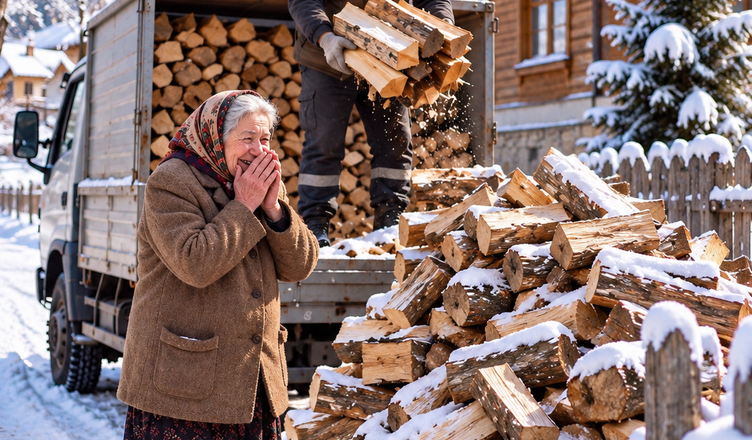
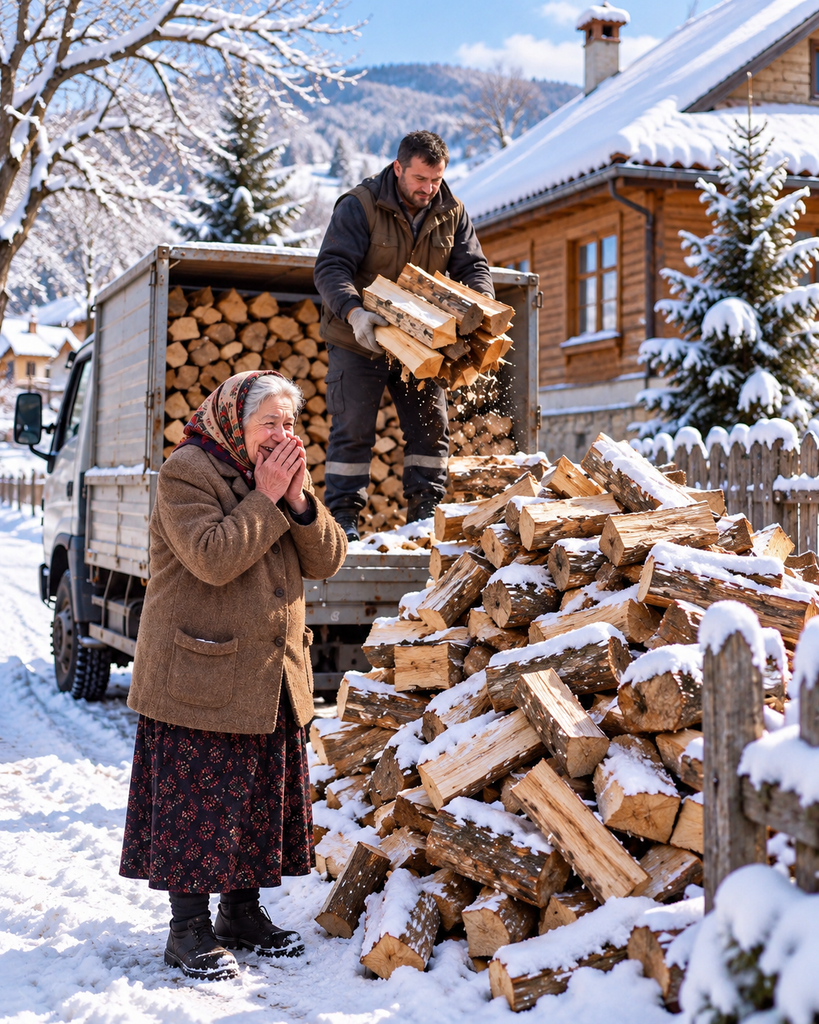
A large delivery truck was reversing toward her property.
It was loaded with firewood.
A lot of firewood.
Margaret stared in confusion.
Then she saw Daniel climb from the cab.
She opened the front door.
“There must be a mistake!”
Daniel waved.
“Morning.”
“You’ve got the wrong address.”
“No, I don’t.”
Two other men got out and began preparing to unload the truck.
Margaret hurried down the path.
“Wait!”
They stopped.
“I ordered two meters yesterday. You already delivered it.”
Daniel nodded.
“I remember.”
“Then why are you here?”
He looked toward the truck.
“We’ve got another ten.”
Margaret felt her stomach tighten.
Ten cubic meters was more wood than she had purchased at once in years.
“I can’t pay for that.”
“You don’t have to.”
“What?”
“The bill’s already taken care of.”
Margaret stared at him.
“By whom?”
Daniel hesitated.
And then he told her.
A Conversation She Didn’t Know Had Happened
After returning to the yard the previous afternoon, Daniel had apparently mentioned Margaret to his employer.
Not dramatically.
He simply said that an older woman living alone had purchased only two cubic meters despite clearly needing much more.
The owner recognized the address.
Years earlier, when he had first started his firewood business, Robert had been one of his earliest customers.
But there was more to the story.
When the business was struggling during its first winter, Robert had repaired the owner’s broken trailer.
The owner had been unable to pay the full repair cost immediately.
Robert had told him not to worry about it.
“Pay me when the business starts making money.”
Apparently, Robert never asked again.
Margaret knew nothing about this.
It sounded exactly like him.
Robert had spent his life fixing things for neighbors, lending tools and refusing payment for small jobs.
To him, those gestures had never seemed significant enough to mention at home.
But somebody had remembered.
The Story Spread Further
Daniel’s employer decided to send additional firewood at no charge.
Then one of the employees heard about it.
He contributed part of his own winter allowance.
Another supplier added several bundles of kindling.
By the time the truck was loaded, what had begun as one man’s decision had become something larger.
Margaret stood beside the driveway listening in silence.
Finally she asked, “Why didn’t anyone call me?”
Daniel smiled.
“Because you would have said no.”
Margaret couldn’t argue with that.
She looked toward the truck.
“You can’t give me all of this.”
“We can.”
“There are people who need it more.”
“Maybe. But today it’s yours.”
Margaret lowered her head.
For several seconds she said nothing.
Then she began to cry.
Accepting Help Can Be Harder Than Giving It
People often describe generosity from the perspective of the giver.
We talk about how important it is to help neighbors, support older people and notice those who may be struggling.
But receiving help can be complicated.
For someone who has spent decades being independent, accepting assistance can feel like admitting defeat.
Margaret had raised children, cared for her husband during illness, worked for most of her adult life and managed a household through difficult years.
She was accustomed to solving problems.
Now strangers were solving one for her.
Her first instinct was embarrassment.
Then Daniel said something that changed the way she saw the situation.
“Your husband helped someone when he didn’t have to. Nobody forgot.”
The wood wasn’t charity in the way Margaret feared.
It was kindness returning years later.
The Shed Filled Up
The men spent more than an hour unloading and stacking the delivery.
The nearly empty shelter gradually disappeared behind neat rows of split logs.
Margaret made coffee.
She found an old tin of biscuits and carried everything outside.
The workers protested that they had other deliveries to make.
Margaret ignored them.
“If you’re going to fill my entire shed,” she said, “you can at least drink one cup of coffee.”
They did.
For the first time in weeks, Margaret looked at winter without calculating how many pieces of wood she could afford to burn each evening.
The change was practical, but it was also emotional.
Her home would be warm.
She could sleep in her bedroom.
She wouldn’t have to choose between heating the house and buying groceries.
A truckload of wood had removed a worry she had been carrying silently for months.
A Problem Many Older People Understand
Although Margaret’s story is fictional, the difficulty behind it is very real.
Older adults living on fixed incomes can be especially vulnerable when energy, food, housing and medical costs rise. People who own their homes are not necessarily financially secure either. Maintenance, taxes, utilities and other unavoidable expenses continue even after a mortgage has been paid.
Pride can make the situation harder.
Many older people spent most of their lives supporting others and may be reluctant to tell family members when they begin struggling themselves.
That is why ordinary attention can matter.
Sometimes the first sign of trouble is not someone asking for help.
It is someone quietly buying less than they need.
Margaret Made One Decision of Her Own
By February, there was still plenty of wood left.
One afternoon, Margaret learned that a recently widowed man several streets away was struggling with his own heating costs.
She called Daniel’s company.
“I have a question,” she said.
Daniel happened to answer.
“I think I know that voice.”
Margaret laughed.
“I have more wood than I’m going to use.”
“That’s not a problem.”
“I know. But someone else has a problem.”
She explained.
Two days later, Daniel arrived again.
This time his truck was empty.
He helped Margaret load part of her supply and drove it to the neighbor.
She insisted on going with him.
Kindness Rarely Ends Where It Begins
Margaret never discovered exactly how many people had contributed to the unexpected delivery.
Eventually she stopped trying.
What mattered was not who had provided each log.
It was the chain connecting them.
Years earlier, Robert had repaired a trailer for a struggling businessman and had not demanded immediate payment.
He probably forgot about it.
The businessman didn’t.
A driver noticed an elderly customer’s unusually small order.
He could have delivered it and continued with his day.
Instead, he mentioned it.
Other workers heard the story and decided to participate.
Margaret received more than she needed.
Months later, some of that same wood warmed another person’s house.
That is how generosity often works.
It doesn’t always return directly to the person who first offered it. It can travel through families, workplaces and communities before appearing again in a completely different form.
Margaret had ordered only what she could afford because she believed she had no other option.
The next morning, a truck appeared carrying far more than firewood.
It carried evidence that small acts are sometimes remembered much longer than we imagine.
And throughout that winter, whenever Margaret added another log to the stove, she was reminded of something her husband had understood instinctively:
A kindness given away is not necessarily gone.
Sometimes it simply takes the long road home.