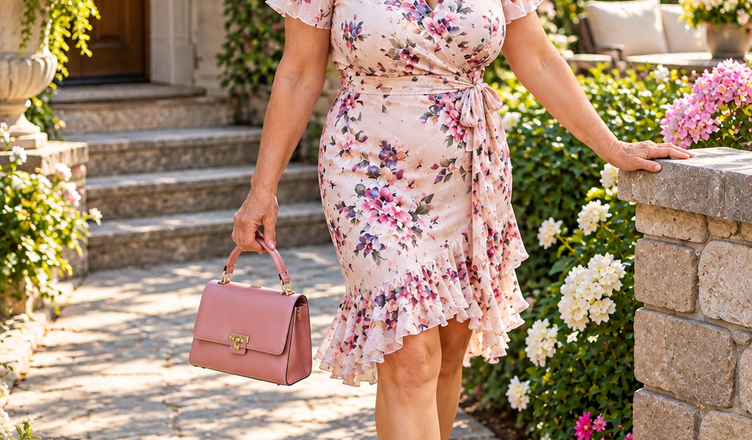
Bright colors become “too much.” Short skirts become “inappropriate.” High heels become something a woman is expected to remember rather than wear. Fashion advice gradually shifts from expressing personality to avoiding attention.
At 92, Evelyn Parker had heard all of it.
She had also decided that none of it interested her very much.
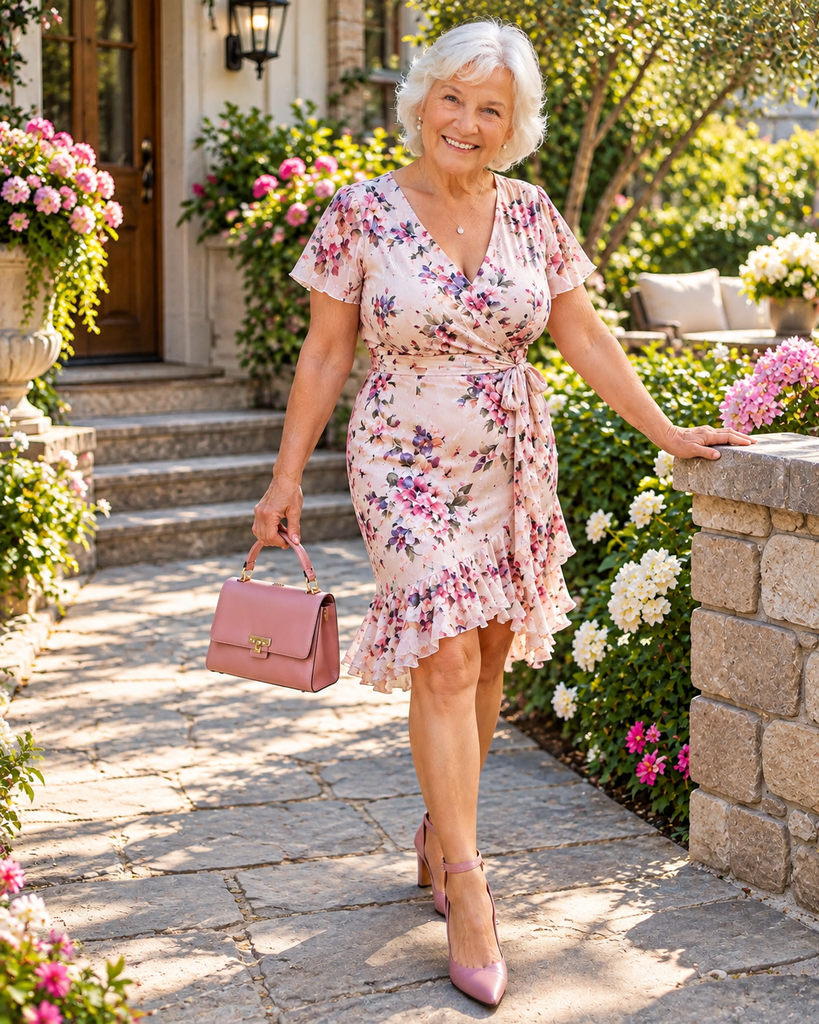
When Evelyn opened her wardrobe in the morning, she did not ask what a woman in her nineties was supposed to wear. She asked the same question she had asked throughout her adult life:
What do I feel good in today?
Sometimes the answer was a comfortable pair of trousers and a sweater. On other days, it was a fitted jacket, a short skirt and the high-heeled shoes she had loved for decades.
Her clothes were not an attempt to look younger.
To Evelyn, they were simply hers.
A Lifetime of Loving Clothes
Evelyn’s fictional story begins long before her 92nd birthday.
She grew up in a household where money was carefully counted and clothing was expected to last. New outfits were usually reserved for special occasions. Everyday garments were repaired, altered and handed down rather than discarded.
That scarcity made Evelyn fascinated by clothing.
As a teenager, she learned basic sewing and began changing inexpensive garments to suit her taste. She shortened hems, replaced buttons and adjusted old dresses until they felt less like someone else’s clothes and more like her own.
Fashion became a form of creativity.
She never worked in the industry and never considered herself an expert. She simply enjoyed getting dressed.
Marriage, work and children changed her life, but not that pleasure.
Over the decades, her wardrobe evolved with her circumstances. There were practical years when comfortable shoes were essential and years when she had little time to think about what she was wearing.
But Evelyn never accepted the idea that reaching a particular birthday meant surrendering personal style.
When Advice Became Permission
The comments became more noticeable as she grew older.
At first they sounded harmless.
“That color is very bold.”
Then they became more specific.
“Wouldn’t you be more comfortable in something longer?”
Later, people stopped disguising the judgment.
“You’re not really going out dressed like that, are you?”
Evelyn found the progression fascinating.
Nobody had officially appointed these people to supervise her wardrobe. Yet strangers, acquaintances and even relatives sometimes behaved as though age had given them voting rights over her appearance.
The assumption was rarely about practicality alone.
There can be perfectly sensible reasons to change how we dress with age. Bodies change. Balance may change. Temperature sensitivity can change. Health conditions may make some garments or shoes uncomfortable.
But comfort is personal.
What Evelyn objected to was the suggestion that older people should become visually invisible simply because others expected it.
The Outfit That Started a Conversation
Shortly after her 92nd birthday, Evelyn attended a family gathering wearing a black miniskirt, a simple blouse, a tailored jacket and a pair of heels she had owned for years.
She had dressed carefully.
She felt good.
Before leaving home, she looked in the mirror and smiled.
At the gathering, most people barely reacted. Her family had seen Evelyn’s style many times.
One younger guest, however, seemed surprised.
She eventually approached Evelyn and asked a question that sounded almost like concern.
“Don’t you ever worry people will think you’re too old to wear something like that?”
Evelyn looked down at her outfit.
Then she looked back at the woman.
“Too old for my own clothes?”
The younger woman laughed awkwardly.
Evelyn wasn’t offended.
She was genuinely curious.
“Who decides when that happens?” she asked.
There was no obvious answer.
Why Does Age Change the Rules?
Clothing has always communicated more than the practical need to cover and protect the body.
It can signal profession, culture, social status, mood, identity or belonging. People use clothing to celebrate, rebel, blend in, stand out or simply enjoy themselves.
Yet aging often changes how that self-expression is judged.
Older women in particular can face contradictory expectations. They may be criticized for “giving up” if they stop caring about appearance, while simultaneously being criticized for “trying too hard” if they remain interested in fashion.
The acceptable territory can become strangely narrow.
Look good, but don’t attract too much attention.
Be confident, but don’t appear to compete with younger people.
Take care of yourself, but don’t look as though you care too much.
These expectations reveal something important: sometimes criticism of an older person’s clothes says more about society’s discomfort with aging than about the clothes themselves.
Evelyn Wasn’t Trying to Be 25
One misunderstanding bothered her more than the others.
People occasionally assumed that because she wore short skirts or heels, she wanted to appear younger.
She didn’t.
Evelyn knew exactly how old she was.
She had no interest in pretending otherwise.
Her hands showed her age. So did her face. She had lived through decades of change, buried people she loved, welcomed grandchildren and great-grandchildren, and accumulated memories that no cosmetic illusion could replace.
Why would she want to erase all of that?
For her, wearing something associated with youth did not mean claiming youth.
A 25-year-old woman could wear a red dress.
So could a 50-year-old.
So could a 92-year-old.
The dress did not come with an expiration date.
Practicality Still Matters
Evelyn was not reckless about clothing.
At 92, she understood that confidence should not be confused with ignoring physical limitations.
She did not wear high heels when she expected to walk long distances. She kept lower, more stable shoes available. On icy days, fashion lost immediately to safety.
That distinction mattered.
Personal freedom does not require pretending age has no physical consequences.
It simply means those consequences should be assessed by the person actually living in the body rather than by strangers making assumptions.
If heels were uncomfortable, Evelyn changed them.
If they were comfortable and appropriate for the occasion, she wore them.
That was the entire philosophy.
The Photograph That Traveled
At the family gathering, Evelyn’s granddaughter took several photographs.
In one, Evelyn stood near a window, one hand resting lightly on a chair, laughing at something outside the frame.
Her granddaughter loved the picture.
With Evelyn’s permission, she shared it online with a short description of her grandmother’s approach to style.
The reaction was larger than either expected.
Many comments were supportive.
Older women wrote that they had stopped wearing certain clothes because relatives had made them feel embarrassed.
Younger people said the photograph made them think differently about aging.
Some people disagreed.
They argued that certain styles should be left behind after a particular age.
Others criticized Evelyn’s skirt or shoes.
She was not surprised.
When her granddaughter nervously showed her a few negative comments, Evelyn shrugged.
“They’re allowed to dislike my skirt,” she said. “They just don’t have to wear it.”
Confidence Is Not the Same as Approval
That response captured something people often misunderstand about confidence.
Confidence does not mean believing everyone will approve of you.
It means understanding that universal approval is neither possible nor necessary.
Evelyn did not need strangers to consider her fashionable.
She did not even need them to understand her choices.
Her clothes were not a public referendum.
At 92, she had spent enough years trying to satisfy expectations that changed depending on who was speaking.
She had reached a simpler conclusion.
A respectful opinion could be heard without automatically becoming an instruction.
Fashion Can Preserve Continuity
Clothing can also carry memory.
An old jacket may remind someone of a first job. A scarf can preserve the memory of a person who gave it as a gift. A pair of shoes may be connected to weddings, dinners or journeys.
For Evelyn, keeping her style was partly a way of maintaining continuity between the woman she had been and the woman she was now.
Aging had changed her.
Of course it had.
But it had not replaced her with a completely different person.
She still enjoyed music.
She still laughed too loudly when something genuinely amused her.
She still liked strong coffee.
And she still enjoyed dressing up.
Why should that final preference have been expected to disappear?
There Is No Universal Uniform for Aging
One of the problems with phrases such as “dress your age” is that they assume everyone of the same age should behave similarly.
But a 70-year-old living on a farm may dress differently from a 70-year-old artist in a city.
One 85-year-old may adore elegant dresses. Another may live happily in jeans.
A 92-year-old may prefer long skirts and flat shoes.
Another may choose a miniskirt.
None of those choices automatically tells us whether the person is dignified, confident, happy or sensible.
Style is individual because people are individual.
Age does not erase that.
What Evelyn Really Represented
The attention surrounding Evelyn was never truly about a miniskirt.
A piece of fabric could not explain why people reacted so strongly.
The larger issue was permission.
Who gets to decide how visible an older person should be?
Who decides when boldness becomes inappropriate?
And why are people sometimes more comfortable with aging when it is quiet, modest and hidden?
Evelyn had no grand campaign against age stereotypes.
She was simply getting dressed.
Yet that ordinary act became meaningful because she refused to treat old age as an instruction to disappear.
The Privilege of Becoming Older
When someone once asked Evelyn whether she wished she could be young again, she thought carefully before answering.
There were things she missed.
She missed having more energy.
She missed people who were no longer alive.
She missed being able to walk for hours without thinking about her knees.
But she did not want to exchange everything she had learned merely to recover a younger face.
Getting older had taken things from her.
It had also given her something.
Perspective.
At 30, she worried about whether people approved of her.
At 50, she worried less.
At 70, she began finding the entire question exhausting.
At 92, she had better things to do.
She would wear practical shoes when she needed them, dress warmly when the weather demanded it and listen to her body when it told her to slow down.
But she would not allow a number on a birthday cake to become the owner of her wardrobe.
Her miniskirts were not a declaration of war against aging.
Her heels were not an attempt to turn back time.
They were simply evidence that the person inside the clothes was still there.
Still choosing.
Still enjoying herself.
Still participating in life.
And perhaps that is the more useful way to think about style at any age.
Clothes do not make someone young or old.
They are one of the many ways people tell the world who they are.
At 92, Evelyn had no intention of letting anyone else finish that sentence for her.