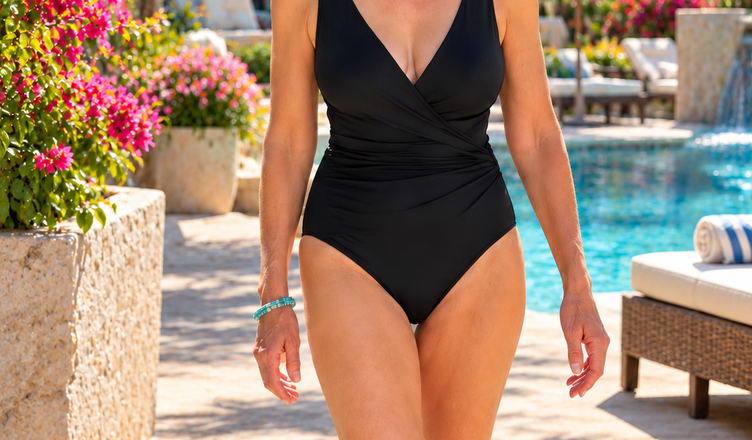
A young woman may be encouraged to experiment with color, shape and trends. Decades later, the message often changes. Suddenly certain dresses are described as “too short,” bright colors as “too loud,” fitted clothing as “too revealing,” and fashionable outfits as something that supposedly belongs to younger people.
For a 76-year-old woman who enjoys dressing boldly and confidently, those unwritten rules can become impossible to ignore. People may insist that she should dress “appropriately for her age,” as though reaching a particular birthday automatically creates a new wardrobe code.

But there is a simple question hidden behind all those opinions: who actually gets to decide what is appropriate?
For women who reject age-based fashion expectations, the answer is equally simple. Clothing is personal. Growing older does not transfer ownership of that choice to strangers.
The Strange Meaning of “Age-Appropriate”
The phrase sounds reasonable until we try to define it.
What exactly should a woman wear at 50? What becomes unacceptable at 60? Which colors disappear at 70? At what age should someone stop wearing jeans, sleeveless dresses, heels, fitted clothes or swimsuits?
There is no universal answer.
Ideas about appropriate clothing change dramatically between cultures, generations, social groups and even families. An outfit considered conservative in one setting may appear daring in another. Something viewed as fashionable today might have caused controversy several decades ago.
That suggests that many supposedly firm rules about aging and fashion are not rules at all.
They are expectations.
And expectations can be questioned.
Aging Is Visible, but Personality Does Not Disappear
One of the strangest assumptions about growing older is that personality should somehow become less visible.
People do not wake up on their 70th birthday with completely different tastes.
A woman who loved dramatic earrings at 35 may still love them at 75. Someone who spent decades wearing colorful dresses does not necessarily develop a sudden passion for beige cardigans simply because her hair has turned gray.
Clothing is not merely protection from weather. It can communicate personality, profession, culture, mood, creativity and identity.
Those functions do not expire with age.
Yet older adults, particularly women, frequently encounter contradictory expectations. They are criticized if they appear to be “trying too hard” to look young, but they may also become socially invisible when they adopt the understated appearance others expect from them.
It can become an impossible standard: do not look old, but do not look as though you are resisting aging either.
The Internet Has Made the Debate Louder
Social media has created unprecedented opportunities for older people to present themselves without waiting for traditional media to decide how aging should look.
Women in their 60s, 70s and beyond can now share fashion, travel, fitness, beauty and everyday life directly with audiences.
That visibility challenges familiar stereotypes.
It also attracts criticism.
A photograph that might once have been seen only by friends and relatives can now reach thousands of strangers. Some respond with admiration. Others feel surprisingly comfortable telling a person they have never met what she should or should not wear.
Comments often focus less on the actual clothing than on the wearer’s age.
The same outfit that receives praise on a 25-year-old can suddenly be considered inappropriate on someone several decades older.
The fabric has not changed.
The observer’s assumptions have.
Why Are Older Women Judged So Harshly?
Part of the answer may lie in the way beauty and youth have historically been linked in advertising and popular culture.
For decades, many beauty campaigns presented aging primarily as something to fight: wrinkles needed correcting, gray hair needed covering and visible signs of age were treated as problems requiring solutions.
Fashion marketing also tended to prioritize younger models.
That created a narrow picture of who was supposedly entitled to be glamorous, sensual or experimental.
Older women certainly appeared in public life, but they were often expected to occupy a different visual category: elegant, restrained and respectable.
There is nothing wrong with choosing that style.
The problem begins when choice becomes obligation.
A woman wearing a traditional outfit because she genuinely loves it is exercising exactly the same freedom as another woman of the same age choosing a fitted dress, leather jacket or bright swimsuit.
Neither needs to represent every woman in her generation.
Confidence Does Not Have an Expiration Date
There is also a tendency to treat confidence in older women as surprising.
When a 76-year-old proudly wears an outfit she loves, descriptions of her may focus on how “brave” she is.
Sometimes that praise is well intentioned.
But consider what it implies.
Why should getting dressed require courage?
The answer is that confidence becomes remarkable only when society has already communicated that certain people are expected to hide.
An older woman who refuses that expectation can therefore appear rebellious even when she is doing something completely ordinary: choosing her own clothes.
Perhaps the more interesting question is not why she feels comfortable wearing them.
It is why observers feel entitled to be uncomfortable.
Style and the Desire to Look Younger Are Not the Same Thing
Another common mistake is assuming that an older person who enjoys contemporary fashion must be desperately trying to appear younger.
That conclusion does not necessarily follow.
Someone can accept her age completely while still enjoying fashion.
A 76-year-old wearing a modern dress does not become 26, nor does she necessarily want to.
Gray hair, wrinkles and fashionable clothing can exist together.
In fact, accepting aging may sometimes mean refusing the idea that aging requires withdrawal.
There is a meaningful difference between denying one’s age and refusing to be limited by stereotypes attached to it.
Clothes Can Influence How We Feel
Most people have experienced the psychological effect of clothing.
An outfit can make someone feel prepared for work, relaxed on vacation, elegant at dinner or confident at an important event.
Researchers have explored relationships between clothing, self-perception and behavior, although individual experiences vary considerably.
What matters in everyday life is straightforward: people often feel different depending on what they wear.
That does not stop at retirement age.
Older adults continue attending weddings, meeting friends, traveling, dating, exercising, working, celebrating birthdays and participating in public life. Their wardrobes can reflect all those experiences.
Treating fashion as exclusively youthful ignores the obvious fact that older people continue living complicated, active lives.
There Is No Single Correct Way to Age
The conversation becomes healthier when it moves away from replacing one stereotype with another.
Older women should not be required to dress conservatively.
But they should not be pressured to dress boldly either.
A woman who loves long traditional dresses does not need to prove that she is liberated by wearing something revealing. A woman who enjoys miniskirts does not need to cover herself to prove that she accepts her age.
Freedom works in both directions.
The point is not that every 76-year-old should dress like the woman challenging these stereotypes.
The point is that every 76-year-old should have room to decide for herself.
Practical Context Still Matters
Rejecting age rules does not mean pretending that clothing never has a context.
Most societies have expectations surrounding workplaces, religious spaces, formal ceremonies, schools and particular events.
A restaurant may require formal attire. A workplace may have safety requirements. A wedding invitation may specify a dress code.
Those are situational expectations.
They are different from telling someone that a perfectly acceptable outfit becomes unacceptable solely because the person wearing it has reached a certain age.
That distinction matters.
“Wear protective shoes in this workplace” has a practical reason.
“You’re 76, so you shouldn’t wear that” is an entirely different statement.
The Body Changes, but Fashion Can Change With It
There are practical aspects of aging that can influence clothing choices.
Bodies change over time. Comfort needs may change. Mobility can change. Skin may become more sensitive. Some people begin prioritizing different fabrics, shoes or fastenings.
But adaptation does not require surrendering personal style.
Fashion can accommodate a changing body rather than demanding that the body disappear beneath clothing.
Someone who once loved high heels may choose lower shoes in the same dramatic style. Another person may discover different cuts that feel comfortable while preserving the colors and silhouettes she has always enjoyed.
Style can evolve without vanishing.
Why These Stories Resonate
Stories about older people ignoring fashion stereotypes often attract large audiences because they are not really just about clothes.
They are about autonomy.
Aging involves many changes that people cannot control. Time changes the body. Families change. Careers end or transform. Social roles shift.
Choosing what to wear can therefore represent something larger: the ability to continue making personal decisions about one’s own life.
That message resonates not only with older adults.
Younger people recognize it too because almost everyone has experienced some version of being told that they are too old, too young, too large, too thin, too serious or somehow the wrong kind of person for something they enjoy.
The details differ.
The underlying question remains familiar:
How much of our lives should be designed around other people’s approval?
Fashion Is Allowed to Be Fun
Modern conversations about appearance can become surprisingly serious.
Clothing gets connected to status, beauty standards, body image, gender, age and social expectations.
Those issues matter.
But fashion also has a simpler purpose.
It can be enjoyable.
People can wear a red coat because they love red. They can choose unusual glasses because those glasses make them smile. They can wear a favorite dress repeatedly because they feel good in it.
Not every outfit needs to communicate a philosophy.
Sometimes a woman is not trying to make a statement about aging.
She simply likes her clothes.
Ironically, allowing older people that ordinary freedom may be one of the most meaningful changes society can make.
A Wardrobe Should Not Come With a Birthday Deadline
There is no birthday after which individuality suddenly becomes inappropriate.
People continue developing throughout their lives. Their tastes can change, but they can also remain remarkably consistent. Some become more conservative with age; others become more adventurous because they finally stop worrying about opinions that once controlled them.
Both paths are legitimate.
The important distinction is whether the decision belongs to the person wearing the clothes or to everyone watching.
A 76-year-old woman does not need universal approval for her wardrobe.
She does not need to convince strangers that her skirt is long enough, her neckline modest enough or her colors quiet enough.
She also does not need to dress younger than she feels.
She needs exactly the freedom routinely granted to everyone else: the ability to look in the mirror, decide what makes her comfortable and walk out the door.
Perhaps that is why confident older women attract so much attention when they reject the command to “dress their age.”
They expose how arbitrary the command has always been.
Age can influence our bodies, experiences and priorities. It can change what feels comfortable and what matters to us.
But it does not automatically determine taste.
And personal style does not arrive with an expiration date.