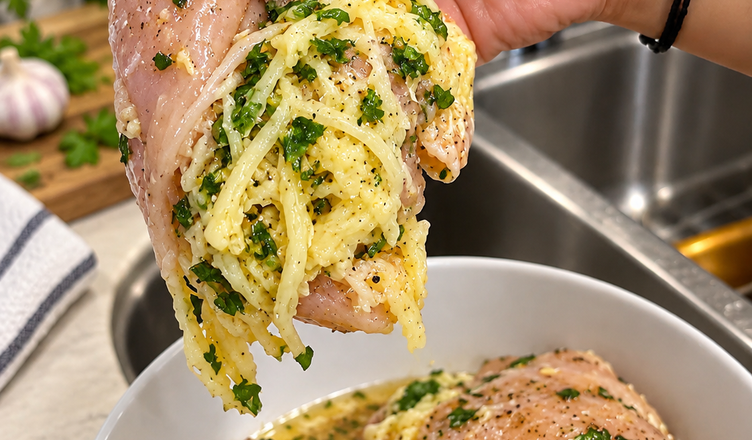
The first reaction is understandable: something must be wrong.
Has the chicken spoiled? Is it contaminated? Was it processed incorrectly? And, most importantly, is it safe to eat?
Although spoilage should never be dismissed when handling raw poultry, a stringy or unusually fibrous appearance can have another explanation. In the poultry industry, researchers have documented muscle abnormalities often described as “spaghetti meat,” alongside related conditions known as woody breast and white striping.
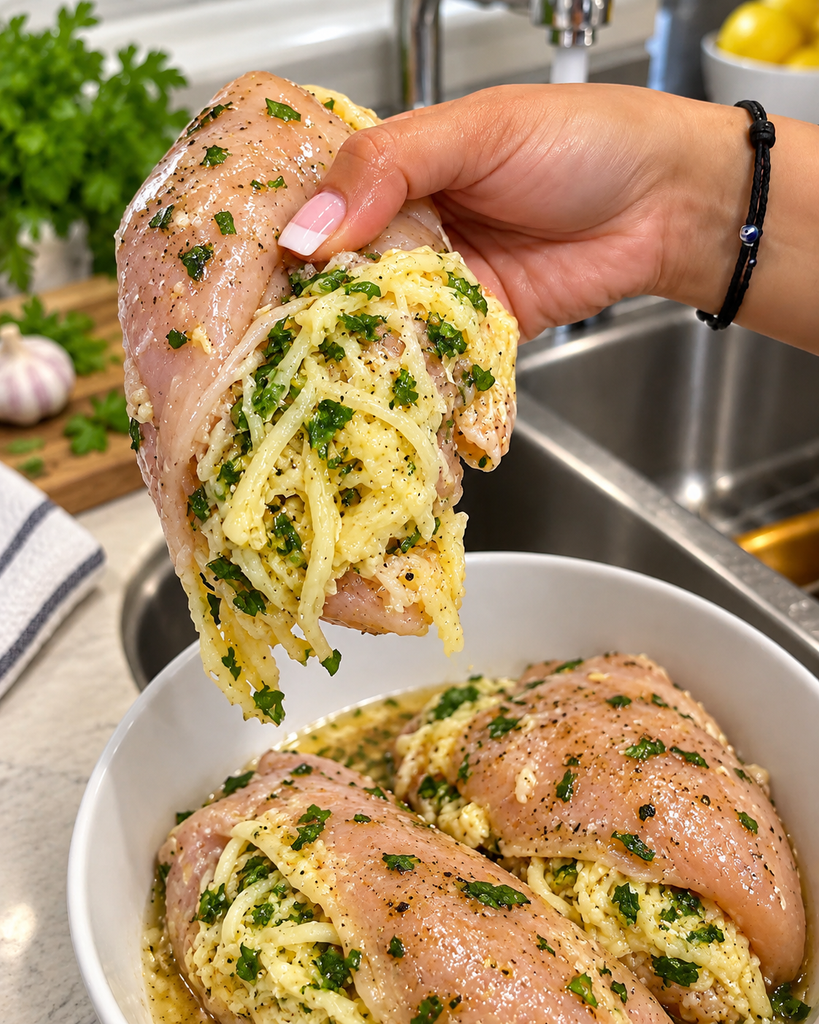
They can make chicken breast look and feel very different from what consumers expect.
What Is “Spaghetti Meat”?
The name sounds dramatic, but it is essentially a description of appearance and texture.
Chicken breast is made from organized bundles of muscle fibers held together by connective tissue. Under normal conditions, those structures give the breast its familiar firmness.
In meat affected by the condition commonly called spaghetti meat, the structural integrity of the muscle can be reduced. The fibers may separate from one another much more easily than usual.
As a result, the breast can appear soft, loose and stringy.
Pulling on it may cause strands of muscle to separate in a way that resembles cooked spaghetti.
That can be disturbing when you have never encountered it before, but the unusual appearance does not automatically mean the meat is decomposing.
Why Does It Happen?
The phenomenon has been associated particularly with modern fast-growing broiler chickens.
Over many decades, poultry production has selected birds for characteristics valued by producers and consumers, including rapid growth and greater breast-meat yield.
Modern broilers can therefore develop large breast muscles in a relatively short period.
That efficiency has made chicken widely available and comparatively affordable, but research has also identified unintended consequences associated with extremely rapid muscle development.
One concern is that muscle growth may outpace the ability of supporting systems to adequately maintain the tissue.
Researchers studying breast-muscle disorders have found changes involving muscle fibers, connective tissue, inflammation and tissue degeneration.
In simplified terms, the bird can develop a very large breast muscle, but the microscopic structure within that muscle does not always develop normally.
The result can be meat with unusual appearance, composition and texture.
Spaghetti Meat Is Not the Only Condition
Several breast-muscle abnormalities have received scientific and industry attention.
Three commonly discussed examples are spaghetti meat, woody breast and white striping.
They are related to the broader issue of muscle development in fast-growing broilers, although they do not look or feel identical.
White striping is probably the easiest for shoppers to recognize. It appears as visible white lines running parallel to the muscle fibers.
Woody breast is associated with unusually hard or firm areas in the breast. Consumers may notice that the raw meat feels abnormally rigid or that cooked meat has an unpleasant texture.
Spaghetti meat tends toward the opposite physical impression: rather than excessive firmness, the tissue can feel soft and structurally weak, with muscle bundles separating into strands.
More than one abnormality may occur in the same bird.
Why Fast Growth Matters
Muscle is living tissue before slaughter, and living tissue needs oxygen and nutrients.
As breast muscles become exceptionally large, adequate blood supply throughout the tissue becomes increasingly important.
Scientific investigations of these muscle disorders have examined whether insufficient vascular development relative to rapid muscle growth contributes to damage within the tissue.
When muscle fibers are damaged, the body attempts to repair them.
But repeated or extensive damage can alter normal muscle structure. Fat and connective tissue may appear where healthy muscle tissue would otherwise be expected.
This helps explain why affected chicken can have differences that are visible not just under a microscope but to consumers standing in their kitchens.
Is Stringy Chicken Automatically Spoiled?
No.
This distinction is important.
A structural muscle abnormality and microbial spoilage are not the same phenomenon.
Chicken can have an unusual texture because of muscle abnormalities without being spoiled.
At the same time, the existence of these conditions does not mean consumers should ignore ordinary warning signs of spoiled meat.
Raw poultry is highly perishable and must be handled carefully regardless of how the muscle fibers look.
If chicken has developed a strong unpleasant odor, abnormal sliminess or other clear signs of deterioration, or if its storage history is uncertain, the safest decision may be to discard it rather than attempting to diagnose the problem visually.
Appearance alone cannot establish microbiological safety.
Can You Tell Whether Raw Chicken Is Safe Just by Looking?
Unfortunately, not reliably.
Food contaminated with disease-causing microorganisms does not necessarily smell bad or look unusual.
Conversely, an odd-looking piece of meat is not automatically contaminated with dangerous bacteria.
This is why food-safety recommendations emphasize proper refrigeration, preventing cross-contamination and adequate cooking rather than relying solely on sight or smell.
Raw chicken should be kept properly chilled and separated from foods that will be eaten without further cooking.
Hands, utensils and surfaces that contact raw poultry should be cleaned appropriately.
Should You Wash Raw Chicken?
Washing raw poultry under the kitchen faucet is generally discouraged by food-safety authorities.
It may feel as though rinsing removes contamination, but water can splash microorganisms from raw chicken onto sinks, countertops, utensils and nearby food.
Proper cooking is the important step for destroying harmful bacteria.
So if a chicken breast looks strange, rinsing it vigorously under running water is not a solution.
It can create an additional cross-contamination problem.
Proper Cooking Still Matters
Poultry should be cooked thoroughly.
A food thermometer is much more reliable than trying to determine doneness from color alone.
For chicken, commonly cited food-safety guidance calls for the thickest part to reach an internal temperature of 165°F, or approximately 74°C.
This is especially important because raw poultry can carry pathogens even when it looks completely normal.
The attractive, firm chicken breast and the strange stringy one both require safe handling.
Normal appearance is not proof of safety.
Does Spaghetti Meat Affect Quality?
Yes, it can.
Even when the issue is primarily a muscle-quality abnormality rather than evidence of spoilage, consumers may notice significant differences in texture.
The meat may not behave normally during preparation.
It can be softer when raw, separate more easily and produce a different eating experience after cooking.
Research into breast-muscle disorders has also identified differences in composition and technological properties, meaning affected meat can perform differently during processing.
For consumers, however, the most obvious issue is usually texture.
People expect chicken breast to have a particular structure.
When that structure begins separating into fibers in their hands, the visual reaction can be strong even before the meat reaches the pan.
Why Haven’t Many Consumers Heard About It?
One reason is that poultry production has changed dramatically while most shoppers interact only with the final packaged product.
Consumers rarely see how broiler chickens are bred, raised or processed.
They simply encounter neat packages of breasts, thighs and wings at the supermarket.
Muscle abnormalities are primarily discussed in agricultural science, animal physiology, meat science and poultry-industry research.
Unless someone encounters an unusually affected breast personally, there may be little reason to learn terminology such as “spaghetti meat.”
Then one strange package suddenly turns an obscure research topic into a very practical question:
What happened to my dinner?
Does Every Large Chicken Breast Have This Problem?
No.
Size alone cannot diagnose a muscle abnormality.
A large breast can be perfectly ordinary, and consumers cannot reliably reconstruct an animal’s growth history simply by looking at a package.
Researchers examine multiple characteristics when studying these conditions, including texture, visible changes and microscopic tissue structure.
It is therefore better to avoid treating every unusual-looking chicken breast as proof of one specific condition.
“Spaghetti meat” may explain some stringy chicken, but there are other reasons meat can change texture during storage, freezing, thawing or preparation.
Context matters.
Freezing Can Change Texture Too
Freezing and thawing can alter meat.
Ice crystals form within tissue during freezing, and those crystals can damage cellular structures. Depending on how the product was frozen, stored and thawed, the meat may lose moisture and develop a softer or less appealing texture.
Repeated freezing and thawing can cause further quality deterioration.
That does not mean every stringy breast has simply been frozen badly, but it illustrates why diagnosing meat from appearance alone can be difficult.
Several different processes can influence texture.
What Should You Do If You Find Chicken Like This?
If the meat is within its use-by period, has been continuously stored at a safe temperature and has no obvious signs of spoilage, unusual muscle structure does not by itself prove that the chicken has gone bad.
However, consumers do not have to eat meat they find questionable or unappetizing.
If a package seems abnormal, photographing it and keeping the label can be useful before contacting the retailer or producer.
The package information may contain batch or production details useful for a complaint or refund.
If there is uncertainty about whether the chicken has been stored safely, or if there are signs suggesting deterioration, throwing it away is preferable to taking an unnecessary food-safety risk.
A Bigger Question About Modern Poultry
The strange fibers also point toward a broader conversation.
Consumers generally want chicken that is affordable, widely available and rich in lean meat.
Producers have become remarkably efficient at supplying it.
But biological systems have limits.
When animals are selected for increasingly rapid growth and greater muscle yield, scientists must also consider the consequences for animal health and meat quality.
Conditions such as woody breast, white striping and spaghetti meat demonstrate that maximizing growth can create trade-offs.
This does not mean every supermarket chicken is abnormal.
It means that the biological consequences of intensive selection deserve serious scientific attention.
Strange Does Not Always Mean Dangerous — and Normal Does Not Always Mean Safe
Perhaps the most useful lesson is that food safety and food appearance are related but not identical.
A chicken breast can look unusual because of changes in muscle structure.
Another breast can look completely normal while still carrying harmful microorganisms.
That is why safe storage, careful handling, avoidance of cross-contamination and thorough cooking remain essential.
If your chicken suddenly separates into strange thread-like fibers, you are not necessarily imagining things.
Researchers have documented a real muscle-quality phenomenon that can produce exactly that kind of appearance.
It may be surprising, and it certainly may not be something you want on your dinner plate.
But the strange texture tells a larger story about how modern chicken grows, how muscle tissue develops and how the pursuit of rapid production can sometimes leave visible traces in the food that eventually reaches our kitchens.
And once you know what those unusual fibers can represent, an ordinary package of chicken breast becomes a reminder that there is far more biology behind our food than its supermarket packaging reveals.