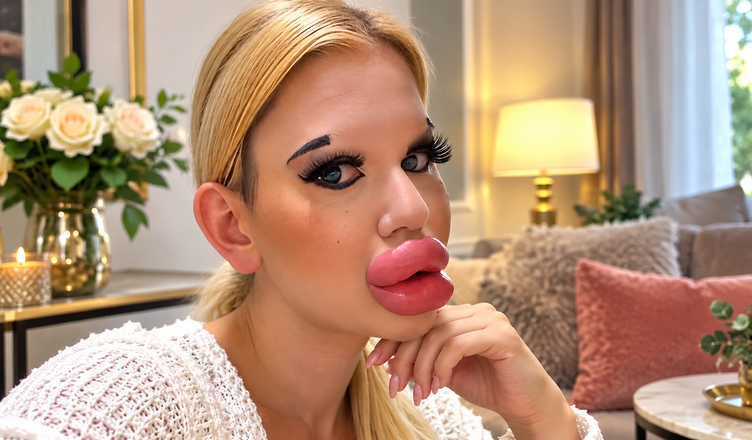
The photographs seem to show two different people.
In the earlier image, a young woman looks naturally into the camera, with features that many commenters would later describe as beautiful. In the later photograph, her appearance is dramatically different: fuller lips, altered facial proportions, carefully shaped features and the highly stylized aesthetic often associated online with a “living doll.”
The transformation reportedly took five years, involved cosmetic procedures and fillers, and cost close to $10,000.
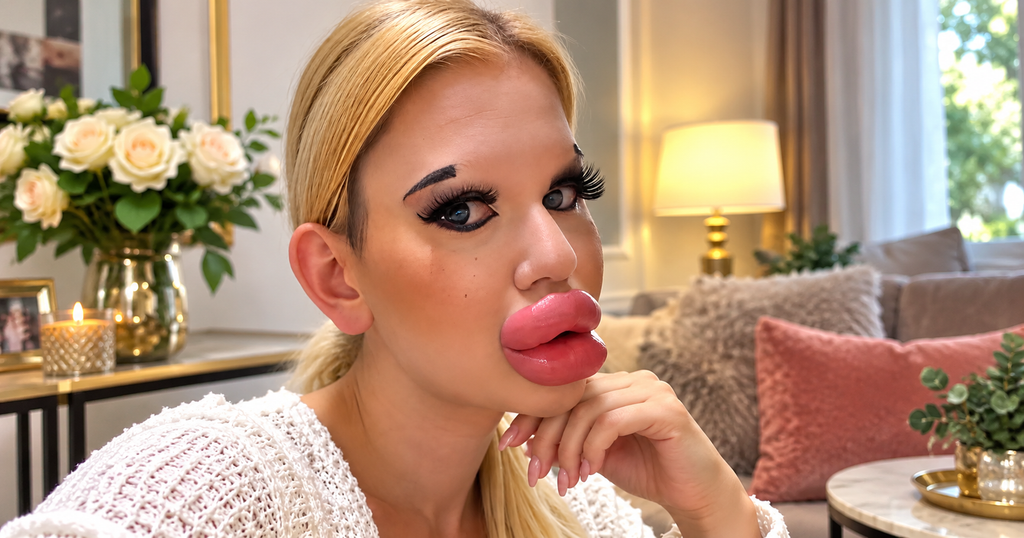
Almost immediately, strangers began debating whether she had improved her appearance or ruined it.
Some praised her for creating the look she wanted. Others insisted she had been more attractive before.
But without a reliably identified person or verifiable medical history in the source material, it would be irresponsible to invent her name, exact procedures, motivations or treatment history. The broader story, however, raises a genuine question that reaches far beyond one before-and-after photograph:
What happens when changing your appearance becomes a long-term project rather than a single cosmetic decision?
The Appeal of the “Living Doll”
The desire to resemble a doll is not entirely new.
For decades, fashion, photography and popular culture have celebrated exaggerated versions of traditionally feminine features: large eyes, smooth skin, small noses, prominent cheekbones and carefully shaped lips.
Social media has intensified that aesthetic.
Filters can enlarge eyes, reshape noses, smooth skin and alter facial proportions in seconds. A person can see an idealized version of their own face hundreds of times before ever entering a clinic.
Eventually, the filtered face may stop feeling artificial.
It can begin to feel like a goal.
For someone attracted to a doll-like appearance, cosmetic treatments can appear to offer a way of transferring that digital identity into physical life.
One Procedure Can Become a Series
Cosmetic transformation does not always begin with a dramatic plan.
Someone may start with a relatively limited treatment.
Perhaps lip filler.
Perhaps a change to the nose.
Perhaps a procedure intended to alter one feature that has caused insecurity for years.
Afterward, another feature may suddenly appear out of proportion.
Changing the lips can alter how the nose or chin is perceived. Changing the nose can make the cheeks appear different. Altering facial volume can change the overall balance of the face.
The person may then decide that another adjustment is necessary.
This does not mean everyone who receives cosmetic treatment will continue indefinitely. Many people undergo one procedure, are satisfied and never pursue another.
But for others, appearance becomes an evolving project.
The Mirror Is Not the Only Influence
Before-and-after transformations are often discussed as though the person made every decision in isolation.
Modern beauty culture is far more complicated.
Friends react.
Followers comment.
Algorithms reward dramatic images.
Clinics advertise transformations.
Influencers document procedures.
Filtered photographs establish facial proportions that may be difficult or impossible to reproduce naturally.
Then there is the attention.
A subtle change may receive little response online.
A dramatic transformation can generate thousands or millions of views.
That does not prove that someone changes their face for attention. Personal motives cannot be reliably diagnosed from photographs.
But it does mean cosmetic decisions now occur inside an environment where extreme appearances can receive extreme engagement.
Why the Cost Can Rise Quickly
A figure such as $10,000 may sound enormous to someone unfamiliar with cosmetic treatments.
Yet repeated procedures can accumulate significant costs over several years.
Some treatments are temporary and may require maintenance. Surgical procedures involve not only the operation itself but potentially consultations, anesthesia, medications, follow-up care and recovery expenses.
Prices also vary enormously between countries, practitioners and procedures.
For that reason, a reported total should not be treated as proof of exactly what someone had done.
Without medical records or direct confirmation, a photograph cannot reveal whether a particular facial change resulted from surgery, injectable treatment, makeup, weight change, lighting, editing or a combination of factors.
Before-and-After Photographs Can Be Deceptive
This is one of the most important details often ignored in viral transformation stories.
Two photographs are not necessarily an objective comparison.
The “before” image may have been taken casually in poor lighting.
The “after” image may use professional makeup, carefully controlled lighting and a flattering camera angle.
Or the opposite may happen.
A viral post trying to portray cosmetic procedures negatively may choose an especially attractive older photograph and compare it with an intentionally unflattering recent image.
Camera lenses themselves can change facial appearance.
A close smartphone photograph can distort proportions differently from a portrait taken from farther away.
Expressions matter too.
So do hairstyle, eyebrows, tanning, cosmetics and digital retouching.
A dramatic difference between two images may be genuine while still exaggerating the extent of physical transformation.
“She Was Prettier Before” Is an Opinion, Not a Measurement
Whenever an extreme makeover circulates online, one reaction appears almost immediately:
“She looked better before.”
Other viewers respond that the new appearance is more distinctive or attractive.
Neither side is stating an objective scientific fact.
Beauty judgments are influenced by culture, fashion, familiarity and individual preference.
Someone who values natural-looking features may dislike an exaggerated cosmetic aesthetic.
Someone who enjoys highly stylized fashion may prefer precisely the features others criticize.
The more important question is not whether strangers approve.
It is whether the person making the changes understands the risks, has realistic expectations and is making informed decisions for herself.
Cosmetic Procedures Are Still Medical Procedures
The word “cosmetic” can make treatments sound trivial.
They are not necessarily trivial.
Injectable fillers can cause swelling, bruising, infection and asymmetry. Rare but serious complications can occur if filler enters or compresses blood vessels.
Surgery carries its own risks, including infection, bleeding, scarring, anesthesia complications and dissatisfaction with the result.
Revision procedures can sometimes be more complicated than the original operation.
This is why qualified medical assessment matters.
A responsible practitioner should discuss expected outcomes, limitations, alternatives and potential complications rather than simply agreeing to every requested change.
When Does Transformation Become Too Much?
There is no universal number of procedures that automatically answers that question.
Three treatments might be excessive for one person and medically reasonable for another.
The issue is more complex than counting appointments.
Warning signs can include constantly moving the goalpost, believing one more procedure will finally solve every insecurity, pursuing treatment despite repeated complications, or experiencing intense distress over minor or barely visible perceived flaws.
Body dysmorphic disorder is a genuine mental health condition involving significant preoccupation with perceived appearance defects that may appear minor or unnoticeable to others.
It should not be casually diagnosed from social-media photographs.
Someone having extensive cosmetic work does not automatically mean they have a psychiatric disorder.
Only a qualified professional can assess that.
Still, psychological wellbeing deserves a place in conversations about major cosmetic transformation.
There Is Also a Question of Autonomy
Criticism of cosmetic procedures can become contradictory.
Society tells women to be beautiful.
Then it mocks them for trying too hard.
It celebrates youthful faces while condemning obvious interventions used to preserve a youthful appearance.
It promotes enormous lips, tiny noses and sculpted cheekbones through filters and advertising, then ridicules people who physically pursue those proportions.
That contradiction should make us cautious.
A competent adult has substantial autonomy over her own body.
She does not need strangers to prefer the result.
At the same time, respecting autonomy does not require pretending every cosmetic trend is harmless.
Both ideas can be true.
People deserve freedom over their appearance, and cosmetic medicine deserves serious discussion about safety, informed consent and unrealistic expectations.
The Internet Never Sees the Whole Person
A viral transformation reduces years of someone’s life to two photographs.
Before.
After.
Natural.
Artificial.
Beautiful.
Ruined.
Those categories are emotionally satisfying because they are simple.
Real life rarely is.
We do not know what happened between the photographs unless the individual has explained it reliably.
We do not know whether she regrets anything.
We do not know which procedures she underwent merely by looking at her face.
We do not know whether the transformation increased her confidence or created new insecurities.
And we certainly cannot determine a person’s character from the size of her lips or shape of her nose.
What the Transformation Really Reveals
The most interesting thing about a dramatic “living doll” transformation may not be whether the woman looked better before or after.
It may be what our reaction reveals about modern beauty.
We now live in a world where a face can exist in several versions simultaneously.
There is the face in the mirror.
The face produced by a front-facing camera.
The professionally photographed face.
The filtered face.
And, increasingly, the face that cosmetic treatment may attempt to create.
The boundaries between those versions are becoming less obvious.
That makes informed choices more important than ever.
If someone chooses to change her appearance, the decision should ideally be based on realistic expectations, reputable professional advice and an understanding that no procedure can guarantee happiness or universal approval.
Because universal approval does not exist.
One group will say she went too far.
Another will say she looks incredible.
A third will insist she should never have changed anything.
After five years, thousands of dollars and a dramatic transformation, there is one thing cosmetic treatment can never provide:
A face that everyone else agrees is perfect.
Perhaps that is the most important lesson hidden inside every shocking before-and-after photograph. Beauty can be modified, photographed, filtered and debated endlessly—but it can never be made objective.