By the beginning of December, Margaret had stopped looking at the weather forecast.
Knowing how cold the following week would be did not change the amount of money in her bank account.
At seventy-three, she lived alone in a small cottage at the edge of a rural village. The house was old, poorly insulated and heated mainly by a wood-burning stove in the living room. For most of her life, winter had simply meant bringing in more logs and putting another blanket on the bed.
That year was different.
After paying for food, electricity, medication and several unexpected repairs, Margaret had almost nothing left.
She calculated what she could spend on firewood three times.
The answer remained the same.
She could afford only two cubic meters.
It wasn’t enough for the entire winter, but it would have to be enough for now.
The following morning, however, she heard a diesel engine outside.
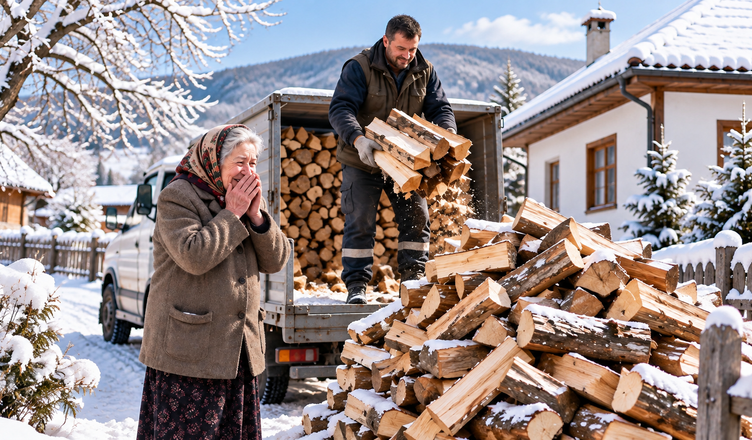
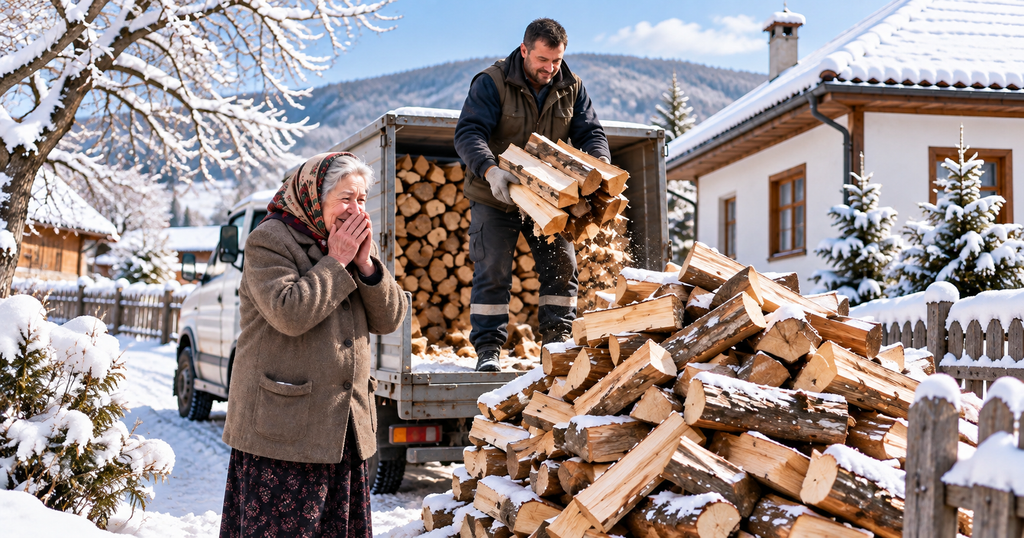
When she opened the door, an enormous delivery truck was reversing toward her property.
It was carrying far more wood than she had ordered.
This is a fictional story inspired by the original premise. The characters and events are invented.
“You’ve Made a Mistake”
Margaret pulled on her coat and hurried outside.
The driver climbed down from the cab and checked his paperwork.
“Margaret Wilson?”
“Yes.”
“Morning. Where would you like it?”
She stared at the truck.
“I ordered two.”
The driver looked at the sheet again.
“I’ve got ten.”
Margaret’s stomach tightened.
Ten cubic meters would probably carry her through the coldest part of winter, but there was no possible way she could pay for it.
“No,” she said quickly. “Please don’t unload anything. There’s been a mistake.”
The driver seemed confused.
“The address is correct.”
“The amount isn’t.”
She explained that she had ordered only what she could afford.
The man listened, then looked at his paperwork again.
Finally, he smiled.
“You don’t owe anything for the extra load.”
That frightened her almost as much as the delivery itself.
The Order From the Day Before
The previous afternoon, Margaret had visited a local timber yard.
She had known the owner, Peter, casually for years. His father had supplied firewood to half the village before Peter took over the business.
When Peter asked how much she wanted, Margaret hesitated before answering.
“Two meters.”
He looked surprised.
She normally bought considerably more before winter.
“That won’t last very long.”
“It’ll last long enough.”
Peter understood immediately.
He did not embarrass her by asking whether she was struggling financially.
He simply wrote down the order.
Margaret paid and went home.
She thought that was the end of it.
It wasn’t.
Someone Else Had Been Listening
A customer had been standing near the counter while Margaret placed her order.
His name was Daniel Harper.
Margaret did not recognize him.
Daniel, however, recognized her.
More than thirty years earlier, when he was nine, his family had lived in the village.
His father had lost his job shortly before Christmas.
For several months, money had been desperately tight.
Daniel remembered cold bedrooms and his mother pretending she had already eaten so that the children would finish the food.
What he had never forgotten was the winter morning when somebody left several bags of groceries and a stack of firewood beside their house.
There was no note.
His parents never discovered who had done it.
Daniel had learned the truth only years later.
The person responsible had been Margaret’s husband, George.
A Kindness She Had Almost Forgotten
George had died seven years earlier.
He had worked as a mechanic and had a habit of helping people without telling anyone.
Margaret sometimes found out only afterward.
A repaired bicycle would disappear from his garage.
A neighbor’s car would suddenly be running again.
A bag of vegetables would be left on someone’s doorstep.
When Daniel’s family had been struggling, George had learned about it through the village.
Margaret remembered helping him pack the groceries.
She had also insisted they leave everything before sunrise because she did not want Daniel’s parents to feel embarrassed.
To Margaret, it had been a small event from decades earlier.
To Daniel, it had become a childhood memory he carried into adulthood.
“The Rest Has Already Been Paid For”
The truck driver finally explained.
A man had contacted the timber yard after Margaret left.
He had paid for an additional eight cubic meters and the delivery charge.
He had only one condition.
Margaret was not to be told who had paid until the wood arrived.
She stood beside the truck, speechless.
“Who was it?” she finally asked.
The driver handed her a sealed envelope.
Inside was a short letter.
Daniel introduced himself and explained the connection.
He wrote that his family had survived a very difficult winter partly because two people had quietly helped them when they needed it most.
George was gone, but Daniel had never forgotten.
Now, he wrote, it was simply time for some of that warmth to come back.
Margaret read the letter twice.
Then she sat down on the step and cried.
Why Accepting Help Can Be Harder Than Giving It
Margaret’s first instinct was still to refuse.
She had spent her adult life believing that responsible people managed their own problems.
If she could not afford ten meters of firewood, she would buy two.
She would heat fewer rooms.
Wear more clothes indoors.
Use the stove only when absolutely necessary.
Asking for help felt dangerously close to admitting failure.
That attitude is common, particularly among people who have spent decades being independent.
But independence does not mean never needing anyone.
A temporary financial difficulty can happen for countless reasons: rising living costs, illness, repairs, loss of income or an unexpected bill.
Needing assistance does not erase the years in which a person supported herself and helped others.
The Truck Began Unloading
Margaret eventually stepped aside.
The driver tipped the first portion of the load into the designated storage area.
The sound of logs hitting the ground echoed across the yard.
What had initially looked like a financial disaster was becoming something else entirely.
A winter’s security.
Margaret would no longer have to calculate every evening whether lighting the stove was worth using another armful of wood.
She would not have to choose between heating the house and preserving the last logs for January.
But the practical value was only part of what overwhelmed her.
Daniel had remembered.
After more than thirty years, something she and George had done quietly had returned to her doorstep.
She Wanted to Thank Him
Margaret asked Peter at the timber yard for Daniel’s telephone number.
Peter refused at first.
Daniel had requested privacy.
Margaret understood.
Instead, she wrote a letter and asked Peter to forward it.
She told Daniel that George would have been embarrassed by the attention.
Then she thanked him.
A week later, another envelope arrived.
Daniel wrote that he had not paid for the firewood because he believed he owed Margaret a debt.
He had done it because George’s example had stayed with him.
As an adult, Daniel had tried to help people whenever he could.
Sometimes that meant money.
Sometimes it meant time.
Sometimes it meant noticing that somebody was struggling before they had to ask.
That, he explained, was the real thing George had given him.
Kindness Rarely Travels in a Straight Line
We often imagine generosity as an exchange between two people.
One person helps.
The other person remembers.
Years later, the favor is returned.
Real life is usually less symmetrical.
The person you help may never be able to repay you.
They may never even know your name.
But an act of kindness can still influence what they do later.
A child who watches someone help his parents may grow into an adult who helps another family.
A neighbor who receives groceries may later volunteer at a food bank.
Someone whose heating bill is quietly paid may one day notice another person standing at a checkout wondering which necessities to put back.
The original act does not return as repayment.
It continues as behavior.
The Firewood Became a Village Story
Margaret tried to keep the delivery private.
That lasted approximately three days.
A truck carrying ten cubic meters of wood is difficult to hide in a small village.
Eventually, people learned what had happened.
But something unexpected followed.
The local shop placed a small collection box near the register for residents struggling with winter heating.
A farmer donated several loads of wood.
Two teenagers volunteered to stack logs for older residents.
Peter at the timber yard began allowing customers to purchase small amounts of firewood that could be anonymously added to someone else’s delivery.
Nobody called it a charity.
That would have embarrassed half the people it was intended to help.
It was simply neighbors helping neighbors.
Warmth Is More Than Temperature
On the coldest night of January, Margaret sat beside the stove with George’s old photograph on the shelf above it.
Outside, frost covered the garden.
Inside, the room was warm.
She thought about the morning decades earlier when she and George had left firewood outside the Harper family’s house.
She could barely remember the details.
Daniel remembered everything.
That difference stayed with her.
We rarely know which moments other people will carry with them.
What feels insignificant to the giver can become unforgettable to the receiver.
A meal.
A ride home.
A repaired heater.
An hour of listening.
A stack of firewood left quietly outside a house.
The Last Two Meters
By March, Margaret still had plenty of wood remaining.
One morning she called Peter.
“I want to order two meters,” she said.
Peter laughed.
“You’ve already got enough.”
“I know.”
There was a pause.
“Then who are they for?”
Margaret looked through her kitchen window at the remaining logs.
“I don’t know,” she said. “You decide.”
She paid for the order.
She asked him not to reveal her name.
Several days later, somewhere else in the village, another truck stopped outside another house.
Someone probably looked through a window and wondered why it was there.
And for the first time all winter, Margaret found herself hoping that nobody would ever tell her exactly where those two meters had gone.
She finally understood something George had understood long before her:
The best way to repay kindness is not always to send it back to the person who gave it.
Sometimes you send it forward, quietly, and let somebody else feel the warmth.