Graduation was supposed to be a day of celebration. For eighteen-year-old Claire Morgan, however, it was also going to be a day marked by absence.
Her father would not be sitting among the families waiting for the graduates to cross the stage. He would not be taking photographs, making jokes about how quickly the years had passed, or telling her how proud he was. He had died two years earlier, leaving behind a quiet house filled with ordinary objects that suddenly seemed anything but ordinary.
Among those objects were his shirts.
There were formal shirts he had worn to work, soft cotton ones reserved for weekends, and several faded button-downs that Claire remembered seeing throughout her childhood. Her mother had packed many of her father’s belongings into boxes after his death, but she had never been able to decide what to do with the clothes.
Giving them away felt too final.
So they remained in the closet.
Then, several months before graduation, Claire had an idea.
Instead of buying an expensive dress for the ceremony and the celebration afterward, she wanted to make one herself. More importantly, she wanted to make it from her father’s shirts.
It wasn’t about saving money. It wasn’t even primarily about fashion.
She wanted her father to be present in the only way still possible.
Turning Memories Into Fabric
Claire had learned basic sewing from her grandmother when she was younger. She could repair a torn seam, replace a button and follow a simple pattern, but she had never attempted anything as complicated as a formal dress.
Still, the idea refused to leave her.
One Saturday morning, she carried several of her father’s shirts to the dining table and began arranging them according to color and texture.
There was pale blue cotton, white fabric with tiny checks, a darker navy shirt and one soft gray piece that had become thinner after years of washing.
Each one brought back a different memory.
Claire could remember her father wearing the blue shirt at a family birthday party. The gray one had been among his favorites when he worked around the house. One white shirt appeared in several family photographs.
Cutting into them was surprisingly difficult.
For several minutes she simply stood beside the table holding the scissors.
Her mother noticed.
«You don’t have to do this,» she said.
Claire knew that.
But preserving the shirts forever inside a dark closet did not feel like preserving her father. They were already becoming objects that nobody touched because touching them hurt too much.
She wanted them to become part of life again.
So she made the first cut.
Over the following weeks, pieces of fabric slowly became a dress.
The process was imperfect. Some seams had to be removed and sewn again. Different fabrics behaved differently under the needle. One section had to be completely redesigned when Claire realized she had measured incorrectly.
Her mother occasionally helped, but Claire insisted on doing most of the work herself.
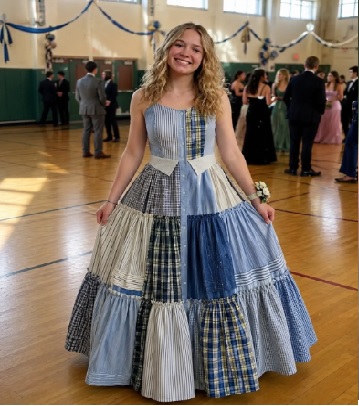
The finished dress was unlike anything available in a store.
Different shades of blue, white and gray formed subtle panels across the skirt. Small sections from shirt pockets became decorative details. Claire even preserved several original buttons.
Anyone looking closely could tell the dress had once been something else.
That was exactly the point.
A Very Different Graduation Outfit
On graduation morning, Claire stood in front of the mirror for a long time.
The dress wasn’t professionally tailored. Some lines weren’t perfectly symmetrical, and the fabrics didn’t match in the way a designer might have chosen.
But when she looked at it, she didn’t see imperfections.
She saw her father.
Her mother became emotional when Claire finally walked downstairs.
For a moment neither of them said anything.
Then they left for the ceremony.
The school hall was already crowded when they arrived. Families were searching for seats, teachers were organizing students, and graduates were taking photographs together before the formal program began.
Claire immediately noticed that most of her classmates had chosen polished, fashionable outfits for the occasion.
She suddenly became conscious of every unusual detail in her own dress.
At first, nobody seemed particularly interested.
Then she heard laughter.
A small group of students several feet away were looking in her direction. One whispered something to another before glancing again at the patchwork fabric.
Another student asked loudly enough to be heard whether Claire had made the dress from old clothes.
Someone laughed.
Claire felt her face grow warm.
She considered explaining.
She could have told them that the fabric had belonged to her father. She could have explained why the buttons mattered or why she had spent weeks sewing everything together.
Instead, she said nothing.
Not every meaningful thing needs to be defended before people who have already decided to mock it.
Still, knowing that did not make the moment painless.
She found her seat and focused on the ceremony.
When the Room Changed
Graduation programs tend to follow familiar patterns. There are speeches about the future, applause for academic achievements and reminders that students are entering a new stage of life.
This ceremony began the same way.
Teachers were thanked. Students received recognition. Families applauded.
Then the principal approached the microphone.
He spoke about the graduating class and the different ways students had demonstrated determination during their final years at school. He mentioned academic success, athletic accomplishments, volunteer work and personal challenges that students had quietly overcome.
Then his tone changed.
He said that achievement was not always measured by grades, awards or trophies.
Sometimes, he explained, character could be seen in the way a person carried love, loss and memory forward.
The room grew quieter.
Claire looked toward the stage.
The principal had learned about her dress earlier that week from one of the teachers who had seen her working on it. Claire had not expected anyone to mention it publicly.
He did not turn the moment into a spectacle. He did not ask Claire to stand immediately or tell the audience how they should react.
Instead, he spoke about the meaning behind what she had created.
One student, he explained, had chosen to attend graduation wearing a dress handmade from shirts that had belonged to her late father.
The whispers stopped.
People began looking toward Claire again, but this time the atmosphere was completely different.
The same dress that had seemed strange only minutes earlier suddenly had a story.
The Difference Between Seeing and Understanding
Nothing about the fabric had changed.
The seams were identical. The colors were identical. The old buttons were still there.
Only one thing had changed: people knew what they were looking at.
That difference matters far beyond a graduation ceremony.
Human beings make judgments quickly. Clothing, accents, jobs, cars, homes and countless other visible details become shortcuts through which we form opinions about strangers.
Sometimes those impressions are harmless.
Sometimes they are cruel.
A secondhand jacket might belong to someone struggling financially. Or it might be the last gift a person received from a parent. An old watch might have almost no monetary value while being priceless to its owner. A repaired piece of furniture might look outdated to a visitor while representing decades of family history.
Objects can carry emotional histories invisible to everyone except the person holding them.
Claire’s dress was one of those objects.
To several classmates, it had initially looked like a strange homemade outfit.
To Claire, it was a collection of memories she could wear.
Why Clothing Can Become So Meaningful
Psychologists and researchers who study grief have long recognized that people often maintain symbolic connections with those they have lost. Moving forward after bereavement does not necessarily require eliminating reminders of a loved one.
Photographs, recipes, letters, jewelry and clothing can become part of that continuing connection.
Clothing can be especially powerful because it is closely associated with physical presence.
A familiar jacket hanging behind a door can instantly remind someone of the person who once wore it. A shirt can recall ordinary mornings, family dinners or car rides that seemed insignificant when they happened.
After someone dies, those ordinary memories often become precious.
Transforming clothing into something new can therefore serve two purposes.
It preserves part of the original object while allowing it to participate in a new chapter of life.
Families sometimes turn old shirts into quilts, cushions, stuffed animals or framed pieces of fabric. Others preserve wedding dresses, military uniforms or work clothes.
The financial value of these objects is usually irrelevant.
Their value comes from association.
Claire had simply chosen another form of remembrance.
She had turned her father’s shirts into something appropriate for a milestone he could not attend.
The Applause She Hadn’t Expected
When the principal finished explaining the story, there was a brief silence.
Then someone began clapping.
Others joined.
Within moments, applause filled the hall.
Claire did not experience it as a victory over the students who had laughed earlier. That was not what she wanted.
If anything, the moment made her realize how easily misunderstanding can become judgment.
Some of the classmates who had laughed avoided her eyes afterward. One approached her later and apologized, admitting that she had assumed the dress was simply an unusual fashion choice.
Claire accepted the apology.
She didn’t want graduation to become a story about humiliation or revenge.
Her father had taught her something very different.
He had been the kind of person who repaired things rather than immediately throwing them away. He saved useful objects, disliked unnecessary waste and believed that possessions mattered because of the experiences attached to them rather than their price.
In an unexpected way, the dress reflected all of that.
More Than Something to Wear
After the ceremony, Claire’s mother wanted photographs.
They stood outside together while families gathered around graduates in the afternoon light.
For one picture, Claire held a photograph of her father.
Years earlier, he had worn one of the shirts that was now part of her dress.
The connection was unmistakable.
Later, when the excitement of graduation had passed and the house became quiet again, Claire carefully hung the dress in her room.
She knew she might never wear it in exactly the same way again.
That didn’t matter.
Its purpose had already been fulfilled.
Graduation traditionally represents separation from one stage of life and movement toward another. For Claire, that transition carried an additional meaning. Growing older meant reaching more milestones without her father physically present.
There would likely be other important days ahead.
New jobs. Birthdays. Perhaps a wedding or children of her own.
Grief does not disappear simply because time moves forward. It changes shape.
The dress could not bring her father back.
But it allowed something associated with him to accompany her into the future.
And perhaps that was why the laughter in the hall ultimately mattered so little.
People had first seen scraps of old shirts stitched together.
Claire had always seen something else.
She saw Saturday mornings, family photographs, familiar buttons, conversations she still remembered and a father who should have been sitting in the audience.
The dress was never intended to impress strangers.
It was her way of saying that someone can be gone and still remain woven into the most important moments of our lives.