By the time Rachel reached the airport with her husband and their 18-month-old twins, she already felt as though she had completed a full day’s work.
Traveling with two toddlers required the kind of preparation that made an ordinary vacation resemble a small military operation. There were diapers, wipes, bottles, snacks, spare clothes, toys, blankets, medicine, two car seats and a stroller that seemed determined to catch on every doorway.
Still, Rachel was excited.
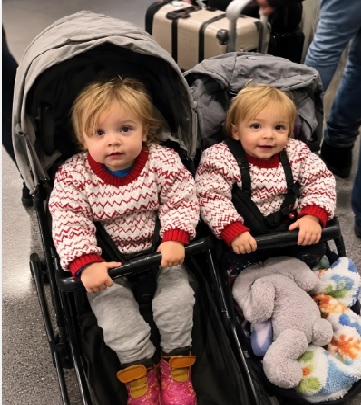
She and Eric were flying to Florida to visit her parents. The twins, Noah and Lily, had grown dramatically since the grandparents had last seen them, and Rachel had spent weeks imagining the reunion. Her father had been counting the days.
The airport was crowded that morning. Families clustered around check-in counters, business travelers hurried toward security, and announcements echoed continuously from overhead speakers.
Rachel kept one hand on the stroller while trying to balance a diaper bag over her shoulder.
“Can you take the car seats?” she asked Eric.
“Sure.”
For the next hour, they operated like a team. Eric carried luggage. Rachel handled the children. They survived security, reorganized their belongings afterward and eventually reached the gate with enough time to buy coffee.
Rachel finally allowed herself to relax.
Then Eric looked at his phone.
“I need to check something,” he said.
Before Rachel could ask what he meant, he walked toward the airline desk.
She barely noticed at first. Noah had dropped his cup, and Lily was trying to pull a stuffed rabbit from the diaper bag. By the time Rachel looked up again, Eric was returning.
He was smiling.
“I got upgraded.”
Rachel stared at him.
“Upgraded?”
“First class.”
She waited for the rest of the sentence.
Perhaps he had upgraded both of them. Maybe there was some complicated seating arrangement they needed to discuss.
Instead, Eric slipped his phone into his pocket.
“You and the kids are still together in economy,” he said. “It actually works out perfectly.”
Rachel thought she had misunderstood.
“You’re sitting in first class by yourself?”
“It was only one seat.”
He said it casually, almost as if he were explaining that the coffee shop had run out of his preferred drink.
Rachel glanced at the stroller, the diaper bag, the car seats waiting to be gate-checked and the two toddlers who would soon need to be carried onto an airplane.
“And what am I supposed to do?”
Eric seemed genuinely surprised by the question.
“You’ll be fine. It’s only a few hours.”
Then he added something that made the situation worse.
“I could really use the break.”
Rachel said nothing.
Boarding began several minutes later.
A Very Different Flight
Eric boarded early with the first-class passengers.
Rachel remained near the gate with the twins.
That detail stayed with her.
He had not simply accepted a better seat. He had walked onto the aircraft while she was still outside managing everything they had brought with them.
When family boarding was announced, Rachel folded the stroller while trying to keep both children nearby. An airline employee helped with one of the car seats, and another passenger briefly held the diaper bag while Rachel lifted Lily.
By the time she reached her row, she was exhausted.
Eric was several rows ahead, behind the curtain separating the cabins.
Rachel could occasionally see flight attendants moving through first class.
The contrast was almost absurd.
Up front, Eric had space, drinks and quiet.
Behind him, Rachel was attempting to keep two toddlers entertained in a confined space thousands of feet above the ground.
Noah wanted to walk.
Lily wanted whatever Noah had.
Then Lily began crying because her ears hurt during the climb. When she finally calmed down, Noah knocked over a cup of water. Rachel apologized repeatedly to the passenger beside her while searching for wipes.
The stranger surprised her.
Instead of appearing irritated, he helped pick up the toys that had fallen beneath the seats.
Later, a woman across the aisle played peekaboo with Lily while Rachel changed Noah.
Small gestures from complete strangers made the flight manageable.
That realization produced an uncomfortable thought.
People who owed her nothing were helping.
Her husband was sitting a few rows away.
At one point Rachel considered walking forward and asking Eric to switch seats with her for an hour.
She decided against it.
Not because she didn’t need the help, but because she suddenly wanted to know something.
Would he come back on his own?
He didn’t.
The Problem Wasn’t the Seat
When the plane landed in Florida, passengers began reaching for their bags.
Eric appeared beside Rachel looking rested.
“How was it?” he asked.
Rachel looked at him for several seconds.
“Busy.”
He smiled.
“First class was incredible. I actually slept.”
That was when something shifted.
Rachel wasn’t furious because Eric had received a better seat. If he had been traveling alone, she would have been happy for him.
The issue was what he had done with the opportunity.
He had looked at a situation in which two parents were responsible for two very young children and concluded that one parent’s comfort mattered more than the other’s workload.
More importantly, he apparently hadn’t considered the decision unusual.
Their argument did not happen at the airport.
Rachel’s parents were waiting outside, thrilled to see the twins. There were hugs, photographs and excited conversations. Rachel didn’t want the beginning of the visit dominated by a fight.
So she waited.
That evening, after the children were asleep, Eric finally noticed that something was wrong.
“Are you still upset about the upgrade?”
Rachel disliked the word “still.”
It suggested that her reaction had already lasted longer than necessary.
“I’m not upset because you sat in first class,” she told him. “I’m upset because you saw me standing there with two babies and all our things, and you decided you deserved a vacation from the family before the vacation had even started.”
Eric immediately defended himself.
“It was one seat. What was I supposed to do, turn it down?”
“Yes.”
The answer surprised him.
Rachel continued.
“Or you could have asked me. Or we could have decided together. You could have taken the seat for half the flight and then switched with me if the airline allowed it. You could have done anything that showed you understood we were both responsible for getting the children there.”
Eric insisted he had assumed she could manage.
That, Rachel explained, was exactly the problem.
Of course she could manage.
She managed constantly.
The question was why she should have to manage alone when her partner was sitting on the same airplane.
The Invisible Side of Parenting
The disagreement uncovered something larger than one unpleasant flight.
Rachel began listing responsibilities she normally handled without discussing them: pediatric appointments, extra clothes for daycare, diapers, grocery lists, birthday gifts, family schedules and knowing when the twins were about to outgrow their shoes.
Eric did plenty around the house. He worked, cooked occasionally, changed diapers and played with the children.
But Rachel realized that much of his participation happened after someone identified what needed to be done.
She was the person doing the identifying.
That distinction matters in many households.
Physical chores are easy to see. The mental work behind them is less obvious.
Packing a diaper bag takes minutes. Remembering what must be inside it requires continuous attention.
Taking a child to an appointment is one task. Remembering to schedule the appointment, checking insurance information, arranging transportation and knowing what questions to ask are separate tasks.
When one partner becomes the default organizer, even a seemingly minor decision can carry unexpected emotional weight.
The first-class seat had become symbolic because it exposed that imbalance in the clearest possible way.
Eric had seen parenting as something Rachel was capable of handling.
Rachel saw parenting as something they were supposed to handle together.
Those ideas sounded similar until they were tested.
What Should Have Happened?
There was nothing inherently wrong with accepting an upgrade.
The problem was accepting it without considering the person left behind.
A simple conversation at the gate could have changed everything.
Eric might have said, “They offered me one first-class seat. What do you think we should do?”
Perhaps Rachel would have told him to take it.
Perhaps she would have asked for the seat herself.
Perhaps they would have declined it.
The final decision mattered less than making the decision together.
Partnership does not mean that every advantage must be divided perfectly. Couples rarely keep exact accounts of who slept longer, who washed more dishes or who had the easier afternoon.
But healthy cooperation usually requires awareness.
When one person is overwhelmed, the other should not treat that moment as an opportunity to disappear.
The Return Flight
During the rest of the Florida visit, the airport incident gradually stopped dominating their conversations.
But Rachel did not forget it.
Neither, apparently, did Eric.
On the morning of their return flight, the family arrived at the airport early. The twins were tired after a week of excitement, and everyone expected another difficult journey.
At check-in, Eric quietly asked whether any upgrades were available.
Rachel heard him and immediately looked over.
Then he turned toward her.
“If there’s one seat,” he said, “you take it.”
Rachel almost laughed.
She declined.
This time she wanted them together.
They boarded as a family.
The flight home was not peaceful. Noah cried during takeoff, Lily refused to sleep, and somebody lost a toy beneath the seat twice.
But Eric handled one child while Rachel handled the other.
They traded snacks, changed diapers and took turns walking the aisle.
Neither parent arrived rested.
Yet Rachel stepped off that plane feeling far better than she had after the first flight.
Nothing about economy class had improved.
What had changed was that she no longer felt alone.
The experience left them with a lesson neither had expected to learn on a family vacation: sometimes the most revealing moments in a relationship are not dramatic betrayals or enormous arguments.
Sometimes they are small choices made when one person is tired, another person needs help, and an unexpectedly comfortable seat becomes available.
A first-class upgrade may last only a few hours.
What it reveals about a partnership can remain long after the plane has landed.