The supermarket was always busiest at the worst possible time.
It was a little after six on a Wednesday evening, and nearly every checkout lane was packed. People were coming home from work, parents were trying to keep tired children under control, and everyone seemed to be watching the clock.
I was no exception.
My three-year-old son, Noah, was sitting in the child seat of my shopping cart, clutching a small box of crackers he had somehow convinced me to buy. I had spent the entire day rushing from one responsibility to another, and all I wanted was to pay for our groceries, drive home, make something simple for dinner, and get Noah into bed.
There were four people ahead of us.
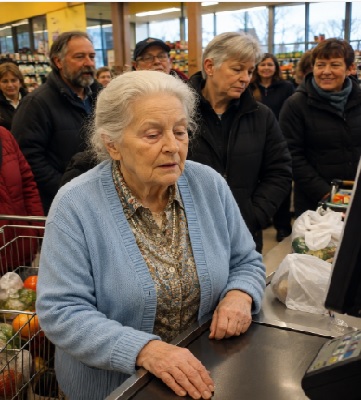
At the front of the line stood an elderly woman.
She was small and slightly stooped, wearing a faded blue coat that looked too warm for the season. Her silver hair had been carefully pinned behind her ears. Nothing about her appearance was remarkable, except perhaps the old-fashioned leather purse she held tightly against her side.
Her groceries were already on the counter.
Bread. Milk. Eggs. A bag of potatoes. Two cans of soup. A small packet of cheese. Tea.
And an apple pie.
It wasn’t a large shopping trip. There was nothing extravagant in her basket.
The cashier scanned everything and gave her the total.
The woman inserted her bank card.
A few seconds passed.
The machine beeped.
The cashier looked at the screen.
«I’m sorry. It didn’t go through.»
The woman seemed confused.
«Oh.»
She tried again.
Another beep.
Declined.
I could immediately feel the mood of the line changing behind me.
Someone sighed.
A man farther back shifted his basket impatiently from one hand to the other.
The elderly woman opened her purse and searched through it. She found a few notes and several coins, carefully placing them on the counter.
The cashier counted the money.
«You’re still short.»
The woman’s face changed.
Not dramatically. She didn’t cry or complain. She simply looked at the groceries as if she were trying to solve a difficult puzzle.
«Then take the pie off,» she said quietly.
The cashier removed it.
It still wasn’t enough.
The woman hesitated.
«The cheese too, please.»
The cashier removed that.
Still short.
By then, the woman was visibly embarrassed.
She began looking through the groceries again.
I remember thinking that there are moments when you can learn a surprising amount about someone’s life without knowing anything about them.
This woman wasn’t choosing between luxuries.
She was deciding which basic foods she could leave behind.
«Take the tea,» she finally said.
I don’t know exactly why that was the moment that got to me.
Maybe it was because tea seemed like such a small comfort.
Maybe it was because she was trying so hard to remain dignified while strangers waited behind her.
Or maybe I was simply tired enough that evening to stop overthinking things.
«Please put everything back,» I told the cashier.
The elderly woman turned toward me.
The cashier looked uncertain.
«I’ll cover what’s missing,» I said.
«No, no,» the woman immediately replied. «You don’t have to do that.»
«It’s okay.»
She shook her head.
«I couldn’t.»
«You can,» I said. «Really.»
I wasn’t wealthy. Far from it.
That week, I had been carefully watching our own spending. Payday was still a couple of days away, and I had already decided there would be no restaurant meals, unnecessary shopping, or little treats until then.
But the amount she was missing wasn’t going to change my life.
For her, at that particular moment, it clearly mattered.
So I paid the difference and asked the cashier to put the apple pie, cheese, and tea back into her bags.
The woman stared at me.
For several seconds, she didn’t say anything.
Then her eyes filled with tears.
«Thank you,» she whispered.
I suddenly felt uncomfortable—not because I regretted helping her, but because I hadn’t expected the moment to become emotional.
«You really don’t need to thank me.»
«But I do.»
She looked at Noah.
He was completely unaware of what had happened. He was busy trying to open his crackers.
The woman smiled at him.
«You have a good boy.»
«Most of the time,» I said.
She laughed softly.
That broke the tension.
The cashier handed her the receipt. The woman gathered her bags, thanked me once more, and walked toward the exit.
A minute later, it was our turn.
I paid for my groceries, loaded everything into the car, strapped Noah into his seat, and drove home.
By the time I was making dinner, I had almost stopped thinking about it.
I didn’t tell anyone.
There didn’t seem to be much to tell.
Someone had been short of money.
I had helped.
That was all.
At least, I thought it was.
Two Days Later
Friday afternoon, Noah and I went back to the same supermarket.
We needed milk, bananas, pasta, and several other things I had forgotten earlier in the week.
This time the store was quieter.
Noah walked beside me rather than sitting in the cart, which meant the trip took twice as long because every brightly colored package became a subject requiring serious investigation.
We were near the bakery section when he suddenly stopped.
«Mom!»
I kept walking.
«Mom! Look!»
There was so much excitement in his voice that I turned immediately.
He was pointing toward the front of the store.
«Wow!»
I followed his finger.
At first, I didn’t understand what he had seen.
Then I recognized the elderly woman.
She was standing near the customer service desk.
But she wasn’t alone.
Beside her stood a middle-aged man in a dark jacket, speaking to one of the store employees.
The elderly woman saw us.
Her entire expression changed.
«There she is!»
The man turned.
For one uncomfortable second, I wondered whether I had somehow done something wrong.
Then they both began walking toward us.
The woman took my hands before I could say anything.
«I was hoping I’d see you again.»
The man smiled.
«I’m Daniel,» he said. «I’m her son.»
I introduced myself.
He explained that his mother, Margaret, lived alone only a few streets away. She was fiercely independent and disliked asking her family for help.
The problem at the checkout had apparently been caused by an issue with her bank card. She hadn’t understood why the payment was being rejected, and rather than calling anyone, she had simply tried to reduce the bill.
Daniel had learned about the incident later.
«My mother hasn’t stopped talking about you,» he said.
Margaret looked embarrassed.
«I told him not to make a fuss.»
«You told me a stranger paid for your groceries when you couldn’t,» he replied. «Of course I’m making a fuss.»
I laughed.
Then he held out an envelope.
I immediately shook my head.
«No. Absolutely not.»
«It’s just the money you spent.»
«I don’t want it.»
«You helped my mother.»
«That’s why I don’t want it.»
For a moment, we stood there arguing politely.
Finally, Margaret took the envelope from her son.
«Then we’ll do it differently,» she said.
She placed it back into Daniel’s pocket.
«You don’t have to repay kindness to the same person.»
I looked at her.
She continued.
«Pass it on to somebody else.»
That ended the argument.
Daniel agreed that the next time he saw someone who genuinely needed help, he would remember what had happened.
I thought that was the end of the story.
It wasn’t.
What Noah Had Actually Seen
While the adults were talking, Noah had wandered a few steps toward a display beside the bakery.
Then he shouted again.
«Mom! The pie!»
That was when I finally understood why he had been so excited.
On a small table were several apple pies identical to the one Margaret had nearly left behind two days earlier.
To Noah, the entire complicated adult situation had been reduced to one memorable object.
The apple pie.
Margaret burst out laughing.
«Would you like one?»
Noah looked at me before answering, which was unusual enough to make all of us laugh again.
Margaret bought the pie.
This time her card worked.
She insisted on giving it to Noah.
We took it home that afternoon, and after dinner we shared it at the kitchen table.
Noah probably remembers very little about that day now.
But I do.
Not because paying for someone’s groceries was heroic. It wasn’t.
In fact, that is precisely why the memory stayed with me.
We sometimes imagine kindness as something dramatic: rescuing a stranger, donating a huge amount of money, changing someone’s entire life.
Most opportunities don’t look like that.
They are ordinary and inconvenient.
They happen while you’re tired.
They happen when you’re in a hurry.
They happen when helping means spending a little more than you intended or waiting a few extra minutes.
And sometimes the person in need doesn’t look helpless.
Margaret certainly didn’t.
She was composed, polite, and determined to handle the problem herself. If I had been looking at my phone instead of watching the checkout, I might never have noticed what was happening.
The Quiet Side of Financial Struggle
That encounter also changed the way I thought about embarrassment and money.
Financial difficulty is often invisible.
A person can be neatly dressed and still be struggling to buy groceries. Someone can own a home and still have very little available cash. An unexpected bill, banking problem, delayed payment, or simple mistake can turn an ordinary shopping trip into a humiliating experience.
Older people may face additional difficulties because modern payment systems can be confusing, particularly when something unexpectedly goes wrong.
But helping someone doesn’t require knowing their entire story.
That lesson mattered to me.
I didn’t need Margaret’s financial history before deciding whether she deserved a loaf of bread or a carton of milk.
I only needed to see the situation in front of me.
There is also a difference between helping and making someone feel small.
Margaret didn’t want pity.
She wanted to maintain her independence.
Looking back, I think the most important part of that evening wasn’t the money. It was allowing her to leave the store without having to continue removing food from her bags in front of a growing line of strangers.
Dignity can be worth more than whatever appears on a receipt.
A Small Rule We Kept
After that Friday, I started doing something simple with Noah.
Whenever we had the opportunity to help someone in a small, reasonable way, I tried to involve him.
Sometimes that meant holding a door.
Sometimes it meant letting someone with one item go ahead of us at the checkout.
Sometimes it meant giving food to a local collection.
I didn’t want to teach him that kindness always produces a reward.
That would have been the wrong lesson.
Margaret’s apple pie was lovely, but it wasn’t payment.
Kindness doesn’t guarantee that someone will return two days later to thank you. Most of the time, you will never know what happened afterward.
And that’s fine.
The real value of helping isn’t that the universe owes you something in return.
It’s that, for one moment, you made another person’s difficult day slightly easier.
Years later, when I think about that supermarket, I don’t remember what I bought for my own family that evening.
I don’t remember the total on my receipt.
I don’t even remember exactly how much Margaret was short.
I remember her looking down at the groceries and deciding what to sacrifice first.
I remember the impatience in the line.
I remember her surprise when someone interrupted that uncomfortable moment.
And most clearly, I remember my little boy pointing across the supermarket two days later, thrilled by something the adults had almost overlooked.
«The pie!»
He had no idea that the apple pie had become part of a much larger lesson.
Sometimes kindness returns to you.
Sometimes it doesn’t.
But perhaps that isn’t the point.
Perhaps the point is simply to notice when the person standing in front of you could use a little help—and, when you reasonably can, to be the person who provides it.