
For some people, changing their appearance means getting a new haircut, experimenting with makeup, or choosing a different wardrobe. For others, the desire for transformation goes much further, becoming a long-term project involving cosmetic treatments, surgery, and thousands of dollars.
The idea of becoming a “living doll” has attracted attention for years. Women and men who pursue this aesthetic often favor unusually smooth skin, prominent cheekbones, full lips, carefully shaped noses, and exaggerated facial proportions.
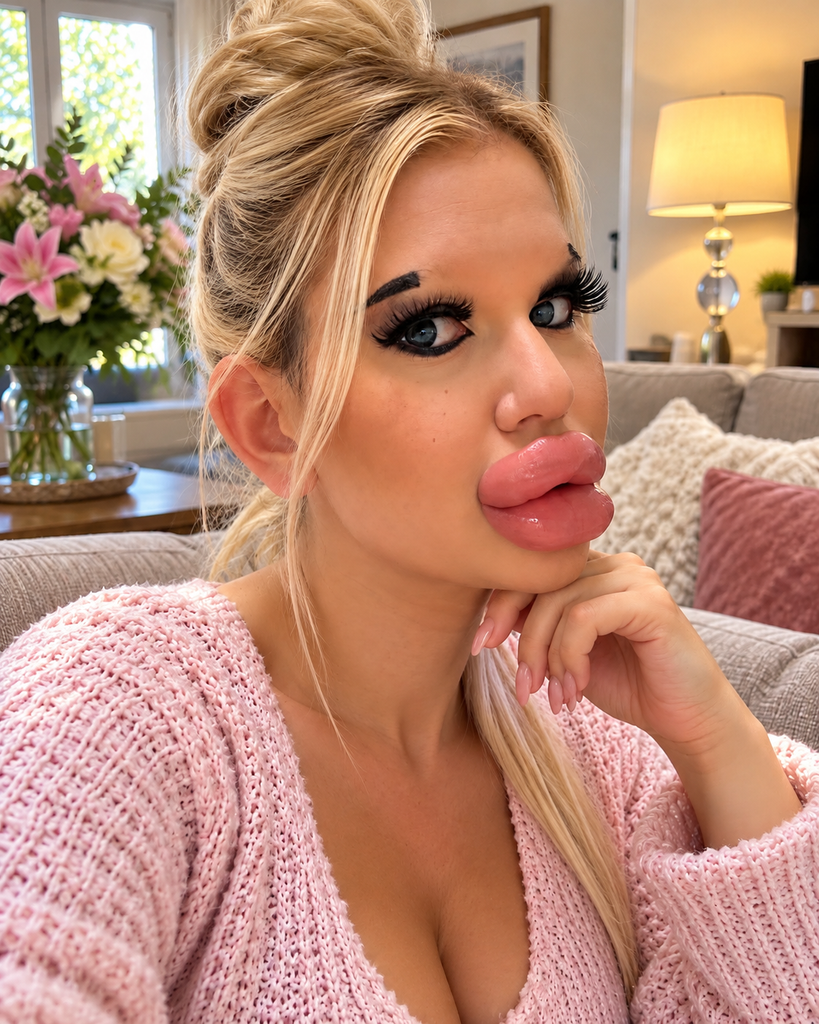
Their transformations can provoke fascination, admiration, and criticism in equal measure.
But behind the dramatic before-and-after photographs lies a more complicated question: What happens when a person’s ideal appearance becomes a goal that constantly moves further away?
Consider the fictional example of a young woman named Vanessa, whose experience illustrates some of the emotional, financial, and practical questions surrounding extreme cosmetic transformations.
A Dream That Began With Makeup
Vanessa was twenty-four when she began experimenting seriously with her appearance.
As a teenager, she had loved fashion dolls, elaborate hairstyles, and theatrical makeup. She admired their symmetrical faces, oversized eyes, and seemingly flawless features.
She didn’t necessarily dislike her natural appearance.
She simply imagined herself looking different.
At first, her transformation was entirely temporary.
She wore colored contact lenses, applied dramatic eyeliner, and used contouring techniques to make her nose appear narrower.
She spent hours watching makeup tutorials and practicing different looks.
Friends complimented her creativity.
Her photographs attracted attention online.
For the first time, Vanessa felt that she had discovered a personal style that made her stand out.
But as her audience grew, so did her interest in making those changes permanent.
She began researching cosmetic procedures.
What started as an artistic experiment gradually became a much more expensive ambition.
The First Procedure
Vanessa’s first cosmetic treatment was relatively modest.
She wanted fuller lips.
After consulting a practitioner, she underwent a lip filler procedure.
The initial result pleased her.
Her lips appeared more prominent, and she felt that her face looked closer to the image she’d been trying to create with makeup.
She posted photographs online.
Some followers praised her new appearance.
Others said they preferred her natural features.
Vanessa focused on the positive comments.
Within months, however, she began noticing other details she wanted to change.
Her cheekbones seemed insufficiently defined.
Her jawline looked too soft.
Her nose appeared wider than she wanted in photographs.
She started planning additional treatments.
Each new procedure seemed to reveal another feature that could be improved.
Five Years of Transformation
Over the following five years, Vanessa underwent a series of cosmetic interventions.
Her choices included additional facial fillers, treatments intended to alter facial contours, and surgical consultations.
She also changed her hairstyle, eyebrows, makeup, and clothing to create a consistent doll-inspired appearance.
By the end of the five-year period, she estimated that she had spent close to $10,000 on procedures and related expenses.
That figure did not include every beauty product, appointment, or journey connected with maintaining her look.
The transformation was dramatic.
People who had known her before sometimes struggled to recognize her in photographs.
Her face appeared fuller in some areas and more sharply defined in others.
Her lips were noticeably larger.
Her makeup emphasized the artificial, polished aesthetic she had been pursuing.
Vanessa considered the transformation an achievement.
But public reactions were far from unanimous.
Why the Internet Loves Before-and-After Photographs
Images comparing someone’s appearance before and after cosmetic procedures frequently attract considerable attention.
They offer a striking visual contrast that can be understood immediately.
A person may appear almost unrecognizable between two photographs taken only a few years apart.
But such comparisons can also be misleading.
Lighting, camera angles, makeup, hairstyle, facial expression, and digital editing can dramatically influence how someone looks.
A photograph taken casually in natural light may appear very different from a professionally styled portrait.
Changes in weight, age, and skincare can also affect facial appearance.
Consequently, photographs alone rarely reveal the full extent of someone’s cosmetic procedures.
They may show that a transformation occurred, but they cannot reliably establish every treatment involved or explain why someone chose it.
That distinction matters when discussing real people whose images circulate online.
Admiration and Criticism
People who pursue unusual beauty aesthetics often receive two very different kinds of reactions.
Supporters admire their determination.
They argue that adults should be free to choose how they present themselves, provided they understand the risks and make informed decisions.
For these supporters, cosmetic transformation can be an expression of creativity and personal identity.
They compare it to tattoos, body modification, theatrical fashion, or other forms of self-expression.
Critics see the situation differently.
Some worry that repeated procedures can produce results that appear increasingly unnatural.
Others question whether social media attention encourages people to pursue more extreme changes.
There are also concerns about medical risks and the possibility of dissatisfaction after treatment.
Both reactions may reflect genuine beliefs, but neither tells us exactly how the person undergoing the transformation feels.
Outsiders can evaluate photographs.
They cannot automatically determine someone’s happiness, confidence, or psychological well-being.
When One Change Leads to Another
One of the most interesting aspects of long-term cosmetic transformation is how personal expectations can evolve.
Someone may begin with a specific goal, such as fuller lips or a different nose shape.
After achieving it, their attention may shift toward another feature.
The original concern becomes less important, while a new one takes its place.
This does not happen to everyone who undergoes cosmetic treatment.
Many people are satisfied with one procedure and never seek another.
But repeated interventions can sometimes become part of an ongoing cycle of adjustment.
The more closely someone examines their appearance, the more details they may notice.
Social media can intensify this process.
Photographs are viewed, compared, enlarged, and judged.
Comments from strangers may influence how someone evaluates a result.
A feature that looked satisfactory in the mirror may suddenly seem inadequate after reading criticism online.
For people considering further treatment, recognizing this pattern can be valuable.
The Financial Reality
Ten thousand dollars is a substantial amount of money for most people.
Yet the cost of cosmetic transformation varies enormously.
Prices depend on the procedure, practitioner, geographic location, complexity of treatment, and whether follow-up care is required.
Some treatments also involve ongoing expenses.
For example, certain temporary fillers gradually break down and may require additional appointments if someone wishes to maintain the same appearance.
Surgical procedures can have longer-lasting effects, but they may involve recovery periods, medical assessments, and potential revision surgery.
A person planning cosmetic changes should consider more than the advertised price.
There may be costs associated with consultations, medication, time away from work, travel, and managing complications.
Choosing a provider solely because they offer the lowest price can introduce additional risks.
Financial planning is therefore an important part of informed decision-making.
The Medical Risks Behind the Results
Cosmetic procedures are sometimes presented as routine beauty treatments.
However, they are medical interventions, and their risks vary depending on the technique used.
Injectable fillers can cause swelling, bruising, asymmetry, infection, or unwanted changes in appearance.
Rare but serious complications can occur if filler enters or compresses a blood vessel, potentially causing tissue damage, vision loss, or other severe outcomes.
Cosmetic surgery carries additional risks, including anesthesia complications, bleeding, infection, scarring, and dissatisfaction with the final result.
Recovery may also take longer than anticipated.
Repeated procedures can complicate future treatment because tissues may have been altered by previous interventions.
These considerations do not mean that every cosmetic procedure is unsafe.
They mean that proper medical evaluation, qualified practitioners, realistic expectations, and informed consent are essential.
Anyone considering treatment should understand the specific benefits, limitations, and risks before proceeding.
The Difference Between Confidence and Perfection
Vanessa initially believed that achieving her ideal appearance would make her feel completely confident.
For a while, every new change produced excitement.
She enjoyed shopping for clothes, taking photographs, and experimenting with different makeup styles.
But she eventually noticed that compliments didn’t always provide the reassurance she expected.
A positive comment could make her happy for an afternoon.
A cruel remark could occupy her thoughts for days.
She began to understand that external approval was unreliable.
Some people would admire her appearance.
Others would dislike it.
No amount of cosmetic treatment could make everyone agree.
This realization changed the way she approached future procedures.
Rather than immediately booking another appointment whenever she noticed a perceived flaw, she began waiting and reconsidering.
Sometimes, after several weeks, the concern no longer seemed important.
Can Cosmetic Procedures Become an Obsession?
Interest in appearance is common and does not automatically indicate a mental health problem.
Likewise, choosing cosmetic surgery does not mean someone has unhealthy self-esteem.
However, persistent distress about perceived physical flaws can sometimes be associated with body dysmorphic disorder, a recognized mental health condition.
People experiencing this disorder may spend considerable time worrying about aspects of their appearance that others barely notice.
Some repeatedly seek reassurance, compare themselves with others, or pursue cosmetic procedures without experiencing lasting satisfaction.
Only a qualified healthcare professional can assess whether someone meets the criteria for such a condition.
It would be inappropriate to diagnose an individual based solely on photographs or the number of procedures they have undergone.
Still, psychological well-being is an important consideration.
If someone feels compelled to change their appearance repeatedly or believes they cannot be happy until they achieve an impossible standard, professional support may help them understand those feelings.
The Influence of Beauty Filters
Modern beauty filters have changed how people imagine their ideal faces.
Many filters smooth skin, enlarge eyes, narrow noses, and alter facial proportions within seconds.
Repeated exposure to these images can make digitally modified features appear normal.
The distinction between a natural face and a computer-generated aesthetic may become less obvious.
For someone pursuing a doll-like appearance, filters can provide inspiration.
But they can also create unrealistic expectations.
A digitally altered face doesn’t have to move naturally, heal after surgery, or account for individual anatomy.
Real cosmetic procedures cannot always reproduce the effects of an image filter.
This is one reason medical professionals emphasize realistic goals during consultations.
An appealing photograph is not necessarily an achievable surgical outcome.
The Emotional Cost of Public Attention
Vanessa’s transformation attracted increasing attention online.
Some viewers admired her dedication.
Others posted unkind comments about her appearance.
A few shared older photographs and claimed she had looked better before undergoing any procedures.
At first, Vanessa tried to defend herself.
She explained that she hadn’t changed her appearance to please strangers.
She had chosen the aesthetic because she genuinely liked it.
But responding to every criticism became exhausting.
Eventually, she stopped reading many of the comments.
She realized that allowing strangers to evaluate her worth was affecting her enjoyment of something that had originally been creative and personal.
The experience raised a broader question about online culture.
Why do people feel entitled to judge another person’s face so harshly?
Discussing the risks of cosmetic procedures is reasonable.
Mocking someone’s appearance is different.
Was the Transformation Worth It?
The answer depends on what the person hoped to achieve.
If Vanessa’s goal was to create a distinctive appearance inspired by dolls, she succeeded.
Her look became recognizable and reflected years of effort.
If her goal was to receive universal approval, that was never realistic.
Beauty preferences differ, and public opinion changes constantly.
If her goal was lasting self-confidence, the answer was more complicated.
She discovered that appearance could influence how she felt about herself, but it couldn’t solve every insecurity or emotional difficulty.
Her transformation also came with financial expenses, medical considerations, and social consequences.
None of those factors can be evaluated from a before-and-after photograph alone.
A dramatic visual result does not automatically mean the experience was either worthwhile or regrettable.
What She Would Tell Her Younger Self
Looking back, Vanessa didn’t wish she’d never experimented with her appearance.
She still loved fashion, makeup, and unusual beauty aesthetics.
But she wished she’d approached some decisions more slowly.
She would have spent more time researching practitioners.
She would have asked more questions about long-term effects.
And she would have avoided making decisions immediately after receiving negative comments online.
Most importantly, she would have reminded herself that changing her appearance was a choice, not an obligation.
She didn’t need to correct every feature that failed to match an idealized image.
She could enjoy a distinctive style without constantly pursuing another procedure.
Beauty Is More Than a Before-and-After Comparison
Stories about extreme cosmetic transformations often focus on a single question: Did the person look better before or after?
But that question reveals more about the observer’s preferences than about the individual undergoing the change.
One viewer may prefer natural features.
Another may admire a highly stylized appearance.
Neither opinion automatically determines whether the person made the right decision.
The more useful questions concern informed choice, health, financial responsibility, and emotional well-being.
Was the person adequately informed about the risks?
Were the procedures performed by appropriately qualified professionals?
Were expectations realistic?
Was the decision made freely rather than under pressure?
And did the outcome improve the person’s life in the ways they had hoped?
These questions offer a more meaningful way to evaluate cosmetic transformation than simply comparing two photographs.
The Real Meaning of Transformation
A face can change dramatically over five years.
Lips can become fuller.
Cheekbones can appear more prominent.
A nose can be reshaped.
Makeup and styling can create an entirely different visual identity.
But the most important changes may be the ones that aren’t visible.
Someone may become more confident, more cautious, or more aware of the difference between personal preference and public approval.
Vanessa’s fictional journey illustrates a challenge that extends far beyond cosmetic surgery.
Many people spend years believing happiness is waiting on the other side of one more improvement.
One more procedure.
One more compliment.
One more photograph that finally looks perfect.
But perfection is difficult to define and impossible to guarantee.
A person can pursue a chosen appearance while also recognizing that their value does not depend on achieving it.
And perhaps that is the most important lesson behind any dramatic transformation.
The question isn’t simply whether someone looks better than they did five years ago.
It’s whether the choices they made were informed, safe, sustainable, and genuinely their own.
Because changing a face is one thing.
Learning to feel comfortable living in it is something else entirely.