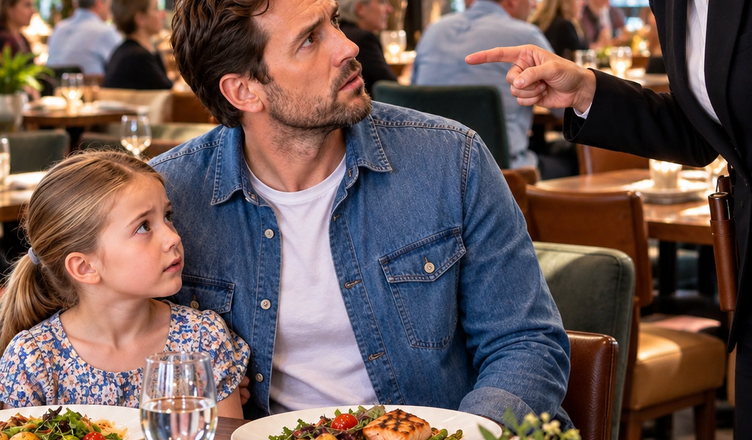
I was cutting a piece of chicken into tiny bites when the restaurant manager stopped beside our table.
My twelve-year-old daughter, Sophie, immediately became tense.
I noticed because I had spent years learning to recognize the signs: the way her shoulders lifted, the way her fingers tightened around her napkin, the way she avoided looking directly at strangers when she sensed conflict.
The manager looked at the plate, then at Sophie.

“This is a fine-dining restaurant,” she said. “Perhaps somewhere more appropriate for children would be better next time.”
Sophie lowered her eyes.
She wasn’t behaving badly.
She wasn’t shouting, throwing food or disturbing anyone.
She simply needed me to cut her meal into smaller pieces.
And the manager had decided that was enough to embarrass her in a room full of strangers.
I didn’t argue.
Instead, I reached into the inside pocket of my jacket and placed a small card on the table.
The manager stared at it.
Within seconds, the confidence disappeared from her face.
But the card wasn’t what most people around us assumed.
It didn’t say I was the restaurant’s owner.
It didn’t identify me as a wealthy investor or powerful official.
It belonged to Sophie.
And it explained something the manager should never have forced her to explain publicly.
The Dinner Sophie Had Been Waiting For
My name is Michael, and Sophie is my only child.
When she was six, she was seriously injured in a car accident.
She recovered in ways doctors once weren’t certain she would, but the accident left lasting effects.
Among them were difficulties with coordination and swallowing.
Most days, strangers would never notice.
Sophie walks independently, attends school, loves science and can spend hours drawing elaborate imaginary cities.
But eating can be complicated.
Certain textures are difficult.
Large pieces of food can create problems.
When we’re somewhere unfamiliar, I usually cut her food into small, manageable bites.
At home, none of this feels unusual.
In public, Sophie has become increasingly self-conscious about it.
At twelve, the last thing she wants is to look different from other children.
That evening mattered because going to that particular restaurant had been her idea.
She had received an award at school for a science project.
I told her we could celebrate anywhere she wanted.
She chose the elegant restaurant downtown because she’d seen photographs of its rooftop dining room.
“Can I dress like an adult?” she asked.
I smiled.
“You can dress however you want.”
She spent nearly an hour choosing her outfit.
When we arrived, she was glowing.
For the first forty minutes, everything was perfect.
Then our meals arrived.
One Ordinary Accommodation
Sophie ordered chicken.
When she saw the portion, she glanced at me.
That was our signal.
“Want some help?”
She nodded.
I took her knife and began cutting.
There was nothing dramatic about it.
Then the manager approached.
Her name tag read “Victoria.”
She looked at me cutting Sophie’s food.
“Is everything all right with the meal?”
“Yes, thank you.”
She remained there.
Then she noticed several pieces of food Sophie had moved to the side of the plate.
“Is there a problem?”
“No.”
Victoria frowned.
“We put considerable care into presentation here.”
I wasn’t sure what she meant.
Then she said:
“If your daughter needs her meal prepared like that, you should have asked before ordering. We don’t normally serve children’s portions in this dining room.”
Sophie froze.
“She doesn’t need a children’s portion,” I said.
Victoria lowered her voice, but not enough.
A couple at the neighboring table could clearly hear us.
“Sir, other guests come here expecting a particular atmosphere.”
That was when Sophie looked down.
I knew exactly what was happening inside her.
She thought she was the problem.
The Card
I could have become angry.
Part of me wanted to.
But anger would have turned Sophie into the center of an even larger scene.
So I reached into my jacket.
I carried a small laminated card because Sophie sometimes struggled to explain herself when anxious.
It stated, in simple terms, that she had a medical condition affecting swallowing and coordination and might require reasonable assistance while eating.
I placed it on the table.
Victoria read it.
Her face changed immediately.
“Oh.”
That was all she said.
Then:
“I didn’t realize.”
“I know.”
“I thought—”
“That is the problem.”
Victoria looked at Sophie.
“I am very sorry.”
Sophie didn’t answer.
I picked up the card.
I could feel people watching us.
What happened next surprised me.
A man at the neighboring table spoke.
“She shouldn’t have needed a card.”
Victoria turned toward him.
He wasn’t angry.
He simply repeated:
“You didn’t need to know her diagnosis to treat her respectfully.”
The sentence stayed with me.
Because he was right.
The Apology Wasn’t Enough
Victoria offered to replace the meal.
I declined.
She offered dessert.
I declined that too.
Then she said dinner would be removed from our bill.
“I don’t want free food,” I told her.
“What would you like me to do?”
That was a better question.
I looked at Sophie.
“Do you want to leave?”
She nodded.
So we left.
Outside, Sophie was silent until we reached the car.
Then she started crying.
“Dad, I ruined dinner.”
I turned toward her.
“No.”
“She said everyone was expecting—”
“You didn’t ruin anything.”
“But you had to show the card.”
That hurt more than the manager’s comments.
Sophie had spent years learning how to manage something she never chose.
Now she believed needing help had somehow embarrassed me.
I told her the truth.
The card existed to make difficult situations easier.
It was not an apology for who she was.
The Phone Call
The following morning, the restaurant’s general manager called.
Victoria had reported the incident herself.
I appreciated that.
Apparently, after we left, she had gone directly to her supervisor and described what happened.
The general manager apologized and asked whether I would explain what should have been done differently.
I agreed, but only after speaking to Sophie.
She said something unexpectedly wise.
“Tell them not to ask people what’s wrong with them.”
So that was what I said.
Staff members didn’t need customers’ medical histories.
If someone requested an accommodation, employees could ask what assistance was needed without demanding a diagnosis.
And if nobody had requested anything?
Then cutting another person’s food was hardly a reason to intervene.
The restaurant promised to review staff training.
I had no way of knowing how much would change, but the conversation seemed sincere.
Then, two days later, Victoria contacted me through her manager.
She wanted to apologize to Sophie personally.
Why Victoria Had Reacted That Way
We agreed to a short meeting at the restaurant before opening hours.
Victoria looked completely different without the authority of a busy dinner service surrounding her.
She apologized directly to Sophie.
No excuses.
Then she explained—not to justify her behavior, but to give context.
The restaurant had recently received several complaints about families with disruptive children.
Management had been putting intense pressure on staff to preserve what they called the “dining experience.”
Victoria had begun treating anything unusual as a potential problem before it actually became one.
She saw me cutting Sophie’s food and made an assumption.
Then she acted on that assumption.
“I was worried about the wrong thing,” she said.
Sophie finally looked at her.
“What were you worried about?”
“Other customers complaining.”
Sophie thought for a moment.
“But nobody was complaining.”
“No,” Victoria admitted. “They weren’t.”
That simple exchange explained almost everything.
Sometimes prejudice doesn’t arrive as open hatred.
Sometimes it arrives disguised as efficiency, standards or an attempt to prevent inconvenience.
The Object on the Table
I later heard a strange version of our story from someone who had been dining there that evening.
According to the rumor, I had placed a law-enforcement badge on the table.
Another person apparently thought it was a card proving I owned part of the restaurant.
Someone else claimed I was a restaurant critic.
None of those stories was true.
I was simply Sophie’s father.
The small object that changed Victoria’s expression wasn’t evidence of my power.
It was evidence of my daughter’s vulnerability.
And in a way, that bothered me.
Why should a medical card have been necessary before Sophie deserved kindness?
Would Victoria’s comments have been acceptable if Sophie didn’t have a disability?
Of course not.
A parent might cut food for a child because of an injury.
Because the child is learning to use utensils.
Because they’re recovering from dental treatment.
Because they have sensory difficulties.
Or simply because the parent wants to help.
None of those situations requires approval from strangers.
Returning
Several months later, Sophie surprised me.
“Can we go back?”
“To that restaurant?”
“Yes.”
I wasn’t sure.
She was.
So we returned.
Victoria was working that evening.
When she saw us, she smiled but didn’t rush over.
She treated us like any other guests.
That was exactly right.
When Sophie’s chicken arrived, she looked at me.
Then she picked up the knife herself.
She cut one piece.
It was too large.
She tried again.
Then she handed me the knife.
“Your turn.”
I cut the rest.
Nobody stared.
Nobody commented.
Dinner continued.
Near the end, Victoria passed our table.
“Everything okay?”
Sophie answered before I could.
“Perfect.”
Victoria smiled.
“Good.”
And kept walking.
What Sophie Taught Me
Parents spend enormous energy trying to prepare children for the world.
We teach them how to behave, how to communicate and how to become independent.
But independence isn’t the same as never needing help.
Most human beings need assistance at different points in their lives.
Children need it.
Older people need it.
People with disabilities need it.
People recovering from illness need it.
Perfectly healthy adults need it too.
The mistake is assuming that needing help reduces someone’s dignity.
That evening, the manager initially saw a twelve-year-old girl whose behavior didn’t fit her expectations of an expensive restaurant.
The card forced her to see medical context.
But the deeper lesson came afterward.
Sophie shouldn’t have needed to prove anything.
Respect should come before explanation.
The little laminated card is still in my wallet.
I hope we rarely need it.
But when I see it, I don’t think about the manager’s embarrassed face.
I think about Sophie returning to that restaurant months later, sitting straight in her chair and handing me her knife without shame.
There are many ways to become stronger.
Sometimes strength means doing something entirely by yourself.
And sometimes it means looking at someone you trust and knowing you can simply say:
“Help me with this.”