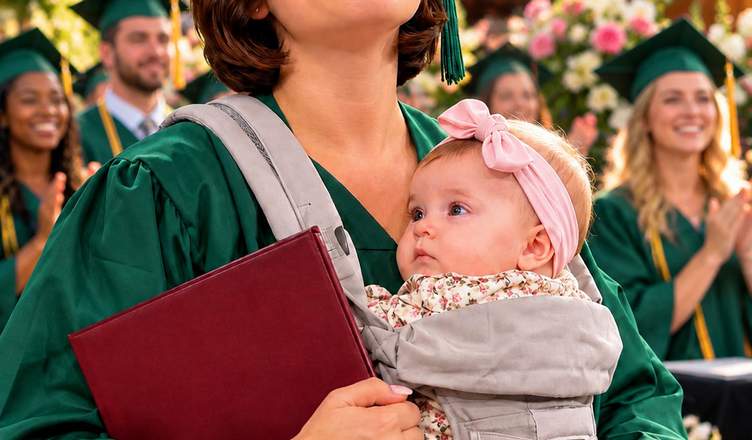
Hundreds of graduates were waiting for their turn, families filled the seats, and the auditorium had been noisy all morning. But as I stepped toward the stage, heads began turning in my direction.
I was wearing the same graduation gown and cap as everyone around me.
There was only one obvious difference.
In my arms, wrapped in a soft white blanket, was my newborn daughter.
She was only a few days old.
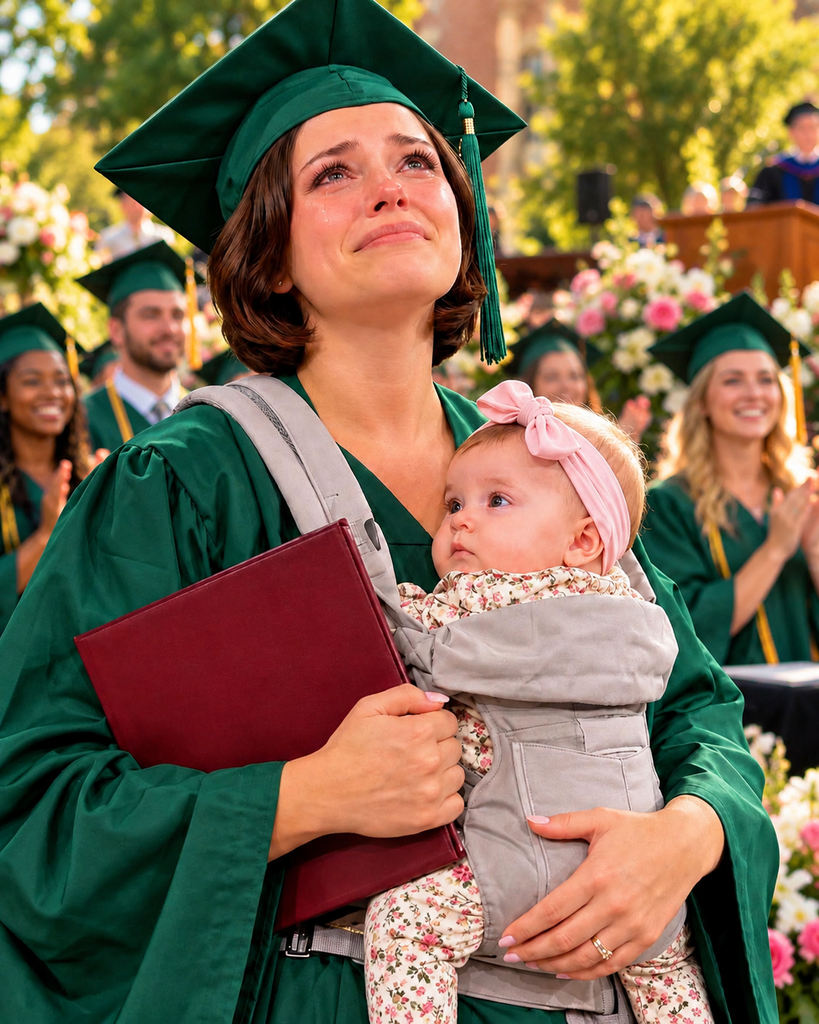
As I carefully climbed the steps toward the stage, I looked down at her sleeping face and felt my throat tighten. I had imagined graduation countless times during the previous four years. In every version, I walked across that stage alone.
Life had written a different ending.
And standing there, exhausted, emotional, and holding my baby against my chest, I realized that the diploma waiting for me represented far more than finishing university.
It represented all the times I had nearly stopped.
Before Everything Changed
When I began university, I was twenty years old and convinced that careful planning could protect me from uncertainty.
I had a schedule for everything.
I knew which courses I needed each semester. I knew when I wanted to graduate. I had started thinking about jobs and internships long before most of my friends considered what they would do after university.
I liked knowing what came next.
During my final year, that confidence disappeared almost overnight.
I discovered I was pregnant.
I remember sitting alone after receiving the confirmation, staring at the calendar on my phone.
My expected delivery date was frighteningly close to graduation.
Suddenly, my carefully organized future looked like a collection of impossible deadlines.
How would I finish my coursework?
What if pregnancy became difficult?
What would happen during final examinations?
Would I need to postpone graduation?
And after the baby arrived, how could I possibly begin the career I had spent years preparing for?
Everyone around me had advice.
Some people told me immediately to take time away from university.
Others insisted that I should continue as though nothing had changed.
Neither answer felt right.
Something enormous had changed.
But I also knew that I did not want fear to make every decision for me.
Two Futures at Once
Pregnancy introduced a strange division into my life.
My classmates discussed interviews, applications, final projects, and graduation parties.
I was thinking about those things too.
But I was also attending medical appointments, researching baby equipment, wondering how much sleep newborns actually allowed their parents, and calculating expenses that had never appeared in my student budget.
In lectures, I took notes while feeling tiny movements beneath my desk.
At home, textbooks gradually began sharing space with baby clothes.
My bedroom looked as though two completely different lives had collided.
There were days when I found that funny.
There were other days when I sat on the floor surrounded by unfinished assignments and wondered whether I had made a terrible mistake by trying to continue.
The hardest part was not always physical.
It was uncertainty.
I could plan an essay deadline.
I could not plan exactly how my body would feel the following week.
Some mornings I woke up determined to finish everything ahead of schedule. By afternoon, exhaustion made reading a single page feel difficult.
I had spent years believing discipline meant forcing yourself forward.
Pregnancy taught me that discipline sometimes meant recognizing when you needed help.
The People Who Made Continuing Possible
Stories about perseverance often focus on one heroic person overcoming everything alone.
My experience was nothing like that.
I continued because people helped me.
My professors worked with me when medical appointments conflicted with classes. Friends shared notes when I missed lectures. My mother appeared with meals without waiting for me to admit I was too tired to cook.
None of them completed my assignments for me.
But they made it possible for me to keep completing them myself.
That distinction became important.
Accepting support did not make the achievement less mine.
Human beings accomplish very little entirely alone.
The closer graduation came, the more determined I became to finish my remaining work before the baby arrived.
I submitted my final major assignment late one evening and stared at the confirmation screen for several seconds.
Then I laughed.
I was still pregnant.
I had made the deadline.
For the first time in months, graduation felt possible again.
Then the Baby Chose Her Own Schedule
Babies, I discovered, have little respect for academic calendars.
My daughter arrived only days before the graduation ceremony.
By the time I held her for the first time, graduation suddenly seemed unimportant.
I was exhausted.
My body hurt.
My sense of time disappeared.
Day and night became feeding, sleeping, waking, changing clothes, and checking repeatedly that this impossibly small person was breathing normally.
Someone mentioned graduation while I was still recovering.
I immediately said I wasn’t going.
Nobody argued with me.
I had already completed the academic requirements. The ceremony was symbolic. My diploma would still exist whether I crossed a stage or stayed home with my daughter.
For a while, the decision felt obvious.
Then the evening before graduation, I saw my cap and gown hanging inside the wardrobe.
I stood looking at them for a long time.
I thought about the previous four years.
The early lectures.
The examinations.
The nights spent writing papers.
The semester when I worked weekends because I needed extra money.
The moment I discovered I was pregnant.
The appointments.
The exhaustion.
The fear that I would not finish.
I realized I wanted to go.
Not because walking across a stage would somehow make my degree more legitimate.
I wanted to see the journey end.
“Then Take Her With You”
There was still one obvious problem.
I had a newborn.
When I explained my hesitation to my mother, she looked at me as though the answer were obvious.
“Then take her with you.”
I laughed.
“To graduation?”
“Why not?”
At first, the idea seemed ridiculous.
Then it began to feel strangely appropriate.
My daughter had already attended months of university with me in a sense. She had been there during lectures, deadlines, and final assignments.
So the following morning, I put on my graduation clothes while she slept nearby.
Nothing about getting ready was glamorous.
I was tired. My gown needed adjusting. I packed more baby supplies than seemed physically possible.
We arrived with the understanding that I could leave immediately if either of us needed to.
That freedom made the decision easier.
The Walk I Had Imagined for Years
When my turn approached, my daughter was asleep.
Someone asked whether I wanted a family member to hold her while I crossed the stage.
I looked down at her.
“No,” I said. “She’s coming.”
Then my name was called.
I stepped forward.
That was when the room seemed to notice.
I heard applause spreading through the audience.
For a few seconds, I felt embarrassed by the attention. Then I saw people smiling.
I walked carefully, concentrating more on holding my daughter securely than on anything else.
When I reached the person presenting the diploma folder, they paused and looked at the baby.
Then they smiled at me.
“Congratulations.”
Two ordinary words.
I nearly cried.
I accepted the folder with one hand while supporting my daughter with the other.
Somewhere in the audience, my family was cheering.
She slept through all of it.
What the Photograph Didn’t Show
A photograph from that moment later became one of my favorites.
It shows a graduate holding a newborn.
It looks triumphant.
But photographs simplify things.
The image does not show the mornings when I was frightened.
It does not show exhaustion.
It does not show the people who helped me.
It does not show the uncertainty of becoming a parent while trying to finish one chapter of my own life.
And it certainly does not prove that everyone in a similar situation should make the same choices I did.
Pregnancy, childbirth, education, finances, health, childcare, and family support differ enormously from person to person. For some students, taking time away from school may be the wisest decision. Others may continue on a different schedule.
There is no universal measure of strength.
Sometimes continuing means refusing to quit.
Sometimes it means changing the plan.
A Diploma and a Beginning
When I returned to my seat, I looked at my daughter again.
She opened her eyes briefly and then went back to sleep.
I had spent months thinking graduation represented the end of something.
Suddenly, it felt more like a bridge.
I was leaving one version of myself behind while becoming someone I had never expected to be so soon.
I was a graduate.
I was also a mother.
Neither identity erased the other.
That realization mattered more to me than the applause.
Life had not followed the schedule I created at twenty. In many ways, it had dismantled that schedule completely.
But a changed plan is not necessarily a ruined one.
Sometimes the future arrives in a form you never imagined.
Mine arrived wrapped in a blanket, sleeping peacefully in my arms while I crossed a graduation stage.
That day I received a diploma I had spent years earning.
But I carried something else away from the ceremony too: the understanding that resilience is not about keeping life exactly as you planned it.
It is about discovering that when the plan changes, you may still be capable of moving forward.
Sometimes you simply cross the finish line differently than you expected.
And sometimes you do it carrying someone new with you.