
Families had claimed the best spots near the water, children were building uneven sandcastles, and groups of friends were arranging umbrellas beneath the bright summer sun.
At 72, Margaret had been coming to the coast for decades. She loved the smell of salt in the air, the feeling of warm sand beneath her feet and the rare freedom of spending an entire day without looking at a clock.
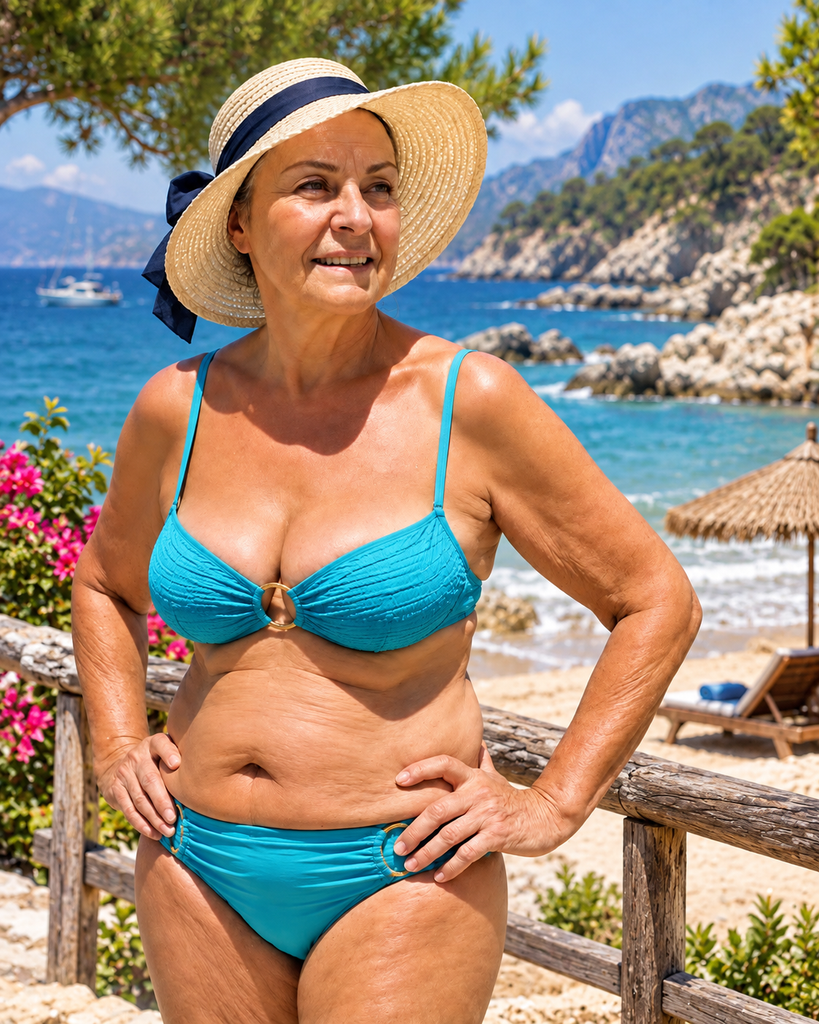
But on this particular morning, something about her attracted attention.
It wasn’t because she was behaving unusually.
She simply walked onto the beach wearing a swimsuit she loved.
It was colorful, fitted and considerably bolder than the clothing some people apparently expected a woman in her seventies to choose.
Most beachgoers paid no attention. A few smiled. Others glanced in her direction for a little longer than necessary.
Then someone made a comment.
Perhaps, the woman suggested, Margaret might feel more comfortable in something “a little more appropriate” for her age.
Margaret looked at her, laughed gently and continued toward the water.
There was no argument.
But the moment raised a much larger question.
At what age are people expected to stop dressing for themselves and start dressing for everyone else’s comfort?
The Unwritten Rules of Aging
Society has many rules that nobody remembers agreeing to.
Children are allowed to experiment.
Teenagers are expected to follow trends.
Young adults can be adventurous.
Then, somewhere along the journey into middle and later life, the rules quietly change.
Colors should supposedly become softer.
Hemlines should become longer.
Swimsuits should cover more.
Hair should become less dramatic.
Clothing should stop attracting attention.
Nobody can identify the exact birthday on which this transformation is supposed to happen.
Yet many people behave as though the deadline exists.
Margaret had heard versions of these ideas before.
She had reached an age when strangers occasionally seemed more concerned about her appearance than she was.
The irony amused her.
She had spent much of her younger life worrying about what other people thought. Now that she cared considerably less, people appeared increasingly eager to offer their opinions.
Confidence Can Arrive Late
When Margaret was 25, she would never have worn the swimsuit she chose at 72.
Not because her body had been less suited to it.
Quite the opposite.
She had been younger, slimmer and far more physically similar to the women featured in fashion advertisements.
But she had also been deeply self-conscious.
She worried about her stomach.
She worried about her legs.
She worried about photographs.
At the beach, she often wrapped a towel around herself immediately after leaving the water.
Looking back, she could hardly understand why.
There had been nothing wrong with her body.
The problem was that she had spent years believing it needed permission to be seen.
Growing older changed that.
Not overnight, and not because she suddenly became fearless.
It happened gradually.
The Body Keeps Changing
Pregnancy changed Margaret’s body.
So did decades of ordinary life.
There were scars that had not existed when she was young. Her skin became softer and less firm. Lines appeared around her eyes and mouth. Her hair changed.
None of this was extraordinary.
It was aging.
Yet the beauty industry often treats these natural changes as problems requiring correction.
Wrinkles need reducing.
Gray hair needs hiding.
Skin needs tightening.
Bodies need reshaping.
The language surrounding aging can make people feel that they are slowly failing at something.
But what exactly is the alternative?
A body that reaches 72 has lived for 72 years.
Expecting it to look 25 is not a reasonable standard.
Margaret eventually stopped treating every sign of age as an enemy.
That did not mean she stopped caring about her appearance.
She still enjoyed clothes. She still liked having her hair done. She still noticed colors that suited her.
The difference was that beauty had stopped meaning youth.
Why Swimsuits Create So Much Judgment
Few pieces of clothing make people feel as exposed as swimwear.
At a beach or swimming pool, bodies normally hidden beneath layers of clothing suddenly become visible.
That can intensify insecurities at almost any age.
For older women, another layer of judgment can appear.
There is often an expectation that aging bodies should become increasingly concealed.
A young woman wearing a bikini may be described as confident.
An older woman wearing the same style may be called brave, inappropriate or attention-seeking.
But the swimsuit has not changed.
Only the age of the person wearing it has.
That contradiction says more about cultural attitudes toward aging than it does about clothing.
“Dress Your Age” — But What Does That Mean?
Margaret had always found the expression confusing.
What exactly does 72 look like?
One 72-year-old might enjoy gardening in practical trousers and an old shirt.
Another may love elegant dresses.
Someone else might spend weekends hiking.
Another might wear leather jackets, large sunglasses and bright lipstick.
They are all the same age.
Age tells us how many years someone has lived. It does not automatically reveal personality, taste, confidence or lifestyle.
The idea that millions of people should suddenly share the same wardrobe because their birth certificates contain similar dates makes little sense.
Fashion Has Never Been Completely Rational
Clothing rules change constantly.
Outfits once considered scandalous become ordinary.
Styles dismissed as outdated return decades later and are suddenly fashionable again.
Jeans moved from workwear into almost every part of daily life. Women’s swimwear transformed dramatically during the twentieth century. Hairstyles, skirt lengths and standards of formality have changed repeatedly.
This history makes one thing clear:
What society calls “appropriate” is rarely permanent.
It is cultural.
And culture evolves.
Social Media Has Made Aging More Visible
For generations, mainstream fashion and entertainment offered a limited picture of older women.
Younger models dominated advertising.
When older women appeared, they were often shown in predictable roles: mothers, grandmothers or consumers of products specifically associated with aging.
Social media has disrupted some of that.
Women in their sixties, seventies and eighties can now share fashion photographs without waiting for a magazine editor to decide whether they belong on the page.
Some build enormous audiences.
Their popularity suggests that many people were waiting to see a broader representation of aging.
But visibility has a cost.
The more publicly someone expresses herself, the more likely she is to encounter strangers who believe they are entitled to judge her.
Confidence Does Not Mean Loving Everything About Yourself
There is another misconception worth challenging.
A confident woman does not necessarily wake every morning delighted with every part of her body.
Margaret certainly didn’t.
There were days when she disliked photographs of herself.
There were clothes she tried on and immediately rejected.
There were physical changes she found difficult to accept.
Confidence meant something different.
It meant those insecurities no longer controlled every decision.
She could think, “My stomach isn’t as flat as it once was,” and still go swimming.
She could notice wrinkles and still enjoy having her photograph taken.
She could acknowledge aging without treating it as humiliation.
That distinction had taken her decades to understand.
The Freedom of Becoming Less Impressed by Strangers
One unexpected benefit of aging was Margaret’s declining interest in random approval.
When she was young, criticism could ruin an entire evening.
By 72, she had accumulated enough experience to put a stranger’s comment into perspective.
She had raised children.
She had buried people she loved.
She had changed careers.
She had cared for relatives.
She had experienced wonderful years and painful ones.
Against that background, someone disliking her swimsuit felt remarkably unimportant.
This may be one reason some older adults become more willing to challenge expectations.
Time can clarify what deserves attention.
Not every opinion does.
There Is No Obligation to Be Bold
Of course, freedom works both ways.
Rejecting age-based clothing rules does not mean every older woman should wear revealing swimwear.
Some people genuinely prefer modest clothing.
Others feel comfortable in full-coverage swimsuits, loose dresses or traditional styles.
Those choices are equally valid.
The point is not that bold clothing is more empowering.
The point is that choice is empowering.
A woman who covers herself because she loves that style is making a personal decision.
A woman who covers herself because she fears strangers will shame her for looking old is experiencing something very different.
Clothes Are Personal, Context Is Practical
There are situations where clothing requirements make sense.
Workplaces may have safety rules.
Religious buildings may request particular forms of dress.
Formal events may have established expectations.
Weather obviously matters.
But “you are too old” is not a practical requirement.
A beach is a place where people swim, relax and spend time outdoors.
A swimsuit serves that purpose regardless of whether the person wearing it is 22 or 72.
What Younger People Can Learn From Older Confidence
Stories about older women confidently wearing unconventional clothing often appeal to younger audiences too.
Perhaps that is because body insecurity does not begin with aging.
Teenagers experience it.
People in their twenties experience it.
New mothers experience it.
Men experience it.
Almost everyone has looked in a mirror and wondered whether other people would approve.
Seeing someone decades older refusing to organize her life around that question can therefore be surprisingly liberating.
The message is not, “You must love your appearance every second.”
It is simpler:
You do not have to postpone living until your body satisfies everyone.
She Walked Into the Water
Margaret did not spend the rest of her morning thinking about the comment.
That was perhaps the most important part.
She did not deliver a speech.
She did not try to convince anyone.
She simply continued toward the sea.
The water was cold at first.
After a few steps, she adjusted.
Then she swam.
Later she returned to her towel, put on her sunglasses and opened the book she had brought with her.
Around her, the beach continued exactly as before.
Children shouted.
Waves broke along the shore.
People came and went.
And the supposedly controversial swimsuit became what it had always been:
A piece of clothing worn by a woman who wanted to spend a summer morning by the sea.
Style Has No Expiration Date
Aging changes many things.
Bodies change.
Priorities change.
Comfort changes.
Sometimes taste changes too.
But age does not automatically erase individuality.
There is no universal wardrobe waiting at 60, 70 or 80.
There is only the person who has reached that age and the decisions she wants to make.
Perhaps that is why Margaret’s quiet response mattered more than an argument would have.
She did not ask permission.
She did not apologize.
She did not attempt to look younger.
She simply refused to accept the idea that getting older required becoming invisible.
At 72, she knew something she had struggled to understand at 22:
Confidence is not having a perfect body.
It is realizing that your body does not need to be perfect before you allow yourself to live in it.