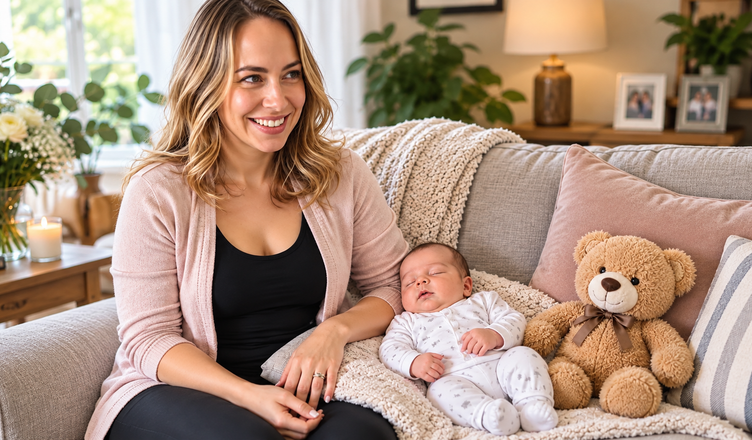
The first time my mother-in-law questioned whether my son belonged to my husband, she disguised it as a joke.
“He certainly didn’t inherit the Harrison nose,” Diane said, smiling across the dinner table.
Our son, Caleb, was four months old.
I ignored her.
Babies change. Children can resemble grandparents, distant relatives, both parents or neither parent in any immediately obvious way. I assumed Diane knew that.
Then came more comments.
Caleb’s eyes were too dark.
His hair was different from my husband’s baby pictures.
His face apparently looked nothing like the men in their family.
Each observation ended with the same little laugh.
Eventually, nobody was laughing.
This is a fictional family story inspired by the original premise. The characters and events are invented, but the central conflict raises a very real question: what happens to a marriage when a demand for certainty becomes an accusation?
For me, the answer began with a DNA test.
It ended with two.
My Husband Stayed Silent Too Long
My husband, Andrew, initially dismissed his mother’s comments.
“She’s being ridiculous.”
“Then tell her to stop.”
“I will.”
But he never really did.
At family gatherings, Diane continued making comparisons. Andrew’s older sister joined in. His father, Frank, usually changed the subject.
I became increasingly uncomfortable.
Then one evening, after Caleb was asleep, Andrew sat beside me and said he wanted to ask something.
I knew before he spoke.
“My mother thinks a DNA test would end all of this.”
I stared at him.
“Your mother?”
He looked away.
“And what do you think?”
“I know he’s my son.”
“That wasn’t my question.”
Andrew rubbed his hands together.
“I just think if we do the test, she can never mention it again.”
That sentence hurt more than Diane’s accusations.
If Andrew truly considered the allegation absurd, there was nothing to prove.
The test was not being requested to establish a medical fact.
It was being requested because my husband’s family had placed my fidelity on trial, and Andrew had decided the easiest solution was for me to provide evidence of my innocence.
I Asked Him One Question
“Have I ever given you a reason to think I cheated?”
“No.”
“Have you ever found messages?”
“No.”
“Caught me lying about where I was?”
“No.”
“Has anyone told you I had an affair?”
“No.”
“Then why am I being asked for proof?”
He had no answer beyond the same argument.
Peace.
He wanted peace in the family.
But what he meant was that he wanted me to absorb the humiliation so everyone else could feel comfortable again.
That was when I agreed.
“Fine,” I said. “We’ll do the test.”
Andrew looked relieved.
Then I added my condition.
“If DNA Is the Standard, Let’s Use It Consistently”
Andrew frowned.
“What condition?”
“If your family believes biological relationships should be verified whenever someone raises a suspicion, we’ll verify another one.”
“What are you talking about?”
“We test whether Caleb is your biological son. And your father tests whether you are his.”
Andrew actually laughed.
Then he realized I was serious.
“That’s insane.”
“Why?”
“Because Dad is obviously my father.”
“And you are obviously Caleb’s father.”
“That’s different.”
“How?”
He became angry.
I remained calm.
I wasn’t accusing Diane of infidelity.
That was the point.
Neither had anyone produced evidence that I had been unfaithful.
If a baseless suspicion was enough to justify testing me, why should the same principle become outrageous when applied to the generation making the accusation?
The Condition Reached His Family
Andrew told Diane.
Her reaction was immediate.
“How dare she?”
I found the outrage revealing.
For weeks, she had treated the possibility that I had deceived my husband as reasonable dinner-table discussion.
The moment the same hypothetical possibility touched her marriage, it became unforgivable.
Frank’s response surprised everyone.
He laughed.
“If this ends the nonsense, I’ll do it.”
Diane stared at him.
“You don’t have to prove anything.”
Frank looked at her.
“Apparently that’s what we’re doing now.”
The room went quiet.
For the first time, I wondered whether my condition had touched something deeper than I intended.
Diane Suddenly Wanted the Testing Stopped
The next morning, Diane called Andrew.
He later told me she had changed her mind.
There was no need for DNA testing, she said.
Families should trust one another.
Genetics were complicated.
Caleb would probably resemble Andrew more as he grew older.
I almost admired the speed of her transformation.
A week earlier, certainty had been essential.
Now trust was sacred.
Andrew asked me whether we could forget the entire thing.
“No.”
He looked surprised.
“You wanted the test.”
“You agreed to it.”
“My mother doesn’t care anymore.”
“I care.”
That was the part he had failed to understand.
The damage was no longer Diane’s suspicion.
The damage was that my husband had participated in it.
The Samples Were Submitted
The process itself was uneventful.
Caleb was tested with Andrew.
Andrew was tested with Frank.
Then we waited.
During those days, the family atmosphere changed completely.
Diane became unusually quiet.
Frank noticed.
So did I.
But I refused to invent an explanation.
Nervousness is not proof of infidelity. People can become anxious for countless reasons, particularly when private family relationships suddenly become the subject of genetic testing.
Andrew, meanwhile, became increasingly embarrassed about what had happened.
One night he said, “I should never have asked you.”
“No,” I replied. “You shouldn’t have.”
“I thought it would make everything easier.”
“For whom?”
He did not answer.
Our Son’s Birthday Arrived
Caleb turned one shortly after the results became available.
We had already planned a small birthday gathering at our house.
I considered canceling it.
Then I decided against turning my son’s birthday into punishment for adults.
The family came.
There was cake.
There were presents.
Caleb was far more interested in wrapping paper than anything inside it.
For almost two hours, nobody mentioned DNA.
The envelopes remained in my desk.
After the cake, Frank finally asked.
“Did the results come?”
The room fell silent.
“Yes.”
I brought them out.
Diane looked as though she wanted to leave.
The First Result Surprised Nobody
I handed Andrew the first report.
The result confirmed that Andrew was Caleb’s biological father.
Nobody spoke.
I looked at Diane.
There was no satisfaction in being proven faithful.
Only exhaustion.
For months, my son’s face had been treated like evidence.
Now a laboratory had confirmed what I had known from the beginning.
Diane whispered, “I’m sorry.”
But there was still another envelope.
Frank reached for it.
Then the Room Changed
Andrew opened the second result.
He read it once.
Then again.
His face lost its color.
Frank noticed immediately.
“What?”
Andrew handed him the report.
The testing indicated that Frank was not Andrew’s biological father.
Nobody moved.
The silence was so complete that I could hear Caleb playing with a plastic truck on the floor.
Diane sat down.
Frank did not shout.
That somehow made the moment worse.
He simply asked, “Did you know?”
Diane began crying.
A Secret Older Than the Marriage We Were Arguing About
What followed did not happen neatly.
There was no dramatic confession that explained everything in a few sentences.
Diane eventually admitted that around the time Andrew was conceived, there had been another man.
She said she had convinced herself for decades that Frank was probably Andrew’s biological father.
Whether she truly believed that throughout those years was something only she could answer.
Frank left the party.
Andrew followed him.
I remained with Caleb.
The birthday decorations suddenly looked absurd against the emotional wreckage in the room.
I had demanded the second test to expose a double standard.
I had not expected it to uncover a family secret.
For the first time, I wondered whether insisting on symmetry had created consequences none of us had been prepared to face.
DNA Can Answer One Question and Create Ten More
Genetic testing can provide powerful information about biological relationships.
But biology and family are not identical concepts.
Frank had raised Andrew.
He had sat beside him through childhood illnesses, taught him to drive, attended his graduation and stood beside him at our wedding.
A DNA result could reveal that they did not share the biological relationship everyone had assumed.
It could not erase those decades.
Andrew struggled with that distinction.
For several weeks, he barely spoke to his mother.
But he continued calling Frank “Dad.”
Frank, despite his anger toward Diane, told Andrew that nothing about their relationship had changed.
“You’re my son,” he said.
That was not a statement about genetics.
It was a statement about thirty-four years of fatherhood.
The Test Did Not Repair My Marriage Either
Some relatives assumed that once Caleb’s paternity was confirmed, my problem with Andrew was over.
It wasn’t.
The laboratory had answered the biological question.
It had not answered the marital one.
Why had Andrew required evidence when I had given him no reason to distrust me?
Why had keeping his mother comfortable mattered more than defending his wife?
Why had he expected me to accept an accusation that he considered insulting when directed at his own family?
We eventually went to counseling.
Andrew apologized without qualification.
Not “I’m sorry, but Mom pressured me.”
Not “I’m sorry you were offended.”
He admitted that he had chosen the easiest path for himself.
Instead of confronting his family, he had asked me to prove something that should never have been in doubt.
That admission mattered more to me than the DNA result.
Diane’s Apology Took Longer
Diane wanted forgiveness quickly.
She did not receive it quickly.
I never prevented her from seeing Caleb, but our relationship changed.
I stopped pretending hurtful remarks were harmless because they came from family.
Eventually, she apologized for questioning my fidelity and for encouraging Andrew to doubt me.
Her own secret made the irony impossible to ignore.
Still, I did not use what happened to humiliate her.
Frank and Diane had their own marriage to deal with.
That was not my victory.
It was their pain.
What the Envelopes Actually Revealed
Two DNA tests entered our family because people wanted certainty.
They got it.
Andrew was Caleb’s biological father.
Frank was not Andrew’s biological father.
But the most important truths were not printed in either report.
A marriage cannot survive indefinitely on demands for proof.
Family pressure does not excuse a spouse from establishing boundaries.
And suspicion applied selectively is not a principle—it is a double standard.
Most importantly, DNA can establish biological connections, but it cannot measure loyalty, sacrifice, trust or parenthood as it is lived over decades.
Caleb’s birthday became a family story none of us would ever forget.
But years later, when I think about those two envelopes, I do not remember feeling triumphant.
I remember how quickly suspicion traveled through three generations.
One accusation was supposed to prove who belonged to whom.
Instead, it forced all of us to ask a much harder question:
What makes someone family after the biology is known?
For us, the answer was not found in a laboratory.
It was found in what each person chose to do after the results arrived.