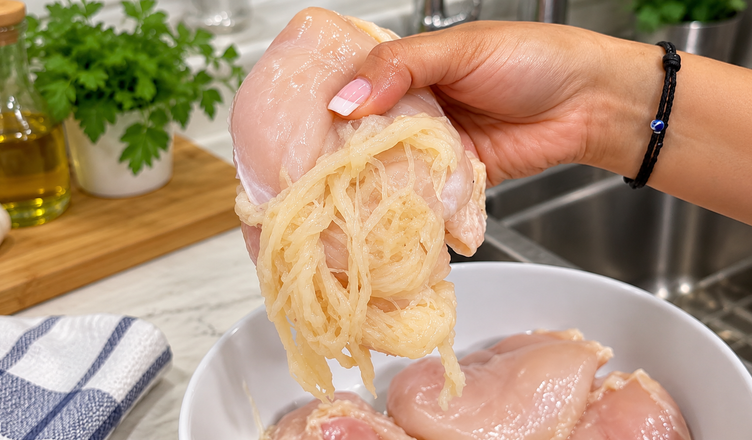
You bring home a package of chicken breasts, open it before dinner and begin preparing the meat as usual. Then something looks wrong.
Instead of remaining firm and compact, the chicken starts separating into long, thin strands. The muscle fibers pull away from one another so easily that the meat almost seems to unravel in your hands.
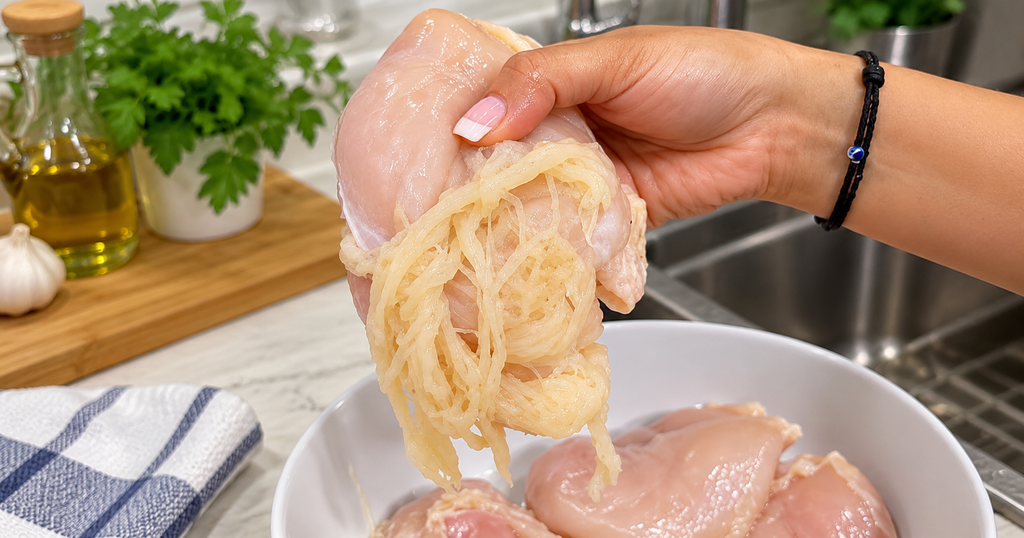
For someone seeing this for the first time, the reaction is understandable: What happened to this chicken, and is it safe to eat?
Images of unusually fibrous chicken have circulated online for years, often accompanied by dramatic explanations. Some posts claim the appearance proves that the meat is artificial, genetically modified, contaminated with parasites or produced in a laboratory.
The reality is generally less sensational.
Chicken breast is muscle tissue, so a fibrous structure is normal. However, modern poultry can also develop recognized muscle abnormalities that make those fibers unusually prominent and alter the meat’s texture and appearance.
Understanding the difference between an unusual quality problem and an actual food-safety warning is important.
Chicken Is Made of Muscle Fibers
The first thing to remember is that chicken breast is not a completely uniform material.
It consists largely of bundles of muscle fibers held together by connective tissue. Normally, those fibers remain organized closely enough that a raw breast looks relatively smooth and solid.
When the structure changes, however, individual fibers or bundles can become much easier to see.
Pull cooked chicken apart and this anatomy becomes obvious. The meat naturally separates along the direction of its muscle fibers.
The unusual cases that attract attention online are different because the separation can be striking even before cooking. Instead of an ordinary smooth breast, the meat may appear loose, stringy or unusually soft.
Several factors can affect texture, so appearance alone cannot identify the cause with certainty.
The Poultry Industry Has Recognized Muscle Abnormalities
Modern broiler chickens have been selectively bred over many generations for traits that include rapid growth and efficient meat production.
That has helped make chicken widely available, but rapid breast-muscle development has also been associated with several recognized meat-quality conditions.
Two frequently discussed examples are known as “white striping” and “woody breast.”
White striping produces visible pale lines running through the breast muscle. Woody breast, as the name suggests, can make portions of the breast unusually firm or hard.
Another condition often discussed alongside them is sometimes called “spaghetti meat” or “spaghetti breast.”
That description is particularly relevant when raw chicken seems to separate into bundles resembling strands.
What Is “Spaghetti Meat”?
The name sounds alarming, but it describes a structural problem in the breast muscle rather than actual spaghetti-like material growing inside the chicken.
In affected meat, the integrity of the muscle structure is reduced. The bundles can separate more readily, creating a loose, stringy appearance.
This can make a chicken breast look as though it is unraveling.
Researchers studying modern broiler muscle disorders have linked such abnormalities with complex biological changes in rapidly developing breast tissue. Scientists continue investigating the precise mechanisms, and it would be inaccurate to reduce every unusual chicken breast to a single cause.
What is clear is that these abnormalities are real phenomena recognized in poultry science.
The strands themselves are not evidence that the chicken has somehow been manufactured from threadlike material.
They are muscle fibers.
Does It Mean the Chicken Is Genetically Modified?
This is a common misunderstanding.
Selective breeding and genetic engineering are not the same process.
Commercial chickens have been bred for desired characteristics through conventional selection. Farmers and breeding programs choose birds with particular traits, and those traits become more common over generations.
That can produce substantial biological changes without inserting foreign genes through genetic-engineering techniques.
Therefore, finding an unusually large or fibrous chicken breast does not demonstrate that the animal was genetically modified.
It may reflect characteristics associated with modern broiler genetics, growth rates, nutrition and muscle development, but that is a different claim.
Is It a Parasite?
Long strands in meat can understandably remind people of worms.
But normal chicken muscle fibers are themselves long structures.
If the breast separates along those fibers, the result may look disturbing without representing parasites.
That does not mean every unusual object found in raw meat should automatically be dismissed.
If you encounter something that appears genuinely foreign, shows independent structure unlike surrounding muscle, or simply cannot be identified confidently, the sensible response is not to guess from an internet photograph.
Do not eat questionable food merely because someone online declares it harmless.
Return it to the retailer or contact the producer when appropriate.
Quality and Safety Are Different Questions
This distinction is essential.
A muscle abnormality can make chicken undesirable without automatically making it microbiologically unsafe.
Conversely, a perfectly normal-looking chicken breast can contain harmful bacteria.
Foodborne pathogens generally cannot be detected reliably by looking at raw poultry.
That is why safe handling and adequate cooking matter even when chicken looks completely ordinary.
The strange fibrous appearance may primarily represent a quality issue—texture, composition and eating experience—while bacterial contamination is a separate food-safety concern.
The two should not be confused.
When Should Chicken Be Discarded?
Appearance is only one part of assessing food.
Spoiled chicken may develop an unpleasant or distinctly abnormal odor, unusual surface characteristics or other obvious changes. But smell and appearance cannot guarantee safety in either direction.
If raw chicken has been stored improperly, left at unsafe temperatures for too long, is well beyond appropriate storage guidance, or has packaging that raises concerns, discarding it can be the safer choice.
When the problem is simply an unfamiliar muscle texture, consumers can also contact the store or manufacturer rather than trying to diagnose it themselves.
Food is not an area where proving bravery has any benefit.
When genuine uncertainty exists, replacing one package of chicken is preferable to taking an unnecessary risk.
Proper Cooking Still Matters
Raw poultry should be handled as though it may contain harmful microorganisms.
That means keeping it separate from foods that will be eaten without further cooking, washing hands and utensils after contact, and preventing raw juices from contaminating kitchen surfaces.
One common mistake deserves particular attention: washing raw chicken under the tap.
Rinsing does not reliably make poultry safer. Instead, splashing water can spread microorganisms from the raw chicken around the sink, countertop and nearby objects.
Cooking is the important control step.
Chicken should reach a safe internal temperature, verified with a food thermometer in the appropriate part of the meat. Following the food-safety guidance issued by public-health authorities in your country is preferable to judging doneness only by color.
Why Are Chicken Breasts So Large Today?
Consumers sometimes notice that supermarket chicken breasts can be considerably larger than they remember from decades ago.
That observation contributes to suspicion when unusual textures appear.
Modern broiler production has indeed changed dramatically through breeding, nutrition and management. Birds have been selected to grow efficiently and produce more meat, including larger breast muscles.
These improvements have economic advantages, but biology has limits.
When muscle develops rapidly, the tissue must still receive sufficient oxygen and nutrients and maintain its structural organization. Researchers have therefore studied how intensive selection for breast yield and growth may be connected with muscle-quality disorders.
That is a more scientifically grounded explanation than claims that stringy chicken is fake meat.
Why Online Explanations Become So Dramatic
Unfamiliar food is particularly effective at generating viral misinformation.
A photograph shows something strange.
Someone provides a frightening explanation.
That explanation is copied repeatedly until speculation begins to look like established fact.
Terms such as “lab-grown,” “mutated,” “parasite-infested” or “chemical-filled” attract more attention than a discussion of muscle structure.
The problem is that visual resemblance is weak evidence.
Something looking like a worm does not make it a worm.
Something looking unnatural does not prove it is artificial.
And a photograph rarely provides enough information to establish food safety.
When possible, explanations should be based on identifiable evidence rather than on the most dramatic interpretation available.
Texture Can Affect the Eating Experience
Even when a muscle abnormality is not itself evidence of dangerous contamination, consumers may reasonably reject affected meat.
Quality matters.
Muscle abnormalities can influence tenderness, water-holding properties, appearance and how meat behaves during cooking.
A customer who purchases an ordinary chicken breast is entitled to expect ordinary quality.
If the meat has a dramatically abnormal texture, photographing it, retaining the package information and contacting the retailer or producer may help identify the product and obtain a replacement or refund.
This also provides manufacturers with information about quality problems entering the supply chain.
What Should You Do If Your Chicken Looks Like This?
If a raw chicken breast begins separating into strange fibers, there is no need to leap immediately to the most frightening conclusion.
First, remember what you are looking at: muscle tissue naturally contains fibers.
Second, recognize that poultry science has documented muscle-quality abnormalities capable of making those fibers unusually visible and loosely connected.
Third, do not use that explanation as an excuse to ignore ordinary food-safety precautions.
If the product smells abnormal, has been stored incorrectly, appears spoiled or contains something you genuinely cannot identify, do not take an unnecessary chance.
And regardless of appearance, handle raw poultry carefully and cook it properly.
The Strange Appearance Has a Less Mysterious Explanation
A chicken breast unraveling into threadlike strands can look deeply unnatural because most consumers rarely see the internal structure of meat so clearly.
But unusual does not automatically mean artificial or dangerous.
In some cases, the appearance may be consistent with a recognized muscle-quality abnormality such as spaghetti meat, in which the breast muscle loses some of its normal structural integrity and separates more easily.
That does not mean every photograph of stringy chicken can be diagnosed from appearance alone.
Nor does it guarantee that a particular package is safe to eat.
The useful lesson is simpler.
Do not let frightening internet claims replace basic food-safety judgment.
Chicken is muscle. Muscle is fibrous. Modern poultry can develop abnormalities that exaggerate that structure.
And when the food in your hands looks so unusual that you are genuinely uncertain about it, you are never obligated to put it on the dinner table simply because someone on the internet says it is probably fine.