Margaret had spent ten years telling people she was perfectly content alone.
Most of the time, she meant it.
Her husband, David, had died after thirty-six years of marriage. The first years without him were the hardest. Eventually, grief stopped occupying every room of her life. She traveled with friends, tended her garden, spent weekends with her grandchildren and learned that living alone did not have to mean being lonely.
She certainly was not searching for another husband.
Then, at sixty-three, she met Henry.
Two years later, she found herself standing outside a bridal boutique, staring through the window at a white dress and feeling something she had not experienced in decades.
Nervousness.
She was sixty-five years old and about to shop for a wedding gown.
She had expected choosing the dress to be emotional.
She had not expected to be laughed at.
Love Was Not Part of the Plan
Margaret met Henry at a community concert.
He was a retired teacher, a widower and the kind of man who could turn an ordinary conversation into something interesting without dominating it.
They became friends first.
Coffee became dinner.
Dinner became weekend trips.
Neither tried to replace the spouses they had lost.
That mattered to Margaret.
Henry never behaved as though her first marriage had to be forgotten for their relationship to be meaningful. He understood that a person could treasure one love without making another less genuine.
When he proposed, Margaret did not answer immediately.
“I’m sixty-five,” she said.
Henry smiled.
“I know.”
“People are going to think we’re ridiculous.”
“Which people?”
She could not answer.
Eventually she laughed.
Then she said yes.
She Almost Bought a Simple Suit
Margaret initially planned to marry in a pale blue suit.
It seemed sensible.
Appropriate.
That word kept appearing in conversations.
Friends asked whether she wanted “something age-appropriate.”
Her daughter Claire finally challenged her.
“If you were forty, what would you wear?”
“A wedding dress.”
“So why are you buying a suit?”
Margaret had no good answer.
The truth was embarrassing.
She wanted a wedding dress.
Not an enormous princess gown or anything designed to make her appear decades younger. She simply wanted the experience of finding a beautiful dress for the day she married Henry.
So Claire made an appointment at a bridal salon.
The Appointment Began Normally
The boutique was elegant and quiet.
Margaret arrived early.
Claire was delayed at work, so Margaret entered alone and explained that her daughter would join her shortly.
A young consultant asked about the wedding.
“Small ceremony,” Margaret said. “About sixty guests.”
“And you’re the mother of the bride?”
Margaret smiled.
“No. I’m the bride.”
The consultant immediately apologized.
But another employee nearby laughed.
Not loudly.
Just enough.
Margaret heard it.
The first consultant began showing her dresses, but Margaret could sense something had changed.
The second employee whispered something.
Both women looked toward her.
Then came another laugh.
“We Usually Recommend Something More Mature”
Margaret tried on the first dress.
It was elegant but too heavy.
The second had sleeves she liked, but the shape felt wrong.
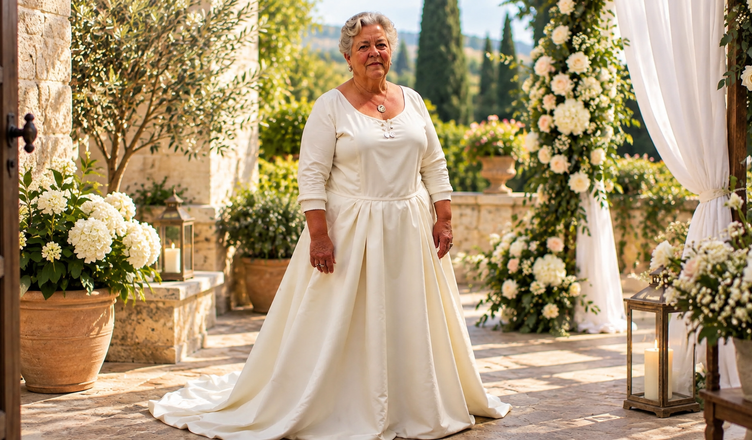
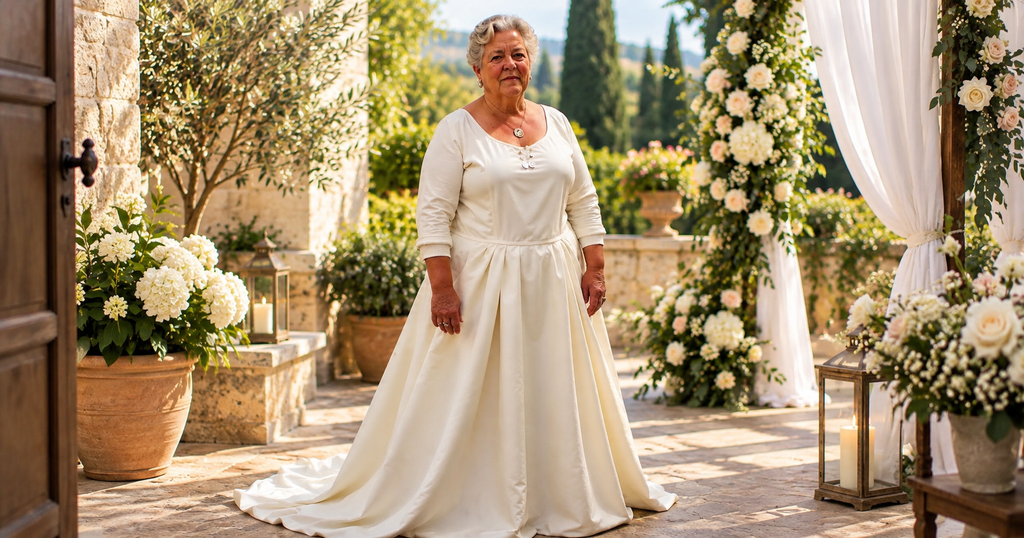
She stepped out wearing the third gown, a simple ivory dress with a fitted waist.
For the first time that afternoon, she smiled at her reflection.
Then she heard one employee say quietly, “That one is definitely ambitious.”
The other laughed.
Margaret turned.
“Excuse me?”
The woman immediately changed expression.
“Oh, nothing.”
“What did you mean?”
The consultant hesitated.
“We just have some styles that might be more flattering for a mature bride.”
There was that word again.
Mature.
Margaret looked at herself in the mirror.
Seconds earlier, she had seen a woman excited about getting married.
Now she saw every line around her eyes.
Her arms.
Her neck.
Her age.
She Went Back Into the Fitting Room
Margaret closed the curtain.
She felt foolish for being upset.
They were strangers.
Why should their opinions matter?
But humiliation does not always obey logic.
She suddenly imagined herself walking down the aisle while guests silently wondered why a woman her age was pretending to be a young bride.
Maybe the blue suit had been the better idea.
Maybe weddings belonged to people beginning life rather than people already carrying decades behind them.
She started removing the dress.
Then she heard Claire’s voice outside.
“Mom?”
Margaret opened the curtain.
Claire took one look at her face.
“What happened?”
“Nothing.”
“Mom.”
Before Margaret could answer, one of the consultants approached.
“We were just helping your mother find something more suitable.”
Claire looked at the woman.
“Suitable for what?”
Then Someone Tapped the Consultant on the Shoulder
The consultant turned.
Standing behind her was an older woman in a dark jacket.
Margaret had noticed her earlier near the back of the boutique but assumed she was another customer.
She was not.
Her name was Evelyn, and she owned the shop.
“What exactly are we trying to make suitable?” Evelyn asked.
The consultant went pale.
“I only meant that certain silhouettes—”
“For her wedding?”
“Yes.”
“And who is getting married?”
The consultant said nothing.
Evelyn pointed gently toward Margaret.
“She is.”
The boutique became extraordinarily quiet.
Then Evelyn looked at Margaret.
“Do you like the dress?”
Margaret hesitated.
“I did.”
“Before someone told you not to?”
Margaret nodded.
The Owner Did Not Create a Scene
Evelyn did not shout.
She did not fire anyone in front of customers.
Instead, she asked the two employees to step into her office.
Then she introduced herself properly to Margaret and Claire.
“I’m sorry,” she said. “You came here to choose a wedding dress, not to defend your age.”
Margaret tried to dismiss the incident.
“It’s all right.”
“No,” Evelyn replied. “It isn’t.”
That response surprised Margaret.
She had spent much of her life smoothing uncomfortable situations for other people.
She knew the instinct well.
Someone embarrassed you, and somehow you ended up reassuring them.
This time, she stopped.
“You’re right,” she said. “It wasn’t.”
The Dress Looked Different After That
Evelyn brought several gowns herself.
She did not begin with Margaret’s age.
She asked about the ceremony.
The venue.
The season.
What fabrics Margaret liked.
Whether she wanted sleeves.
Whether she planned to dance.
Most importantly, she asked how Margaret wanted to feel.
“Like myself,” Margaret said.
They eventually returned to the ivory gown.
Margaret put it on again.
The dress had not changed.
Her body had not changed.
Only the meaning surrounding the reflection had.
Claire began crying.
“Please don’t,” Margaret said.
“I can’t help it.”
“You’ll ruin your makeup.”
“I’m not the one getting married.”
“Good point.”
They both laughed.
Henry’s Reaction Answered the Only Question That Mattered
Margaret did not show Henry the dress before the wedding.
Several months later, when she entered the ceremony room, she saw his face change.
He looked delighted.
Not surprised that a sixty-five-year-old woman could look beautiful.
Not impressed that she looked younger than her age.
Simply delighted to see the woman he loved walking toward him.
That distinction mattered.
Margaret did not need to become younger to deserve romance.
Henry did not need to pretend they were beginning adulthood.
They were beginning something new precisely as the people they had already become.
Both carried histories.
Both had known grief.
Both had loved before.
Neither considered that a reason to refuse happiness now.
Why Do We Treat Weddings as a Young Person’s Privilege?
The fictional incident in Margaret’s story points to a broader cultural habit.
Marriage is often presented visually as the beginning of adult life.
Young couple.
First home.
Children.
Decades ahead.
But real lives do not always follow that sequence.
People divorce.
Partners die.
Relationships end.
New ones begin.
Some people marry for the first time later in life. Others remarry after loss or separation.
There is no age at which companionship becomes automatically inappropriate.
Yet older brides can encounter strange assumptions.
Should she wear white?
Should she have a large ceremony?
Should she call herself a bride?
Should she wear a traditional gown?
Most of those questions have no universal answer.
If two adults are choosing to marry, the celebration belongs to them.
Aging Does Not Cancel the Desire to Be Celebrated
One of the most damaging stereotypes about aging is that older people should gradually stop wanting things associated with younger adulthood.
Romance.
Fashion.
Adventure.
Attention.
Celebration.
But reaching sixty-five does not erase emotional needs.
Older adults can experience love with the same complexity as anyone else.
The relationship may be informed by different circumstances—adult children, retirement, health concerns, financial planning or memories of previous partners—but different does not mean less meaningful.
Margaret was not trying to become a twenty-five-year-old bride.
She wanted to be a sixty-five-year-old bride.
There is a significant difference.
A Photograph on Her Mantel
After the wedding, Margaret framed one photograph.
She and Henry are standing outside the venue.
Her hair is silver.
The lines around her eyes are visible.
So are Henry’s.
Neither looks young.
Both look happy.
Months later, Claire asked whether Margaret ever thought about what happened in the bridal shop.
“Sometimes.”
“Does it still bother you?”
Margaret considered the question.
“Not really.”
Then she looked at the photograph.
“I think what bothered me was that, for a few minutes, I believed them.”
That was the part she remembered most.
Not the laughter.
Not the apology.
The moment she allowed someone else’s idea of aging to make her ashamed of something joyful.
At sixty-five, Margaret had already lived through marriage, motherhood, loss and ten years of rebuilding a life alone.
She knew that time was precious precisely because she had experienced how suddenly it could change.
So when love unexpectedly returned, she eventually understood there was no reason to make herself smaller to accommodate strangers.
She wore the wedding dress.
She walked toward Henry.
And she stopped asking whether she was too old for a new beginning.
The more useful question was whether she was still alive enough to want one.
The answer was yes.