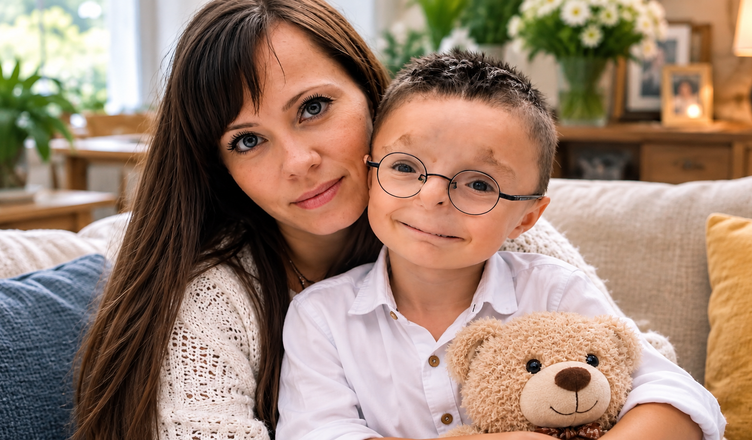
By the time Daniel was nine, he had learned not to get excited when adults came to meet him.
Excitement made disappointment harder.
Prospective adoptive parents would visit the children’s home, speak with staff and spend time with several children. Sometimes Daniel was included. He would answer questions politely, show them the books he liked and try not to talk too much.
Then they would leave.
A few weeks later, another child would pack a suitcase.
Daniel would remain.
This fictional story is inspired by the theme of the original premise rather than presented as a documented adoption case. Adoption systems differ widely between countries, and real children in care have individual histories that should never be reduced to sentimental stereotypes.
Daniel’s story begins with something painfully simple: people kept seeing his difficulties before they saw him.
Then a woman named Rebecca arrived.
The Boy Nobody Knew How to Read
Daniel was not the child who ran toward visitors.
He stayed near the edge of the room.
He disliked unexpected physical contact and became anxious when plans changed without warning. When overwhelmed, he sometimes stopped speaking altogether.
Adults often interpreted his behavior as rejection.
“He doesn’t seem interested in connecting.”
“He barely looked at us.”
“He’s very withdrawn.”
The descriptions were not entirely false.
They were simply incomplete.
Daniel had spent years experiencing instability. He had learned that adults could make promises and disappear. Remaining emotionally cautious was not proof that he did not want affection.
It was a way of protecting himself from losing it again.
Rebecca Was Not Looking for a Perfect Child
Rebecca was forty-three and single when she began exploring adoption.
She worked as a librarian and lived in a small house with an untidy garden and a spare bedroom she had been using for storage.
People occasionally asked why she wanted to adopt alone.
Her answer was practical.
She wanted to become a parent, understood that adoption involved responsibility rather than rescue, and believed she had enough stability and support to offer a child a home.
She completed the required assessments and preparation.
During that process, she heard repeatedly that older children could face greater difficulty finding permanent families.
Many prospective parents hoped to adopt infants or very young children.
Rebecca did not rule out an older child.
That decision eventually brought Daniel’s profile to her attention.
Their First Meeting Was Almost Silent
Rebecca expected nothing dramatic from their introduction.
That turned out to be useful.
Daniel sat across from her with a puzzle.
“Do you like puzzles?” she asked.
He shrugged.
She did not push.
After several minutes, Rebecca picked up a book from a nearby shelf and began reading quietly.
Daniel continued working.
Eventually, he looked at the book.
“I’ve read that.”
“Is it good?”
“The ending is stupid.”
Rebecca smiled.
“Then you just saved me some time.”
Daniel almost smiled too.
That was their first conversation.
No instant embrace.
No magical recognition.
No declaration that they belonged together.
Just two people sharing a room long enough for one of them to feel slightly less uncomfortable.
What Rebecca Noticed
Over several meetings, Rebecca began seeing details that were easy to miss.
Daniel remembered tiny pieces of information people mentioned weeks earlier.
He was extraordinarily gentle with animals.
He liked drawing buildings and could spend an hour adding windows, staircases and imaginary rooms.
He became distressed by uncertainty but relaxed considerably when he knew exactly what would happen next.
Instead of asking, “Why is he difficult?” Rebecca began asking, “What makes him feel safe?”
That difference shaped everything that followed.
It did not mean ignoring challenging behavior.
It meant trying to understand what the behavior communicated.
Children who have experienced instability may develop coping strategies that once helped them survive but become difficult in a safer environment. Trust cannot simply be demanded because an adult now has good intentions.
It has to be demonstrated repeatedly.
Moving Home Was Not a Fairy-Tale Ending
When Daniel eventually moved into Rebecca’s house, both were excited.
Both were also frightened.
The first weeks were harder than Rebecca had imagined.
Daniel hid food in his bedroom.
He asked repeatedly whether he would have to leave if he broke something.
He kept most of his belongings packed.
At night, he sometimes slept in his clothes.
Rebecca initially wanted to reassure him constantly.
“This is your home now.”
“You’re safe.”
“I’m not going anywhere.”
But she learned that words alone had limited power.
Daniel had heard promises before.
So she focused on consistency.
Breakfast appeared every morning.
School pickup happened when she said it would.
If plans changed, she told him beforehand whenever possible.
Rules remained predictable.
Consequences did not include threats of abandonment.
Gradually, Daniel unpacked.
The Broken Lamp
Their most important moment came because of a lamp.
Daniel knocked it from a table while running through the living room.
It shattered.
Rebecca heard the crash and hurried downstairs.
Daniel stood frozen beside the pieces.
His face had gone pale.
“I’m sorry,” he said.
“It’s okay. Don’t move—you could cut your feet.”
“I didn’t mean to.”
“I know.”
“I can pay for it.”
Rebecca looked at him.
“With what money?”
He did not laugh.
Instead, he whispered, “Are you going to send me back?”
Rebecca understood then that the broken lamp was not a lamp to Daniel.
It was a test.
Perhaps every mistake was.
She put on shoes, swept up the glass and asked him to help find the dustpan.
Later, they bought another lamp together.
Nothing dramatic happened.
That was exactly why the moment mattered.
Daniel had made a mistake, and his life had not collapsed.
Love Was Built in Ordinary Days
Months became years.
Daniel stopped hiding food.
His suitcase disappeared into the attic.
He began leaving drawings on the refrigerator.
At thirteen, he became fascinated by architecture.
At fifteen, he spent weekends sketching old buildings around town.
Rebecca never claimed credit for his abilities.
She had not created his curiosity or intelligence.
Those things had already belonged to him.
What she could provide was the stability in which they had room to develop.
That distinction matters in stories about adoption.
Adoptive parents are sometimes portrayed as heroes who “save” unwanted children.
Real family relationships are more complicated.
Children are not projects.
They bring histories, personalities, strengths, grief and relationships that existed before adoption.
A permanent family does not erase the past.
Ideally, it creates enough safety for a child to build a future alongside it.
At Seventeen, Daniel Asked About His File
Rebecca had always spoken honestly about adoption in age-appropriate ways.
As Daniel grew older, he wanted to understand more about his early childhood.
The records contained painful information.
Some questions had answers.
Others did not.
Rebecca sat beside him while he read.
She resisted the temptation to explain away everything that hurt.
There are losses that cannot be repaired by a reassuring sentence.
Eventually Daniel said, “Why didn’t anybody want me?”
Rebecca answered carefully.
“Adults made decisions about what they thought they could handle. That isn’t the same as there being something wrong with you.”
Daniel stared at the papers.
For years, he had interpreted every failed placement as a judgment of his worth.
Understanding that distinction did not instantly erase the wound.
But it gave him another way to understand it.
Years Later, the Story Changed Again
Daniel eventually studied architecture.
He was particularly interested in public spaces—schools, libraries and community buildings.
During university, one assignment asked students to design a residential environment for children who could not live with their birth families.
For Daniel, the project became personal.
He remembered institutional corridors.
Waiting rooms.
Temporary bedrooms.
The strange feeling of living somewhere while knowing it might never become home.
His design focused on smaller shared spaces, private storage, natural light and bedrooms that did not feel temporary.
When Rebecca saw the drawings, she recognized something.
Daniel had been drawing houses since childhood.
Back then, almost every page had contained enormous doors.
Now the buildings looked different.
They had windows everywhere.
“You Saw Something Nobody Else Did”
Years after leaving home, Daniel returned for Rebecca’s birthday.
They sat in the same living room where the lamp had broken long ago.
The replacement was still there.
Daniel looked at it and laughed.
“I can’t believe you kept that thing.”
“It works.”
“It’s ugly.”
“You chose it.”
“I was nine.”
“You had questionable taste.”
Then Daniel became serious.
“You know what people always say about you?”
Rebecca waited.
“They say you saw something in me that nobody else saw.”
She looked at him.
“I don’t think that’s true.”
Daniel frowned.
“You didn’t?”
“No. I think plenty of people saw you. They were just frightened by what they didn’t understand.”
He was quiet.
Rebecca continued.
“I didn’t discover some secret wonderful child hidden underneath. You were already you. I just had time to get to know you.”
For Daniel, that answer meant more than being told he had been rescued.
The Part Adoption Stories Often Leave Out
Stories like Daniel’s are frequently compressed into a satisfying formula.
Nobody wanted the child.
A kind person arrived.
Love solved everything.
Real attachment rarely works that neatly.
Love matters enormously, but children who have experienced loss or instability may also need time, specialist support, predictable routines and adults willing to understand behavior in context.
Adoption itself does not erase trauma.
Nor does every adoption have the same outcome.
The purpose of a permanent family is not to manufacture a perfect inspirational ending. It is to provide belonging, care and responsibility over time.
Rebecca could not change Daniel’s first nine years.
She could be present for the years that followed.
That turned out to be enough to change both of their lives.
What Everyone Had Overlooked
Daniel was never unwanted because he lacked value.
He was a quiet, frightened child whose defenses made connection difficult.
Rebecca’s contribution was not extraordinary insight.
It was patience.
She stayed long enough to learn that silence did not mean indifference.
She understood that fear could look like stubbornness.
She learned that trust arrived through hundreds of ordinary promises kept.
And Daniel eventually learned something equally important.
Being chosen was not something he had to repay by becoming perfect.
Years earlier, he had kept his suitcase packed because he expected every home to be temporary.
As an adult, he designed buildings intended to make vulnerable people feel that they belonged.
Perhaps that was the unexpected direction his story took.
The child who once waited for someone to offer him a permanent place eventually devoted part of his own life to thinking about what makes a place feel like home.
And the answer was never simply walls, furniture or a name on a bedroom door.
Home was the place where a broken lamp remained just a broken lamp—and nobody had to wonder whether a mistake meant they would be sent away.