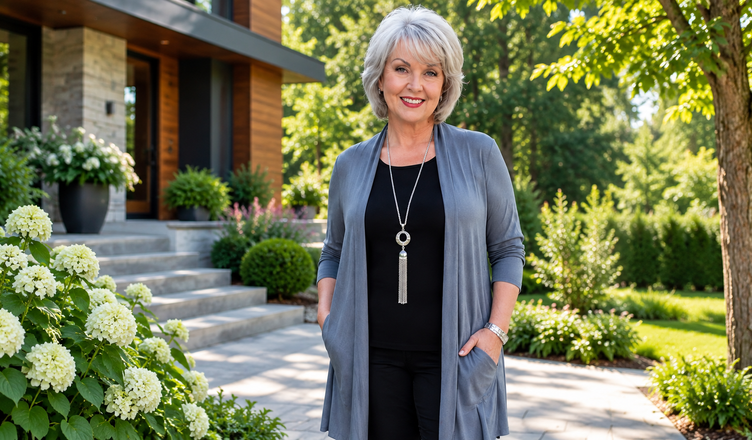
My sixtieth birthday was supposed to feel like a celebration. Instead, when the last guest left and the apartment became quiet, I sat alone at the kitchen table wondering whether the most exciting part of my life was already behind me.
My marriage had ended years earlier. My daughter had her own family, my career was winding down, and I had built a comfortable life that looked perfectly respectable from the outside.
But I missed having someone beside me.
Then I met Adrian.
He was 45, charming without appearing arrogant, attentive without being overwhelming. We met at a small charity event through mutual acquaintances. I expected a polite conversation and nothing more.
Instead, we talked for almost two hours.
When he asked for my number, I laughed.
“You realize I’m fifteen years older than you?”
“I can count,” he replied.
For the first time in years, I went home smiling.
He Made Me Feel Visible Again
Our relationship developed quickly.
Adrian sent messages in the morning and called in the evening. He remembered small details. If I mentioned liking a particular tea, it appeared in my kitchen the next time he visited. When I complained that a cabinet door would not close properly, he arrived with tools.
The age difference bothered me more than it bothered him.
I worried about what people would think.
My daughter, Claire, was especially cautious.
“I’m not saying he’s using you,” she told me. “I’m saying you’ve known him for three months.”
I became defensive.
“If he were sixty and I were forty-five, would everyone be this suspicious?”
She admitted they probably would not.
That seemed to settle the argument for me.
Perhaps I wanted it settled.
Then He Moved In
Six months after we met, Adrian’s landlord announced that the apartment he rented was being sold.
I offered him my spare room temporarily.
He hesitated just long enough to make the decision feel like mine.
Within weeks, his shirts occupied half my wardrobe and his coffee mug sat beside mine every morning.
At first, I loved it.
The apartment no longer felt empty.
We cooked together, watched films and argued playfully about music. I began imagining a future I had stopped believing was possible.
Then something changed.
Adrian became unusually interested in my finances.
Not directly.
Never enough to make one question seem alarming.
He asked whether I owned the apartment outright.
Later, he wondered if I had made a will.
Another evening, he asked what would happen to the property if something happened to me.
I laughed.
“Are you planning my funeral?”
He kissed my forehead.
“I’m planning our future.”
At the time, I found the answer romantic.
Later, I remembered every word.
A Folder That Wasn’t Mine
The discovery happened because my printer stopped working.
Adrian had connected his laptop to it a few days earlier, so I opened the computer to check the printer settings. He had never forbidden me from using it.
A document was already open.
I would have closed it immediately if I had not seen my name.
It was a draft letter addressed to a financial adviser.
The first paragraph discussed “long-term housing security.”
The second discussed me.
Adrian wanted information about whether being added to the title of my apartment would give him a claim to the property.
I felt cold.
Then I noticed another folder.
Inside were notes about my apartment’s estimated value, my retirement savings and several questions concerning inheritance.
One line was impossible to misunderstand:
“Best option if relationship ends after title transfer?”
I read it three times.
The man sleeping beside me had apparently been calculating what he could leave with.
I Wanted an Explanation
When Adrian came home, I did not scream.
I placed the laptop on the table.
His face changed immediately.
“That isn’t what you think.”
“Then tell me what it is.”
He said he had been trying to understand his position because he had moved into a home that legally belonged entirely to me. He claimed he wanted security.
That explanation might have made sense if the notes had concerned rent, household expenses or what would happen if I asked him to leave.
They did not.
They concerned ownership.
Inheritance.
My savings.
The financial consequences of our relationship ending.
“Were you going to ask me to put your name on the apartment?”
He was silent.
That was my answer.
The Truth Was More Complicated Than a Simple Scam
Eventually, Adrian admitted that he had serious financial problems.
He had debts he had minimized when we met. A previous business venture had failed. He had been moving between rentals while trying to rebuild his finances.
He insisted that his feelings for me were genuine.
Perhaps they were.
That was the most painful possibility.
It would have been easier if everything had been fake.
People like simple categories: love or manipulation, victim or villain, truth or lie.
Real relationships can be messier.
A person can feel affection and still behave selfishly.
Someone can love the comfort, security and lifestyle another person provides while also believing that emotional attachment makes the arrangement acceptable.
But genuine affection does not erase deception.
Adrian had hidden information that would have mattered enormously to my decisions.
And he had researched how to obtain a legal interest in my largest asset without discussing it honestly with me.
Whatever he called that, I knew what it meant for our relationship.
I could no longer trust him.
He Asked for Another Chance
Adrian spent that night in the spare room.
The next morning, he apologized.
He offered to show me everything: his debts, bank statements and financial history.
“I was embarrassed,” he said. “I didn’t want you to think I was a failure.”
“You weren’t researching how to pay your debts,” I replied. “You were researching my property.”
He had no convincing response.
He asked whether we could attend counseling.
For a moment, I almost agreed.
Then I imagined myself spending the next five years wondering whether every affectionate gesture had another purpose behind it.
I realized that staying would not restore trust.
It would merely turn me into an investigator inside my own relationship.
I asked him to move out.
Protecting Yourself Is Not the Same as Refusing Love
The experience taught me something I wish I had understood earlier.
Romance and financial caution are not enemies.
People entering relationships later in life may bring decades of accumulated assets, retirement accounts, property, debts, children from previous relationships and existing estate plans.
That makes financial transparency especially important.
A partner who genuinely respects you should be able to discuss money without pressuring you into transferring assets or proving your love through financial sacrifice.
Large financial decisions should never be made simply because saying no feels unromantic.
Independent professional advice can also be valuable before changing property ownership, signing guarantees, combining substantial assets or revising estate documents.
Love may be emotional.
Legal ownership is not.
I Also Had to Admit My Own Mistake
For several weeks after Adrian left, I was furious with him.
Eventually, I became angry with myself.
I had noticed warning signs.
I had simply explained them away.
Not because I was foolish.
Because I desperately wanted the relationship to work.
When my daughter expressed concern, I interpreted it as judgment about our age difference.
Sometimes it was.
But that allowed me to dismiss the parts of her concern that were reasonable.
I had turned skepticism into an enemy because I was afraid it would destroy something that made me happy.
The irony was that caution might have protected that happiness—or revealed much earlier that it had weak foundations.
The Question Everyone Asked
Friends wanted to know whether Adrian had ever loved me.
I stopped trying to answer.
Maybe he did.
Maybe he loved me and the security I represented.
Maybe, over time, he convinced himself there was no meaningful difference.
Only Adrian could know that completely.
What I knew was enough.
Love that requires deception is not the kind of love I want.
Starting Again at Sixty
The breakup hurt more than I expected.
But something surprising happened after the worst of it passed.
I did not return to the woman who had sat alone after her sixtieth birthday believing romance was over.
Adrian had been wrong for me, but meeting him had proved one thing I had forgotten:
I was still capable of falling in love.
That mattered.
I began seeing friends more often. I traveled alone for the first time in years. I stopped treating my age as a closing argument against new experiences.
And I made myself one promise.
If another relationship entered my life, I would not approach it with suspicion.
But I would bring my judgment with me.
There is a difference.
Being open to love does not require handing someone the keys to everything you have built.
Trust can grow gradually.
Financial transparency can exist alongside romance.
Boundaries are not evidence that love has failed.
Sometimes they are evidence that you have finally learned how to protect yourself without closing your heart.
At sixty, I thought the greatest surprise was that a younger man could fall in love with me.
I was wrong.
The real surprise was discovering that I no longer needed anyone else’s attention to prove that my life was still valuable.
I had already built a home, raised a family, survived a divorce and created a life of my own.
The next person who entered it would be welcome to share that life.
But he would not be allowed to quietly take ownership of it.