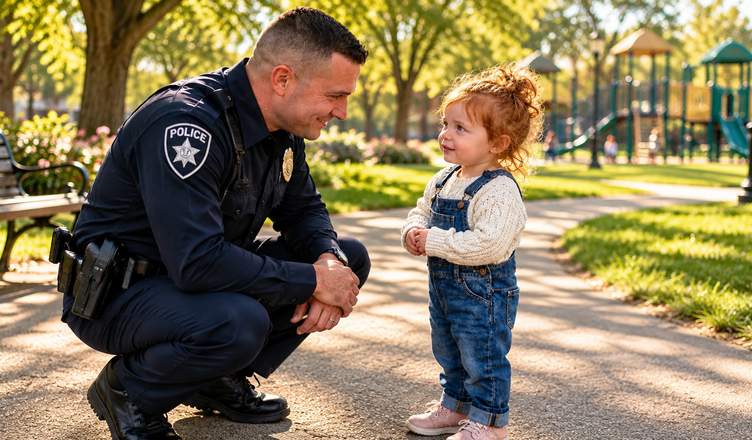
Officer Michael Harris had heard plenty of unusual confessions during his years in law enforcement.
He had never expected one from a two-year-old.
It happened on a quiet Tuesday afternoon when a young mother entered the police station holding the hand of a little girl named Sophie. The child’s cheeks were wet with tears. She clutched a small stuffed rabbit against her chest and refused to look at anyone.
Her mother approached the front desk.
“My daughter says she needs to speak to a police officer.”
Michael initially assumed it was a game.
Then Sophie looked up at him with genuine fear.
“Are you going to put me in jail?”
The room went quiet.
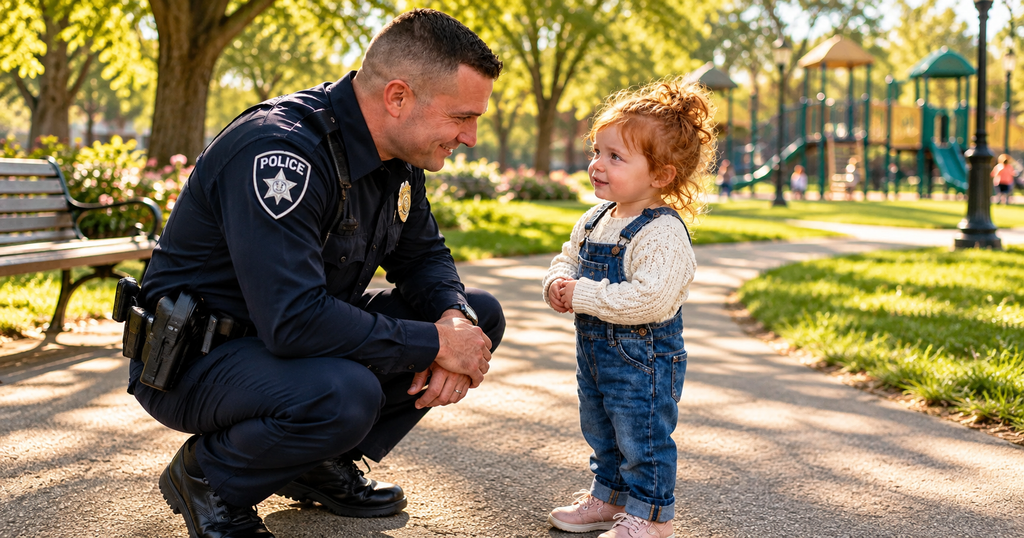
Michael crouched so they were at the same height.
“What happened?”
Sophie squeezed the rabbit tighter.
“I did something bad.”
The Mystery Had Started That Morning
Sophie’s mother, Laura, explained that her daughter had been behaving strangely since breakfast.
Usually energetic and talkative, Sophie had become unusually quiet. She followed Laura from room to room and repeatedly asked whether police officers knew when someone had done something wrong.
At first, Laura thought little of it.
Then Sophie asked what jail was.
“Why do you want to know?”
The little girl refused to answer.
Half an hour later, she began crying.
“I have to tell the police.”
Laura tried to reassure her, but Sophie became increasingly upset.
Eventually, Laura decided that taking her to the station might be the simplest way to discover what had frightened her so badly.
Now, surrounded by uniformed officers, Sophie seemed to regret that decision.
Michael Changed His Approach
Michael understood that asking a toddler direct questions would probably make matters worse.
So he stopped acting like a police officer.
He asked the stuffed rabbit’s name.
“Mr. Buttons,” Sophie whispered.
“Has Mr. Buttons ever been to a police station?”
She shook her head.
“Neither had I when I was his age.”
That earned the smallest smile.
Michael found a chair and sat nearby rather than standing over her.
“No one is angry,” he said. “You can tell your mom whenever you’re ready.”
Sophie looked at Laura.
Then at Michael.
Finally, she whispered:
“I stole something.”
Laura blinked.
“What did you steal?”
Sophie reached into the pocket of her little jacket.
The Evidence
Her hand emerged closed around something.
She slowly opened her fingers.
In her palm was a tiny plastic dinosaur.
Laura stared at it.
Then she recognized it.
Earlier that morning, they had visited a small toy shop while buying a birthday present for Sophie’s cousin.
Sophie had spent several minutes looking at a display of inexpensive miniature dinosaurs near the checkout.
Laura had told her they were not buying one.
Apparently, while Laura was paying, Sophie had put a green dinosaur into her pocket.
Nobody noticed.
Not until they returned home.
“I took him,” Sophie said.
Michael looked at the toy.
“This is what you wanted to tell us?”
Her lower lip trembled.
“I’m bad.”
That changed the mood completely.
Why a Tiny Toy Had Become a Terrifying Secret
For an adult, the situation was simple.
A toddler had taken a cheap toy without fully understanding ownership or consequences.
For Sophie, however, the event had become enormous.
Laura had recently been teaching her that taking something belonging to another person was wrong.
Around the same time, Sophie had overheard an older child talking about thieves being arrested.
Her developing mind had connected the two ideas.
She had taken something.
People who steal things are thieves.
Police arrest thieves.
Therefore, the police were coming for her.
Children often reason by applying simple rules literally. They do not yet understand the layers adults add: intention, age, responsibility, context and proportion.
Sophie had broken a rule.
In her mind, that meant she belonged in jail.
The Officer Had a Choice
Michael could have laughed.
Several adults in the room were certainly struggling not to smile at the sight of the tiny dinosaur.
But laughing at Sophie would have taught the wrong lesson.
Her fear was real even if the danger was not.
Instead, he asked:
“Do you think the dinosaur belongs to you?”
“No.”
“Where does it belong?”
“The store.”
“What could we do about that?”
Sophie thought for a moment.
“Give him back?”
“That sounds like a very good idea.”
She looked surprised.
“You’re not taking me to jail?”
“No.”
“Really?”
“Really.”
The relief on her face transformed the room.
Returning to the Store
Laura could easily have returned the dinosaur herself.
Instead, she decided Sophie should participate.
They drove back to the toy shop.
Michael did not accompany them; there was no need to turn a small parenting moment into an official police matter.
Laura simply told Sophie that when we make a mistake, we try to correct it.
Inside the store, Sophie hid behind her mother at first.
The owner, a woman named Janet, listened as Laura explained what had happened.
Then Sophie placed the dinosaur on the counter.
“I took him,” she said.
“I’m sorry.”
Janet accepted the apology without making the child feel worse.
“Thank you for bringing him back.”
That should have been the end of it.
But Janet did something else.
She handed Sophie a small paper bag.
Inside was a sheet of dinosaur stickers.
“These aren’t because you took the toy,” Janet explained to Laura. “They’re because you came back and told the truth.”
Laura hesitated before accepting them.
She wanted Sophie to understand an important distinction: honesty could be encouraged without turning wrongdoing into something that earned a reward.
So on the drive home, they talked.
The Difference Between Guilt and Responsibility
Sophie’s tiny crisis contained a lesson that remains important long after childhood.
Guilt says, “I did something wrong.”
Shame often turns that into, “I am something wrong.”
The distinction matters.
A child who believes she is fundamentally “bad” may become more frightened of admitting future mistakes.
A child who learns that actions have consequences but can sometimes be repaired develops a healthier understanding of responsibility.
Laura did not tell Sophie that taking the dinosaur was acceptable.
It was not.
But she also refused to let one impulsive act define her daughter.
“You made a bad choice,” she explained. “Then you made a better choice by telling me.”
Sophie seemed to understand at least part of it.
At two years old, that was enough.
Why Children Take Things
Very young children do not understand property in the same way adults do.
They can recognize that an object belongs to someone else while still lacking the impulse control to leave something desirable alone.
That does not mean parents should ignore the behavior.
It means the response should match the child’s developmental level.
For a toddler, returning an item and offering a simple apology may teach more than frightening punishment.
As children grow, expectations naturally change.
The goal is not merely to make a child afraid of consequences.
It is to help them understand why honesty, ownership and respect matter.
Sophie’s fear of jail had certainly stopped her from enjoying the stolen dinosaur.
But fear alone was not the lesson Laura wanted her to remember.
The Story Followed Her Home
For several days afterward, Sophie repeatedly told relatives that she had “visited the police.”
The details became increasingly dramatic with every retelling.
In one version, Michael had apparently saved Mr. Buttons from prison.
In another, the green dinosaur had been the criminal.
Laura eventually stopped correcting her.
But something had genuinely changed.
A few weeks later, Sophie picked up a piece of candy near the checkout counter in another store.
She stared at it.
Then she held it toward her mother.
“Do we pay first?”
“Yes.”
Sophie returned it to the shelf.
Laura smiled.
The lesson had survived even if the details of the police station had become confused.
Months Later
Laura and Sophie occasionally passed the police station while driving through town.
Whenever they did, Sophie pointed toward it.
“That’s my policeman.”
Michael, of course, was not actually hers.
But he had become part of an important childhood memory.
He had been the adult in uniform who could easily have dismissed her fear as silly.
Instead, he treated her seriously enough to help her understand it.
That distinction is easy to underestimate.
Adults know that a plastic dinosaur is trivial.
A toddler does not.
To Sophie, the little green toy had represented the possibility that she had become a terrible person.
She needed someone to show her that making a mistake and being a bad person were not the same thing.
The Confession Everyone Remembered
Years later, Laura would probably remember the scene more clearly than Sophie did: the police station, the stuffed rabbit, the trembling hand opening to reveal a toy barely large enough to fill the child’s palm.
There had been no crime mystery.
No dangerous secret.
No reason for anyone to be shocked by what the girl had actually done.
But there was something unexpectedly meaningful in her confession.
At two years old, Sophie was beginning to understand that actions affect other people.
She was also learning that truth can be frightening to tell.
Most importantly, she discovered that admitting a mistake does not always end with punishment.
Sometimes it begins with repair.
The little dinosaur returned to the toy shop.
Sophie returned home with her mother.
And Officer Michael returned to work with a story he would remember for years.
A terrified little girl had walked into his station believing she deserved to go to jail.
She left understanding something many adults still struggle to learn:
Doing something wrong does not mean you are beyond making it right.