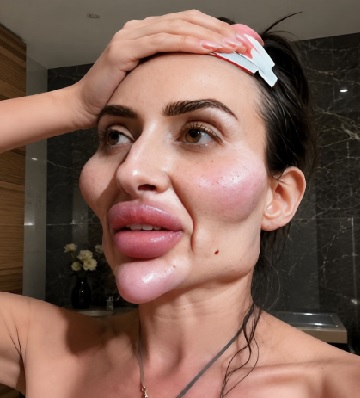
In the age of social media, an unusual appearance can attract attention almost overnight. A single photograph can travel across platforms, generate thousands of comments and turn someone previously unknown to most people into the subject of an international conversation. Few physical features create as immediate an impression as dramatically pronounced cheekbones, and one woman’s striking transformation has become a particularly vivid example.
Her present-day appearance is difficult to overlook. Her cheeks are extraordinarily prominent, changing the proportions of her face and creating a look that immediately distinguishes her from the people around her. Images showing her current appearance have circulated widely online, where reactions range from fascination and curiosity to criticism and disbelief.
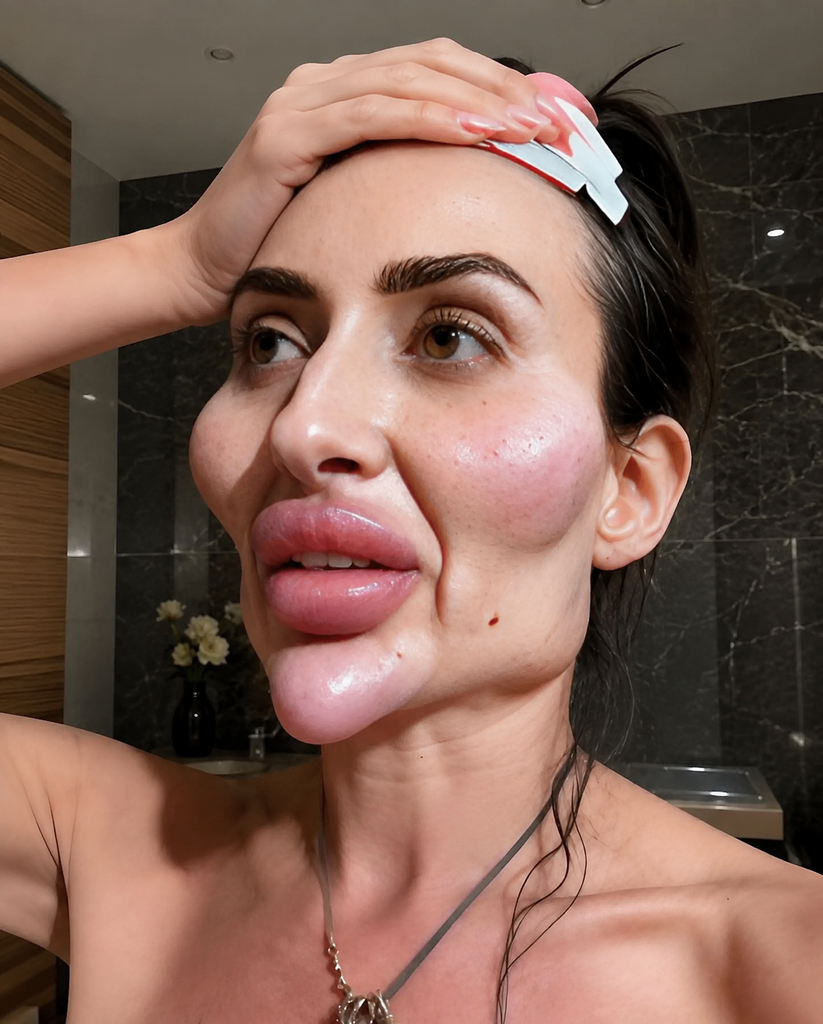
Yet the most interesting part of the story may not be how she looks today.
It is the contrast with photographs from before her transformation.
A Face That Once Looked Completely Different
Earlier photographs reveal a woman whose facial proportions were much more conventional. Looking at those pictures beside more recent images, someone unfamiliar with her story could easily wonder whether they were actually seeing the same person.
That contrast explains much of the public fascination.
People naturally pay attention to dramatic before-and-after images because the human brain is particularly sensitive to changes in faces. We recognize people through combinations of features rather than through one characteristic alone. Altering the cheeks, lips, nose, jawline or eyebrows can therefore influence how we perceive the entire face.
With especially large changes, familiar proportions disappear. The eyes may appear smaller or differently positioned even though they have not changed. The jaw can seem narrower because the middle of the face has become wider. Even a person’s expression can appear different.
This visual effect helps explain why old photographs associated with extreme cosmetic transformations often generate more discussion than recent photographs alone.
The question becomes not simply, «What does she look like?» but «How did she get from there to here?»
Why Prominent Cheekbones Attract So Much Attention
Cheekbones play an important role in the structure of the human face. They influence shadows, contours and the perceived relationship between the eyes, nose and jaw. For generations, high or clearly defined cheekbones have also been emphasized in photography, fashion and beauty culture.
Cosmetics can enhance them temporarily through contouring and highlighting. Cosmetic procedures can create stronger and longer-lasting changes.
However, there is a considerable difference between subtly emphasizing an existing feature and making that feature the dominant characteristic of a person’s appearance.
When cosmetic changes become extreme, they can move beyond conventional beauty trends and become a form of personal aesthetic expression. For some people, the goal is not necessarily to look natural or to satisfy traditional ideas about attractiveness. Instead, the desired appearance may be intentionally unusual.
That distinction is important when discussing people whose transformations attract widespread attention.
Outside observers frequently judge such appearances according to their own standards: Would I want to look like this? Do I consider this beautiful? Why would somebody do this?
But those questions do not necessarily explain the motivations of the person involved.
The Internet Turns Transformation Into Spectacle
Social media has profoundly changed the way cosmetic transformations are seen.
Decades ago, a person with an extremely unusual appearance might have attracted attention primarily within their own community or through occasional television and magazine coverage. Today, a photograph can reach millions of people without its subject ever meeting the overwhelming majority of them.
Algorithms also tend to reward content that produces immediate reactions. A photograph that makes viewers stop scrolling, look twice or open the comments has obvious advantages in an attention-driven environment.
Extreme transformations are therefore particularly suited to viral circulation.
Before-and-after comparisons intensify that effect. Instead of presenting only an unusual face, they offer a miniature story: a recognizable beginning followed by an unexpected result.
The viewer immediately wants to understand what happened in between.
Unfortunately, this environment can also remove important context. Images are reposted, cropped and paired with sensational descriptions. Claims about someone’s age, number of procedures, motivations or supposed records can spread even when reliable evidence is absent.
For that reason, descriptions such as «the biggest cheekbones in the world» should be treated carefully unless they are supported by a recognized and independently verified record. Viral popularity is not the same thing as formal certification.
What can be observed from photographs is a dramatic visual transformation. Claims that go beyond that require evidence.
Cosmetic Modification Is Rarely a Single Moment
One common misconception about dramatic transformations is that they happen through one enormous procedure.
In reality, major changes to someone’s appearance may develop gradually. A person can begin with a relatively modest alteration, become accustomed to the result and later decide that they want something more noticeable.
This phenomenon is not limited to cosmetic procedures.
Human perception adapts surprisingly quickly. A new haircut can initially seem dramatic and become completely normal after several weeks. The same can happen with tattoos, body modifications and aesthetic treatments. Once a change becomes familiar, the next modification may no longer seem as extreme to the person making it as it does to someone seeing the entire transformation at once.
That difference in perspective is crucial.
Online audiences often compare two photographs separated by years. They experience the complete transformation within seconds.
The person in those photographs experienced every intermediate stage.
Those are psychologically very different experiences.
Personal Choice and Medical Reality
Adults generally have considerable freedom to decide how they want to present themselves, including through cosmetic modification. At the same time, medical procedures should not be reduced to entertainment simply because the results are visually striking.
Injectable fillers and other cosmetic interventions have potential complications. The exact level of risk depends on the procedure, material, quantity, technique, anatomical location and health of the individual.
Possible complications can range from relatively temporary problems such as swelling, bruising or asymmetry to more serious outcomes. This is one reason qualified medical assessment and appropriate professional care matter.
An image on social media cannot tell viewers whether a procedure was performed safely, what substances were used or what medical advice the individual received. Nor should photographs alone be used to diagnose someone’s physical or psychological condition.
The distinction between observation and speculation is especially important when discussing unusual appearances.
We can observe that a transformation is dramatic. We can discuss why it attracts attention. But motivations, medical histories and psychological explanations should not be invented simply because they would make the story more sensational.
Why the Earlier Photographs Feel So Surprising
There is another reason before-and-after pictures are powerful: they challenge our sense of identity.
We tend to assume that a person’s face is one of the most stable elements of who they are. Hairstyles change. Clothing changes. People gain and lose weight. But facial recognition is deeply connected with our understanding of individual identity.
When someone’s appearance changes enough to disrupt that recognition, viewers experience a small contradiction.
They know intellectually that a person can alter their appearance, yet visually they struggle to connect the two versions.
That is why comments under transformation photographs so often contain variations of the same reaction: «I would never have recognized her.»
The reaction reveals something about the observer as much as the person being observed.
A face is simultaneously biological, social and personal. It is inherited, but it can also be modified. It identifies us to other people while becoming part of the image we choose to present to the world.
Modern cosmetic technology has made that relationship increasingly flexible.
Beauty Standards Are No Longer Moving in One Direction
Traditional beauty culture often encouraged people to pursue similar characteristics: smooth skin, symmetry, particular body proportions and facial features associated with contemporary fashion.
Social media has complicated that model.
There are still dominant beauty trends, but there is also an enormous market for individuality. Being instantly recognizable can itself become valuable. An unconventional appearance can create an audience precisely because it rejects moderation.
This does not mean everyone who dramatically changes their appearance is motivated by fame. Without reliable statements from an individual, assigning such a motive would be speculation.
But the digital environment undoubtedly rewards visual distinctiveness.
The more unusual the appearance, the more likely people are to photograph it, discuss it and share it. Attention then generates further attention.
The result can become a feedback loop in which a person’s appearance is no longer merely personal. It becomes public content.
The Problem With Cruelty Disguised as Opinion
There is nothing unusual about having a reaction to an extreme transformation. Some viewers will admire it, others will dislike it and many will simply be curious.
But there is a meaningful difference between discussing an aesthetic choice and attacking the human being who made it.
Online distance often erases that distinction.
People write comments they would probably never say to someone standing in front of them. Appearance becomes treated as permission for ridicule, and viral subjects can receive enormous numbers of personal insults from complete strangers.
A more useful discussion asks different questions.
How are modern beauty standards changing? Why do extreme transformations become viral? What role does social media play in encouraging visual novelty? Where is the boundary between aesthetic freedom and medical risk? And why are we so fascinated by people who deliberately depart from conventional appearances?
Those questions reveal much more than another round of insults ever could.
More Than a Before-and-After Photograph
The fascination surrounding a woman with extraordinarily prominent cheekbones ultimately reflects a much larger cultural phenomenon.
Her transformation attracts attention because the difference between earlier and later photographs is dramatic. Yet the reaction surrounding those images tells another story: one about cosmetic technology, internet culture, changing ideas of beauty and our instinctive fascination with faces.
Some viewers may prefer the earlier appearance. Others may appreciate the later one. Neither reaction changes a basic principle: aesthetic preference is subjective, while personal dignity should not depend on whether strangers approve of someone’s appearance.
Perhaps that is why these photographs remain so compelling. They are not simply images of one woman’s changing face.
They confront viewers with the remarkable degree to which appearance can now be altered, while raising a much more difficult question about identity itself.
When a person’s face changes almost beyond recognition, what exactly are we reacting to—the transformation, the individual behind it, or our own expectations of what a human face is supposed to look like?