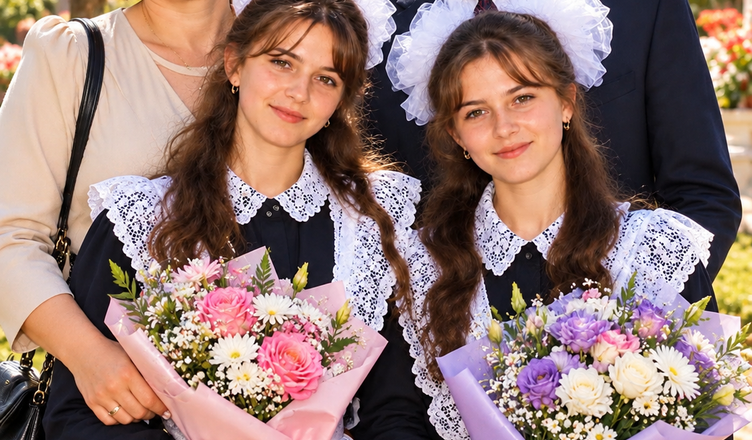
For thirty years, I kept the last photograph of my daughters in a wooden frame beside my bed.
In it, seventeen-year-old Hannah was laughing at something her younger sister had whispered. Sixteen-year-old Sophie stood beside her, wearing a pale blue dress she’d spent weeks saving for.
Behind them was our front porch, decorated with yellow flowers.
It was a perfectly ordinary photograph, taken on the evening of their school dance.
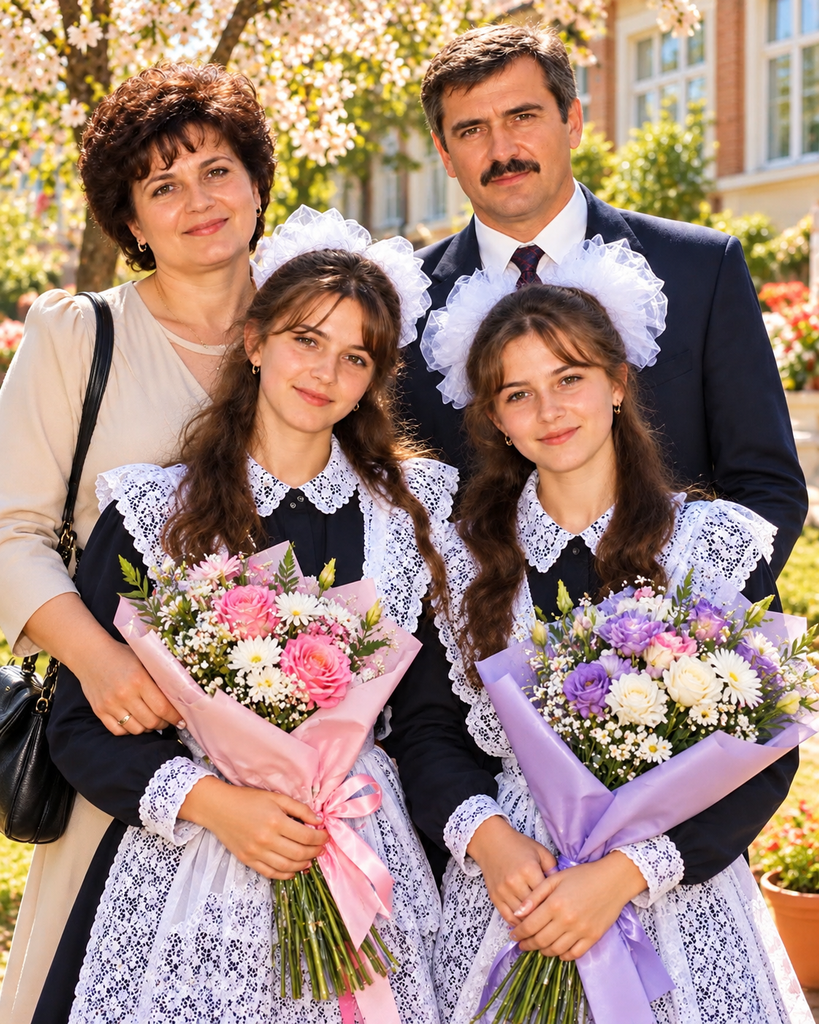
Three hours later, both girls disappeared.
The police searched for months. Volunteers walked through forests and abandoned buildings. Their faces appeared on television, in newspapers, and on thousands of posters.
Nothing brought them home.
Then, shortly after my seventy-fourth birthday, I decided to digitize our old family photographs.
When I enlarged the picture from that terrible evening, I noticed something reflected in the glass of our front door.
A white delivery van.
And on its side, a symbol I hadn’t seen in thirty years.
I knew exactly whose van it was.
The realization made me physically ill.
Because the man who owned it had spent years helping me search for my daughters.
His name was Walter Briggs.
And he’d been my closest friend.
The Night Everything Changed
My wife, Ellen, and I lived in a quiet town called Millbrook.
I worked as a mechanic, and Ellen was a nurse at the local hospital.
Our daughters were inseparable.
Hannah was confident and outspoken. Sophie was quieter, happiest when drawing or playing the piano.
They argued over clothes, borrowed each other’s shoes, and insisted they had nothing in common.
But they rarely went anywhere without each other.
On the evening of the spring dance, Ellen helped them with their hair while I polished the family car.
The girls posed for photographs outside our house.
Hannah wore a dark green dress. Sophie wore blue.
At seven o’clock, I drove them to the school gymnasium.
They promised to call if their plans changed.
I watched them disappear through the entrance, laughing.
That was the last time I saw them.
At ten-thirty, Ellen called the school.
The dance had ended, but the girls hadn’t returned.
By midnight, we were driving through town, checking every road and asking everyone we encountered whether they’d seen them.
At two in the morning, we called the police.
By sunrise, our lives had become something neither of us recognized.
The Search That Never Ended
Investigators established that Hannah and Sophie had left the dance shortly after nine.
Several classmates remembered seeing them near the school parking lot.
One girl said Sophie had received a message and seemed worried.
Another recalled Hannah saying they needed to speak to someone before going home.
Nobody could identify that person.
Their handbags were never found.
Neither girl had taken extra clothing or money.
There was no indication they’d planned to run away.
Police interviewed friends, teachers, relatives, and strangers who claimed to have seen them.
They searched nearby rivers and woodland.
Nothing led to a confirmed answer.
Walter Briggs was among the first volunteers.
He owned a small delivery company and knew the surrounding roads.
He organized search parties, printed posters, and brought food to volunteers.
When Ellen became too exhausted to continue searching, Walter sat with her for hours.
I trusted him completely.
I had no reason not to.
The Photograph in the Drawer
Ellen died twelve years after our daughters disappeared.
Her health had deteriorated gradually, and grief seemed to drain the joy from everything she once loved.
Before she died, she made me promise something.
«Don’t let their names disappear,» she whispered.
I never did.
Every year, on the anniversary of their disappearance, I placed flowers beneath their photograph.
I kept a box of newspaper clippings and letters from people who believed they’d seen the girls.
Most leads went nowhere.
Eventually, the police investigation became a cold case.
I continued calling whenever I remembered something that might help.
But as the years passed, fewer people remembered Hannah and Sophie.
Then my grandson from a later relationship suggested I scan my old photographs before they deteriorated.
I spent several evenings sorting through albums.
When I reached the picture taken on the porch, I noticed a faint shape in the reflection behind my daughters.
At first, I assumed it was our car.
But our car had been parked on the street.
I enlarged the image.
The reflection showed part of a white van.
On its door was a blue circle surrounding a small red arrow.
Briggs Delivery Services.
Walter’s company.
The Detail Nobody Had Questioned
Walter had always claimed he’d spent that evening at home.
He told police he’d heard about the disappearance the following morning.
Yet the photograph suggested his van had been outside our house shortly before the dance.
That alone didn’t prove wrongdoing.
Walter delivered packages throughout town.
He might have stopped nearby for an ordinary reason.
But something about the image troubled me.
I remembered Sophie standing beside the kitchen window that afternoon, watching the road.
When I asked what she was looking at, she’d said, «Nothing, Dad.»
I also remembered Walter asking unusual questions during the first search.
Had the girls been upset?
Were they planning to meet anyone?
Had they mentioned leaving town?
At the time, those questions seemed helpful.
Now they sounded different.
I contacted Detective Laura Mitchell, who had recently been assigned to review old missing-person cases.
She agreed to examine the photograph.
«Mr. Bennett,» she told me, «this is worth investigating. But please don’t confront Walter yourself.»
I promised I wouldn’t.
It was the hardest promise I’d made in years.
The Records That Changed the Case
Detective Mitchell requested surviving documents from the original investigation.
The old case file contained hundreds of witness statements, photographs, and handwritten notes.
One detail stood out.
A student had reported seeing a white van near the school shortly after the dance.
The witness couldn’t remember the license plate.
Investigators had checked several local delivery companies, including Walter’s.
His statement said his van had been parked at his warehouse that night.
Nobody had been able to verify it.
At the time, the information hadn’t been considered sufficient to identify him as a suspect.
Now investigators had a reason to examine it again.
Walter had retired years earlier.
His delivery company had closed, and the warehouse had been sold.
But the building still stood.
After reviewing the evidence, police obtained the necessary authorization to search the property.
What they found beneath a section of the old office floor changed everything.
The Box Beneath the Floorboards
Inside a sealed metal container were several personal items.
A silver bracelet.
A small blue handbag.
A school photograph.
And a folded piece of paper.
I recognized the bracelet immediately.
I’d given it to Hannah for her sixteenth birthday.
The handbag belonged to Sophie.
The paper contained a handwritten note.
Dad, if you find this, please know we tried to come home.
I read those words sitting in the detective’s office.
My hands shook so badly that I couldn’t hold the page.
For thirty years, I’d wondered whether my daughters had chosen to leave.
Now I knew they’d wanted to return.
But the note didn’t explain where they’d gone.
Or whether they were still alive.
Walter’s Arrest
Police questioned Walter about the items discovered at his former warehouse.
He initially denied knowing anything.
Then investigators confronted him with the evidence.
He admitted that Hannah and Sophie had been in his van on the night they disappeared.
He claimed he’d only been trying to help them.
According to Walter, the girls had discovered that he was involved in an illegal scheme using his delivery business to transport stolen goods.
Hannah had overheard a conversation several days before the dance.
She confronted him and threatened to tell the police.
Walter persuaded the girls to meet him after the dance, claiming he wanted to explain.
Instead, he drove them to his warehouse.
He said he intended to frighten them into silence.
But the situation escalated.
He locked them in a storage room.
When they tried to escape, he panicked.
Walter’s account changed several times.
Investigators treated his statements cautiously and continued searching for independent evidence.
Eventually, he disclosed a location outside town.
A place I’d driven past hundreds of times.
The House Near the Quarry
The property was an abandoned farmhouse near an old stone quarry.
Walter claimed he’d taken the girls there after leaving the warehouse.
He said he’d planned to release them once he was certain they wouldn’t report him.
But something went wrong.
During an attempted escape, Sophie fell down a steep embankment and suffered a serious injury.
Walter claimed Hannah refused to leave her sister.
He said he panicked and abandoned them.
I couldn’t comprehend what I was hearing.
Two frightened teenagers.
One badly injured.
And a grown man who chose to leave them rather than call for help.
Investigators searched the area.
They discovered human remains in a concealed depression near the quarry.
Forensic testing later confirmed that the remains belonged to Hannah and Sophie.
After thirty years, my daughters had finally been found.
The Truth I Had Feared
When Detective Mitchell came to my house with the results, I knew before she spoke.
She sat beside me.
«I’m so sorry, Mr. Bennett.»
I looked at the photograph on the mantelpiece.
Hannah was laughing.
Sophie was smiling.
They were still teenagers in my mind.
I had imagined them growing older somewhere.
I had imagined weddings, children, and ordinary lives.
I had even imagined that one day they’d walk through my front door and explain everything.
Now those possibilities were gone.
The truth was devastating.
But it also ended the terrible uncertainty that had followed me for three decades.
I finally knew where my daughters were.
And I knew they hadn’t abandoned us.
The Trial
Walter was charged in connection with the girls’ abduction and deaths.
The prosecution presented the recovered belongings, forensic findings, witness testimony, and evidence from the warehouse.
Walter’s lawyers challenged parts of his statements and argued about the circumstances of the deaths.
The trial lasted several weeks.
I attended every day.
Sometimes I had to leave the courtroom because the details were too painful.
I listened as witnesses described the final hours of my daughters’ lives.
I learned that Hannah had tried repeatedly to protect Sophie.
I learned that Sophie had kept asking to call home.
And I learned that Walter had continued participating in the search while knowing what had happened.
That was the part I struggled to understand.
He’d sat at our kitchen table.
He’d comforted Ellen.
He’d looked me in the eyes and promised to help find our girls.
All while carrying a secret that destroyed our family.
The jury found him guilty of serious offenses connected to their disappearance and deaths.
He received a lengthy prison sentence.
But no punishment could give me back the years we’d lost.
The Funeral We Waited Thirty Years to Hold
We buried Hannah and Sophie beside their mother.
The church was full.
Some people had known the girls personally.
Others had been children when they disappeared.
A few had participated in the original searches.
I placed the last photograph of my daughters beside their flowers.
I also brought two small objects.
For Hannah, a book of poetry she’d loved.
For Sophie, a miniature piano ornament.
During the service, I spoke about the girls as they had been before tragedy turned them into newspaper headlines.
Hannah loved thunderstorms.
Sophie hated peas.
They both sang terribly in the car.
They argued over whose turn it was to wash dishes.
They were funny, stubborn, generous, and full of plans.
I wanted people to remember that.
Not only how they died.
But how they lived.
The Questions That Remain
People sometimes ask whether finding the truth brought me peace.
I never know how to answer.
It brought answers.
It brought an end to the uncertainty.
It allowed me to bury my daughters beside their mother.
But peace is something different.
I still wake up some mornings expecting to hear their voices.
I still wonder what their lives might have been.
Would Hannah have become a journalist, as she once dreamed?
Would Sophie have studied music?
Would they have had children?
Would they still have argued over borrowed clothes?
Those questions have no answers.
And I’ve learned that grief doesn’t disappear simply because a mystery is solved.
It changes shape.
The Photograph I See Differently Now
The original photograph remains beside my bed.
I no longer look at it only as evidence.
I look at it as a father.
Hannah’s arm is around Sophie’s shoulders.
Sophie’s hair is slightly messy because she’d refused to let her mother fix it.
Behind them, the glass door reflects the street.
The van is barely visible.
For thirty years, nobody noticed it.
Perhaps we were too focused on the girls’ faces.
Perhaps the image was too small.
Perhaps the investigators simply had too many leads and too little evidence.
I don’t blame myself for missing it.
I didn’t know what I was looking for.
But I am grateful that I eventually found it.
That tiny reflection gave investigators a reason to revisit a witness statement that had been overlooked.
And that led them to the truth.
What I Want People to Remember
My daughters were not famous.
They weren’t wealthy.
They were two ordinary girls who went to a school dance and never came home.
Their disappearance changed our town.
For years, parents became more cautious.
Children were warned not to accept rides.
Neighbors watched unfamiliar vehicles.
But time passed.
People moved away.
New families arrived.
The story became something older residents mentioned occasionally.
For me, it never became history.
It was always present.
Every birthday.
Every holiday.
Every empty chair at the table.
I kept searching because I couldn’t accept that two lives could simply vanish without explanation.
And in the end, an ordinary photograph helped reveal what had happened.
The Last Promise
I am seventy-five now.
My hands aren’t as steady as they used to be.
I walk more slowly.
And I know I have fewer years ahead of me than behind.
But I still visit the cemetery every Sunday.
I bring fresh flowers.
I sit beside Ellen’s grave and tell her about the girls.
Sometimes I read aloud from Hannah’s poetry book.
Sometimes I simply sit quietly.
I wish Ellen had lived long enough to know the truth.
She died believing our daughters might still be somewhere in the world.
I hope that, in some way, she knows they have finally come home.
The last photograph I took of Hannah and Sophie once represented the beginning of thirty years of unanswered questions.
Now it represents something else.
Proof that they were loved.
Proof that they were together.
And a reminder that even the smallest detail can matter.
I spent half my life searching for my daughters.
I couldn’t save them.
But I kept the promise I made to their mother.
I never let their names disappear.
And after thirty years, I finally brought them home.
Clarify the timeline and agesStrengthen the evidence chain