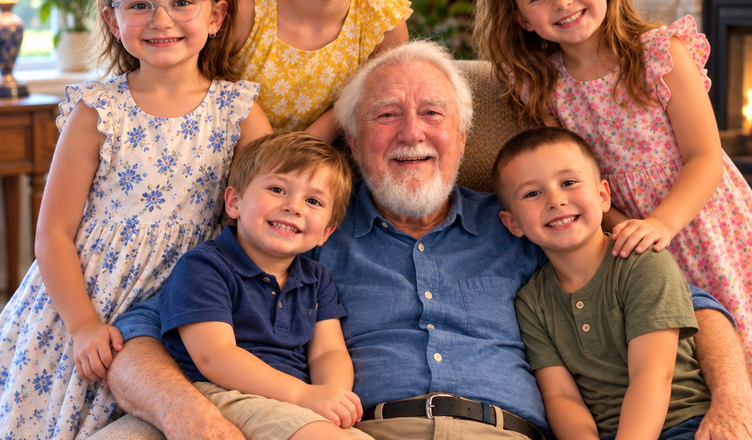
The first time Mr. Whitmore came to dinner, he brought six apples in a paper bag.
«There are seven of you,» he said apologetically, counting my husband, our five children, and me. «I seem to have miscalculated.»
Our youngest daughter, Rosie, who was four, immediately handed one back.
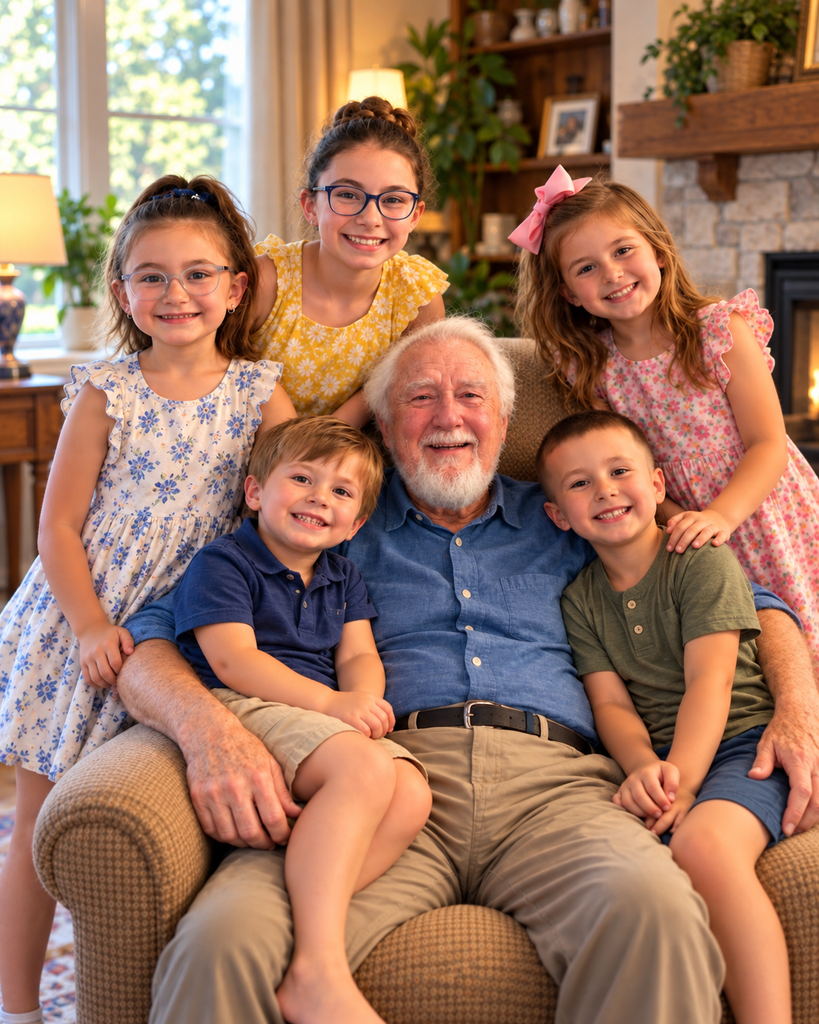
«Now there’s enough,» she announced.
He laughed so hard that his eyes filled with tears.
That was how our friendship began.
Two years later, Arthur Whitmore had become such an important part of our lives that our children couldn’t imagine a Sunday without him.
He was eighty-eight, lived alone in the small house next door, and had no family we knew about.
So when his ninetieth birthday approached, my husband and I decided to give him something more meaningful than another sweater or birthday cake.
We wanted to make him an official part of our family.
But when Arthur opened the envelope containing our carefully prepared documents, his face lost all its color.
He stared at the papers for a long time.
Then he whispered, «Please send the children into the other room.»
My husband, Daniel, looked confused.
«Arthur, what’s wrong?»
The old man slowly removed his glasses.
«There’s something I should have told you before I ever stepped inside this house.»
The Neighbor Who Appeared at Our Door
We moved to the village of Ashford three years earlier.
Daniel had accepted a position at a nearby engineering firm, and we wanted somewhere quieter to raise our children.
Our new house was old, with uneven floors, a narrow staircase, and a garden that had been neglected for years.
But it had enough bedrooms for everyone.
Our children ranged from four to fourteen, and the house quickly filled with noise.
The neighbor on our left was Arthur Whitmore.
We rarely saw him during the first few months.
He kept his curtains half closed and spent most afternoons sitting beneath a large chestnut tree.
One Saturday, Daniel was struggling to repair our garden gate when Arthur appeared carrying a toolbox.
«That hinge won’t hold,» he said. «The wood underneath has rotted.»
Within an hour, he had helped Daniel replace the damaged section.
When I offered him money, he looked offended.
«A cup of tea will do.»
He stayed for lunch.
Then dinner.
By the end of the evening, our youngest children were asking when he would visit again.
The Grandfather Our Children Chose
Arthur had a remarkable way with children.
He never spoke to them as though their problems were unimportant.
When our oldest son, Benjamin, worried about a mathematics examination, Arthur sat with him for an entire afternoon.
When our daughter Sophie broke her favorite toy, he repaired it with such care that she declared him a magician.
He taught the younger children how to plant vegetables, identify birds, and make simple wooden toys.
Most importantly, he listened.
Our house was busy, and Daniel and I were often exhausted.
Arthur seemed to have endless patience.
He attended school performances, remembered birthdays, and cheered louder than anyone at Benjamin’s football matches.
One afternoon, Rosie climbed into his lap and asked, «Can I call you Grandpa Arthur?»
He looked startled.
Then he smiled.
«If you’d like.»
From that day onward, all five children called him Grandpa.
He never corrected them.
A Man With Almost No Past
Despite how close we became, Arthur rarely discussed his earlier life.
We knew he had worked as a railway engineer.
We knew his wife had died many years earlier.
He said they had never raised children together.
When I asked whether he had relatives elsewhere, he usually changed the subject.
«Not anyone who visits,» he would say.
I assumed he had experienced some painful family estrangement.
At his age, perhaps he simply preferred not to discuss it.
There were other little mysteries.
He never allowed us to help clean his spare bedroom.
He kept a locked wooden chest beside his fireplace.
And whenever Daniel mentioned the previous owners of our house, Arthur became unusually quiet.
We noticed these things.
But we trusted him.
And because he had never given us a reason to doubt his kindness, we didn’t investigate.
The Birthday Surprise
As Arthur’s ninetieth birthday approached, our children began planning a celebration.
Sophie wanted balloons.
Benjamin offered to bake a cake.
Rosie insisted that Arthur needed a crown.
But Daniel and I wanted to do something lasting.
Arthur had once admitted that his greatest fear was becoming seriously ill and having nobody to speak for him.
We began discussing practical ways to support him.
After consulting a solicitor, we learned that certain legal arrangements could allow Arthur to designate trusted people to help with decisions and emergencies, subject to his consent and the applicable requirements.
We also prepared a personal family declaration.
It wasn’t an adoption certificate or a document that would magically create a legal relationship.
It was a framed promise, signed by all seven of us, that Arthur would always have a place at our table.
We hoped he would be touched.
We never imagined he would be frightened.
The Envelope That Changed the Evening
Arthur arrived wearing his best jacket.
The children sang, the cake was cut, and Rosie placed a paper crown on his head.
He laughed and allowed everyone to take photographs.
Then Daniel handed him the envelope.
«Arthur,» he said, «you’ve done more for this family than we could ever repay. We want you to know you’ll never have to face the future alone.»
Arthur opened it.
He read the family declaration first.
His lips trembled.
Then he saw the solicitor’s letter explaining the proposed arrangements.
His expression changed completely.
He set the papers down.
«Where did you get these names?»
I frowned.
«What names?»
He pointed to the document.
«Our full names and address?»
Arthur shook his head.
«No. Your mother’s maiden name, Daniel.»
Daniel looked at him.
«Why would that matter?»
Arthur covered his face with his hands.
When he finally spoke, his voice was barely audible.
«Because I knew your mother.»
The Secret From Forty Years Earlier
We sent the children into the living room with a film and a plate of cake.
Then Arthur began talking.
Forty-two years earlier, he had worked at a railway maintenance depot in northern England.
Daniel’s mother, Margaret, had been employed there as an administrative assistant.
She was twenty-six, recently widowed, and raising a young son.
That son was Daniel.
Arthur said he remembered Margaret as hardworking and fiercely protective of her child.
One winter evening, a serious accident occurred at the depot.
A maintenance vehicle moved unexpectedly while workers were nearby.
Arthur had been responsible for checking part of the equipment.
A colleague was badly injured.
The investigation later found failures in safety procedures.
Arthur admitted that he had overlooked a warning during his inspection.
«I wasn’t the only person who made mistakes,» he said. «But I knew I’d made one.»
He was disciplined and eventually left the railway.
What haunted him, however, was what happened afterward.
The Woman Who Refused to Stay Silent
According to Arthur, Margaret had discovered that an earlier safety report had been altered.
She believed management was trying to minimize responsibility for the accident.
She spoke to investigators.
Her testimony helped establish what had happened.
But her decision came at a cost.
She lost her job several months later.
Arthur believed she had been pushed out because she refused to remain silent, although he acknowledged that he never obtained proof of the employer’s motives.
Without steady income, Margaret struggled.
She moved away with Daniel and eventually found work in another town.
Arthur wanted to apologize.
He wrote several letters.
None received an answer.
«I was ashamed,» he told us. «She did the right thing while the rest of us were trying to protect ourselves.»
Daniel sat motionless.
His mother had died five years earlier.
She had rarely discussed her time at the railway.
Why Arthur Moved Next Door
Arthur explained that after his wife died, he began sorting through old papers.
Among them was a letter from Margaret.
It had arrived years after the accident.
He had kept it but never told anyone about it.
The letter thanked him for eventually providing a statement that supported her account.
She wrote that she hoped he had found peace.
At the bottom, she mentioned that her son had grown into a kind young man.
Arthur became curious about what had happened to the family.
Years later, through publicly available information and an old acquaintance, he learned that Daniel was living in Ashford.
When the house next door came onto the market, Arthur purchased it.
«I told myself I wanted a quiet place to spend my remaining years,» he said.
«But that wasn’t the whole truth.»
He looked at Daniel.
«I wanted to see whether Margaret’s boy was happy.»
My husband stared at him.
«You moved here because of me?»
Arthur nodded.
«I didn’t expect you to welcome me. I certainly didn’t expect your children to call me Grandpa.»
The Part That Hurt Most
For several minutes, none of us spoke.
Then Daniel asked the question I had been thinking.
«Why didn’t you tell us?»
Arthur looked down.
«At first, I was afraid you’d blame me for what happened at the depot.»
«And later?»
«Later, I was afraid you’d think I’d become your friend for the wrong reasons.»
Daniel stood and walked toward the window.
I could see he was struggling.
His mother had worked hard to raise him.
She’d taken cleaning jobs, worked evenings, and saved every spare pound for his education.
He had always known she was resilient.
But he’d never understood why she left her railway job.
Now an elderly neighbor was telling him that an accident and its aftermath had changed her life.
And that the same man had deliberately moved next door decades later.
It was a lot to absorb.
The Locked Chest
Arthur asked whether Daniel would accompany him to his house.
They returned twenty minutes later carrying a small wooden box.
Inside were photographs, employment records, and old letters.
Arthur spread them across our dining table.
There was a photograph of Margaret standing beside a group of railway workers.
Daniel recognized her immediately.
She looked young and serious, with the same determined expression she wore in family photographs.
There were copies of Arthur’s statements about the accident.
And there was the letter Margaret had written years later.
Daniel read it twice.
Then he passed it to me.
Near the end, Margaret had written:
I hope you understand that telling the truth mattered more than protecting anyone’s reputation. We cannot change what happened, but we can decide what kind of people we become afterward.
I looked at Arthur.
He was crying silently.
A Difficult Conversation
Daniel didn’t immediately embrace him.
He asked questions.
Why had Arthur waited so long to speak?
Had he deliberately encouraged the children to become attached to him?
Was he trying to make up for his guilt?
Arthur answered without becoming defensive.
He admitted that guilt had influenced his decision to move nearby.
But he insisted that his affection for the children was genuine.
«I came because of the past,» he said. «I stayed because of who you are.»
Daniel considered that.
Then he asked something unexpected.
«Did my mother forgive you?»
Arthur looked at the letter.
«I think she did. But I never felt I’d earned it.»
Daniel sat down again.
«My mother didn’t spend her life asking people to earn forgiveness. She wanted them to behave better.»
Arthur nodded.
«She was a remarkable woman.»
«Yes,» Daniel said. «She was.»
What We Decided About the Documents
The celebration had ended hours earlier.
The children were asleep.
Arthur’s paper birthday crown lay beside the cake.
Daniel picked up the family declaration.
«You should have told us,» he said.
«I know.»
«We need time to understand everything.»
«Of course.»
Then Daniel looked at me.
I nodded.
He turned back to Arthur.
«But none of this changes what you’ve done for our children.»
Arthur began shaking his head.
«You don’t owe me anything.»
«We know,» Daniel replied.
He placed the declaration in front of him.
«This isn’t repayment. It’s a promise.»
Arthur stared at the signatures.
Then he finally smiled.
We agreed not to rush any legal arrangements.
Arthur would review the solicitor’s advice independently and decide what he wanted.
But the personal promise remained.
He was welcome in our home.
That had never depended on paperwork.
Telling the Children
The next morning, our children wanted to know why Grandpa Arthur had left early.
We explained that he had shared some important memories about their father’s mother.
Benjamin was old enough to understand more of the story.
The younger children needed only a simple explanation.
We told them that Arthur had known their grandmother long ago and that the adults were learning about something difficult from the past.
Rosie asked whether Grandpa Arthur was in trouble.
Daniel smiled.
«No, sweetheart.»
«Can he still come for pancakes?»
«Yes.»
She looked relieved.
«Good. Because he makes the best ones.»
Sometimes children see what adults complicate.
They knew Arthur as the man who repaired bicycles, remembered their favorite stories, and showed up when they needed him.
His past mattered.
But it wasn’t the only thing that defined him.
The Months After the Confession
Our relationship with Arthur changed, though not in the way I feared.
Daniel began visiting him more often.
They talked about Margaret, the railway, and the years before Daniel could remember.
Arthur answered questions he had avoided for decades.
Some conversations were painful.
Others brought unexpected laughter.
Daniel learned that his mother had once organized a Christmas party for the depot workers and insisted that everyone contribute food.
Arthur remembered her terrible singing and her habit of carrying spare pencils behind her ear.
Those details were precious.
They gave Daniel new memories of his mother through someone else’s eyes.
Meanwhile, the children continued treating Arthur exactly as before.
He remained Grandpa.
He still came for Sunday lunch.
And Rosie still insisted he wear the paper crown whenever we celebrated a birthday.
A Promise That Didn’t Need a Signature
Several months later, Arthur asked Daniel and me to accompany him to a solicitor’s office.
He had decided to put certain practical arrangements in place.
He wanted clear instructions about medical decisions, emergencies, and who should be contacted if he became unable to manage his affairs.
The solicitor explained the requirements and helped ensure Arthur understood his choices.
We were careful that he felt no pressure.
He also updated his will.
We told him that his money and property were his to distribute as he wished.
He laughed.
«I know. You’re not getting my terrible collection of railway magazines unless you specifically ask for it.»
Daniel grinned.
«I’ll take the magazines.»
Arthur looked delighted.
It was one of the first times I’d seen him speak about his future without fear.
His Ninetieth Birthday, Revisited
A year after the surprise, we held another family dinner.
Arthur was ninety-one.
This time, there were no envelopes.
No unexpected documents.
Just food, laughter, and five children arguing about who would sit beside him.
After dessert, Arthur asked everyone to be quiet.
He stood slowly, leaning on the table.
«I’ve been given many things in my life,» he said. «Some I deserved. Some I didn’t.»
He looked at Daniel.
«I spent years wishing I could change something I did when I was younger.»
Then he looked around the table.
«I finally understand that the past cannot be repaired by pretending it never happened.»
His voice trembled.
«But perhaps we can still do some good with the time we have left.»
Rosie raised her hand.
«Grandpa, is this a speech?»
Everyone laughed.
Arthur smiled.
«Yes, my dear. A very long one.»
«Can we have cake now?»
«Absolutely.»
The Family We Never Expected
Arthur’s confession taught us something I hadn’t understood before.
People can enter our lives carrying histories we know nothing about.
Sometimes those histories include mistakes, regrets, and choices they wish they could undo.
Learning the truth can be painful.
It can change how we understand someone.
But it doesn’t necessarily erase the kindness they’ve shown us.
Arthur had moved next door partly because he wanted to confront a piece of his past.
He hadn’t been completely honest about his reasons.
That mattered.
Daniel had every right to feel unsettled.
But Arthur had also spent two years loving our children without asking for anything in return.
Both things were true.
We didn’t need to ignore one to acknowledge the other.
The Empty Chair That Will One Day Remain
Arthur is ninety-two now.
He walks more slowly and sometimes forgets where he left his glasses.
The children have grown taller.
Benjamin is preparing for university.
Rosie is learning to read chapter books and insists on practicing aloud to Grandpa Arthur.
We know he won’t be with us forever.
That knowledge makes ordinary afternoons feel more valuable.
Sometimes I watch him sitting at our kitchen table, listening as the children talk over one another.
He looks content.
Not because his life has been free of mistakes.
But because he is no longer carrying his regrets alone.
The framed family declaration hangs in his hallway.
Beside it is a photograph of Margaret from the railway depot.
Arthur placed them together himself.
When Daniel asked why, he answered simply.
«Because one reminds me where I went wrong. And the other reminds me that I was given another chance.»
What His Secret Really Changed
When Arthur turned pale at the sight of our birthday gift, I feared we’d discovered something that would destroy our friendship.
Instead, we uncovered a history that connected our families long before we met.
It wasn’t a simple story of forgiveness.
There were uncomfortable truths, unanswered questions, and emotions that took time to understand.
But there was also the possibility of choosing what happened next.
Arthur couldn’t undo the mistakes of his younger years.
Daniel couldn’t recover the years when his mother struggled.
And none of us could erase the fact that Arthur had kept his reasons for moving next door a secret.
What we could do was decide whether the man sitting at our table still had a place there.
He did.
Not because he had earned a legal title.
Not because he shared our blood.
And not because we felt sorry for him.
But because family, at its best, is built through care, honesty, responsibility, and the willingness to show up.
Arthur came into our lives carrying an old regret.
He stayed long enough to become someone our children loved.
And when the truth finally emerged, we discovered that the most meaningful part of our birthday gift wasn’t the paperwork.
It was the promise behind it.
Whatever happened next, he would not have to face it alone.
Clarify the birthday timelineStrengthen Arthur’s central secret