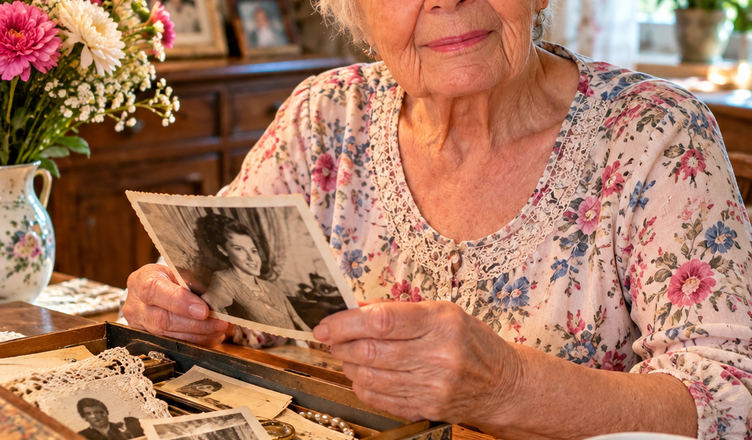
This year, however, there was one thing he wanted more than anything else.
He wanted his son to call.
Arthur woke shortly after seven on the morning of his birthday. For several minutes he remained beneath the blankets, listening to the familiar sounds of his small apartment. A refrigerator hummed in the kitchen. Pipes clicked somewhere behind the wall. Outside, a delivery truck stopped and then moved on.
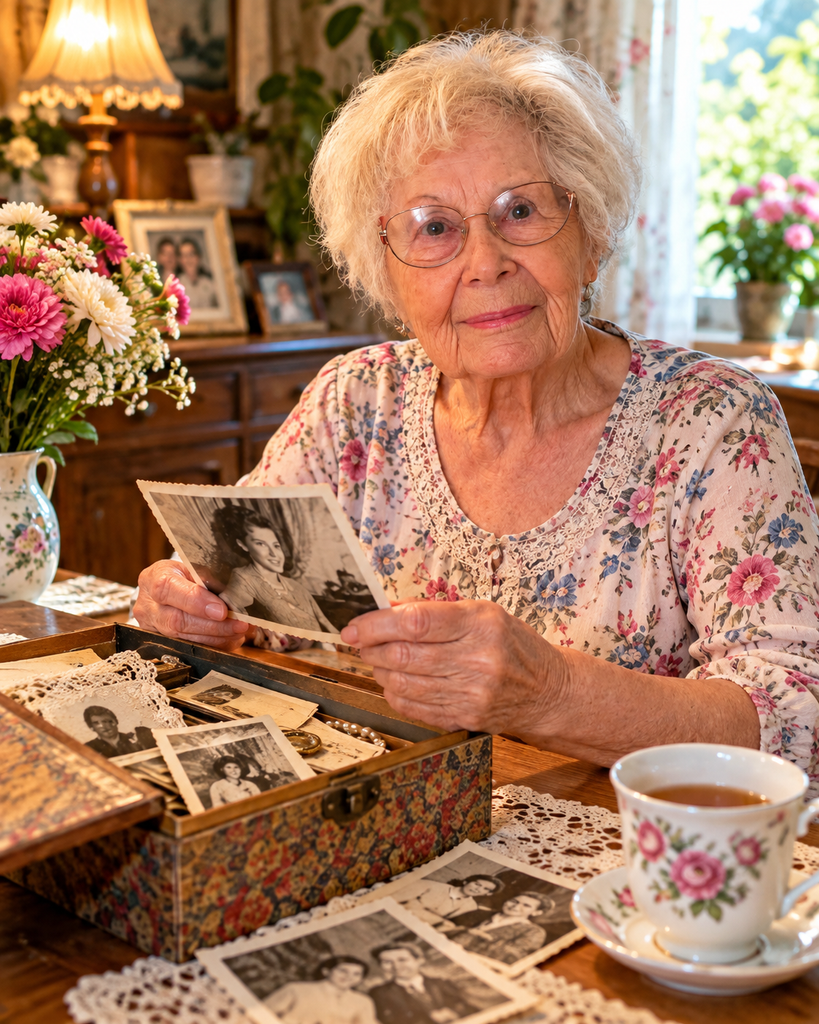
Nobody knocked.
His telephone remained silent.
Arthur told himself it was early.
People were busy. His son might be working. Perhaps he would call later.
That small possibility was enough to get him out of bed.
A Birthday for One
Arthur made tea and ate a piece of toast at the kitchen table. On the wall opposite him hung photographs collected over nearly a century.
There was his wedding picture. His late wife, Margaret, was laughing rather than looking at the camera.
Another photograph showed their son, Michael, at about eight years old, proudly holding a fish that was hardly bigger than his hand.
There were school photographs, Christmas dinners, summer trips and family celebrations.
Arthur had stopped adding new pictures years ago.
After breakfast, he put on his coat and walked slowly to the neighborhood grocery store.
He didn’t need much: milk, bread and something for dinner.
Then, near the bakery counter, he saw a row of small cakes.
For a moment he considered walking past them. Buying yourself a birthday cake at ninety-seven felt strangely embarrassing.
But then he changed his mind.
He chose the smallest chocolate cake in the display.
At the checkout, the young cashier glanced at it.
“Celebrating something?”
Arthur smiled.
“My birthday.”
The cashier wished him well, and for a few seconds Arthur felt unexpectedly cheerful.
Someone had said the words.
It was a small kindness, but on a lonely day, small kindnesses become large.
The Empty Chair
Back home, Arthur placed the cake on the kitchen table.
He found a candle in a drawer. There were several, but he chose only one. Ninety-seven candles would have been ridiculous, he thought.
By noon, the phone still hadn’t rung.
Arthur tried not to look at it.
He washed a cup that was already clean. He rearranged the mail. He turned on the television but couldn’t follow the program.
Eventually, his eyes returned to the photographs on the wall.
Michael.
The name itself carried both love and pain.
They had once been close.
When Michael was young, they spent weekends repairing things in the garage, fishing at a nearby lake or simply driving with no particular destination.
But relationships rarely collapse in a single dramatic moment.
More often, they weaken slowly.
A disagreement becomes resentment. Resentment becomes distance. Both people wait for the other to apologize. Months pass. Then years.
Arthur could no longer identify the exact moment when stubbornness had become silence.
There had been arguments about money and family responsibilities. Arthur had said things he regretted. Michael had said things that hurt him too.
After Margaret died, the distance between father and son became even greater.
At first there were occasional calls.
Then only Christmas messages.
Eventually, nothing.
The Problem With Waiting
Arthur had spent years telling himself that Michael knew where to find him.
He had repeated the same thought whenever someone suggested he should make the first move.
“He has my number.”
The sentence had protected Arthur’s pride.
It had also protected his loneliness.
As the afternoon passed, something about turning ninety-seven made that old logic seem increasingly foolish.
How much time was left for either of them to be right?
At his age, Arthur understood better than most people that time is not an abstract resource. You cannot store it for later. You cannot recover an afternoon because you eventually decide you should have used it differently.
Still, making the first move frightened him.
What if Michael ignored him?
Silence without trying was painful.
Silence after reaching out might be worse.
One Photograph
Shortly after five, Arthur decided to light the candle.
He placed the little cake in front of him and struck a match.
The flame trembled.
For a moment, he simply watched it.
Then he took out his old mobile phone.
It was not a smartphone. Arthur disliked touchscreens and had refused several offers to replace his simple device. Its buttons were large, the camera was poor, and writing a message required patience.
He photographed the cake.
The first picture was blurry.
He tried again.
The second was good enough.
Then he opened Michael’s contact.
Arthur stared at his son’s name for a long time.
His first instinct was to write something emotional, explaining everything he regretted.
He deleted it.
Then he considered writing nothing except “97 today.”
That sounded almost accusing.
He deleted that too.
Eventually, he typed:
“It’s my birthday today. I bought myself a little cake. I hope you’re doing well. Dad.”
Arthur read the message several times.
Then he added one more sentence.
“I miss you.”
His thumb hovered over the button.
Finally, he pressed it.
The message was gone.
Nothing Happened
Five minutes passed.
Then ten.
Arthur blew out the candle.
He cut himself a small piece of cake and made another cup of tea.
Half an hour passed.
The phone remained silent.
He tried to convince himself that sending the message had been enough.
At least Michael would know that his father had thought about him.
At least Arthur had finally done something instead of waiting.
The evening grew darker.
Around seven, Arthur turned on a lamp and settled into his chair.
He began watching an old film, though his attention remained fixed on the telephone sitting beside him.
At 7:23, it rang.
Arthur froze.
For several seconds, he simply stared at it.
The sound seemed impossibly loud in the quiet apartment.
Then he picked it up.
Michael’s name was on the screen.
Arthur’s hands began to shake.
He answered.
“Hello?”
For a moment, nobody spoke.
Then came a voice Arthur had not heard in years.
“Happy birthday, Dad.”
Arthur closed his eyes.
There were countless things he could have said.
Instead, he managed only:
“Thank you.”
Another silence followed, but this one felt different.
It wasn’t the hard silence of resentment.
It was the fragile silence of two people trying to find a way back to each other.
The Conversation They Had Avoided for Years
Michael admitted that he had stared at the photograph for a long time before calling.
He had not forgotten his father’s birthday.
That surprised Arthur.
Michael had remembered the date every year.
Sometimes he had even considered calling, but anger, embarrassment and fear always stopped him.
Arthur understood immediately because he had been doing exactly the same thing.
Neither man had stopped caring.
They had simply become trapped by the expectation that the other person should make the first move.
Their first conversation did not magically erase years of hurt.
They disagreed about some memories.
Arthur apologized for things he had said.
Michael apologized for disappearing.
Neither attempted to settle every old argument in one evening.
That would have been impossible.
Instead, they did something more important.
They kept talking.
After a while, Michael asked about the cake.
Arthur laughed.
“Chocolate.”
“You still like chocolate?”
“At ninety-seven, I’m not changing now.”
For the first time that day, Arthur laughed without forcing it.
A Knock at the Door
Their conversation lasted almost an hour.
Before hanging up, Michael asked a question.
“Are you going anywhere tonight?”
Arthur looked around the empty apartment.
“I don’t think my social calendar is particularly crowded.”
Michael laughed.
“Stay home.”
Arthur didn’t understand, but he agreed.
Approximately forty minutes later, someone knocked.
Arthur assumed it was a neighbor.
When he opened the door, Michael was standing in the hallway.
For several seconds, neither man moved.
Michael looked older than the son Arthur carried in his memories. His hair was grayer, his face more tired.
Arthur suddenly wondered how different he himself must look through his son’s eyes.
Then Michael stepped forward.
Their hug was awkward at first.
Neither knew exactly where to put his arms.
But neither let go quickly.
Michael had brought another cake.
This one was far too large for two people.
They put it beside Arthur’s tiny grocery-store cake and laughed at the absurdity of having more dessert than dinner.
They talked until late.
Not everything was repaired.
Some wounds require time, and reconciliation is rarely as simple as one telephone call.
But something fundamental had changed.
The silence had ended.
Why Family Estrangement Can Last So Long
The fictional story of Arthur and Michael reflects a very real human pattern.
Family estrangement can arise from serious conflict, incompatible expectations, repeated hurt, unresolved grief or long-standing differences in values and behavior. Sometimes distance is necessary and healthy, particularly when a relationship involves abuse, manipulation or persistent boundary violations.
But other estrangements survive for a different reason: both people become convinced that reconciliation must be initiated by the other.
Pride can disguise itself as principle.
Fear can disguise itself as indifference.
Years pass while both sides privately wonder whether the other still cares.
Reconnection is not always possible or appropriate. No one is obligated to return to a harmful relationship simply because the other person is family.
Yet where the underlying relationship is safe and both people still want contact, a small message can sometimes open a door that years of waiting never will.
The Second Candle
Before Michael left that night, Arthur noticed that the original candle was still beside the little cake.
He picked it up.
“We never did this properly.”
He pushed the candle into the larger cake and lit it again.
Michael turned off the kitchen light.
Arthur looked at the single flame.
Earlier that evening, the same candle had represented something painful: another year passing in an empty room.
Now his son was sitting across from him.
Arthur did not make a complicated wish.
He had already received more than he had expected.
He blew out the candle.
At ninety-seven, he had learned something that would have been useful decades earlier.
Sometimes the distance between two people is not measured in kilometers or years.
Sometimes it is measured by one sentence neither person has been willing to say.
Arthur had finally said his:
“I miss you.”
And this time, someone answered.