It was the smell.
I had walked into the garden shortly after breakfast to water the flowers. It had rained heavily the night before, and the soil was still dark and damp. Everything seemed ordinary until I reached the flower bed beside the fence.
Then an odor stopped me.
It was strong enough to make me step backward.
Something smelled dead.
My first thought was that a small animal had crawled beneath the bushes and died. I put down the watering can and reluctantly began searching.
There was nothing beneath the shrubs.
Then I saw something red beside the mulch.
At first, I thought it was plastic.
Then it appeared to move.
A Strange Red Shape in the Soil
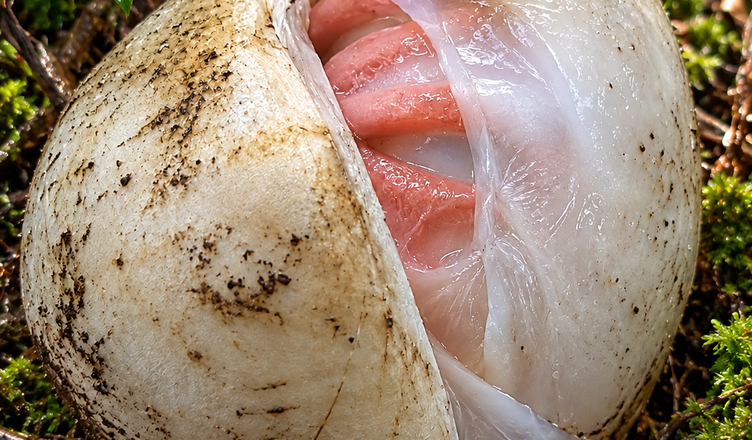
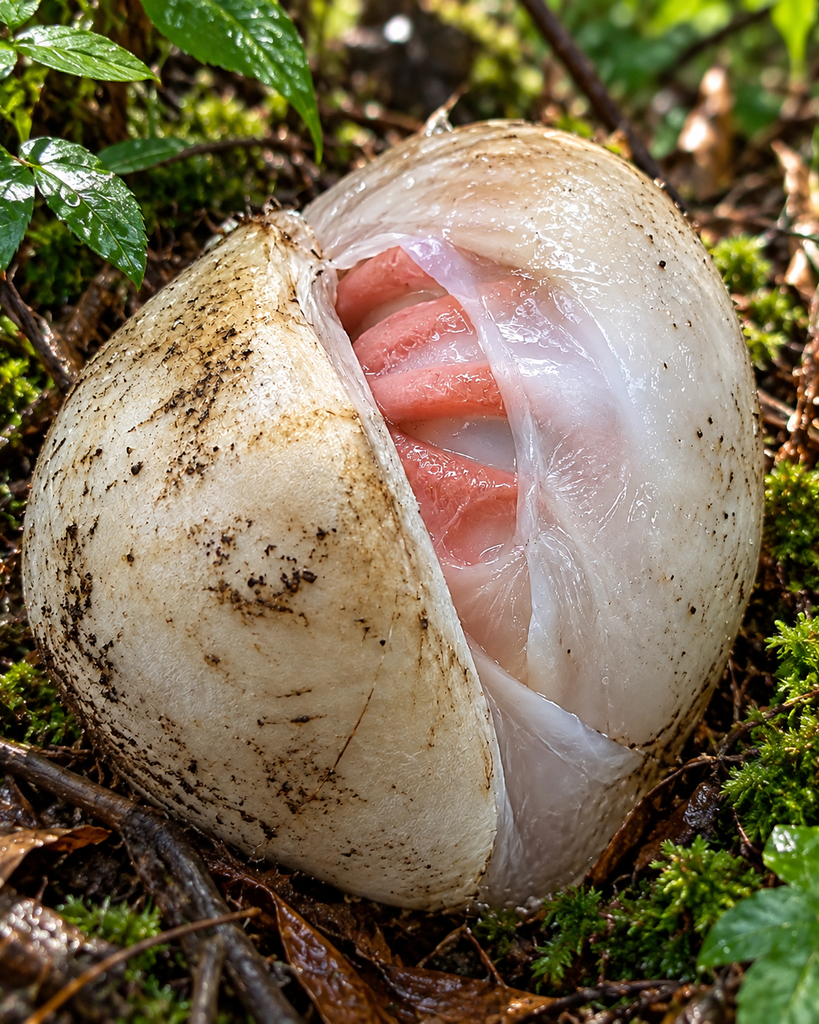
Several red structures were emerging from a pale, broken object on the ground.
They looked disturbingly organic.
The red “arms” curved outward, and their surfaces were coated with a dark, sticky substance. Flies were already gathering around them.
I crouched down but immediately regretted getting closer.
The smell was much stronger near the object.
It resembled rotting meat.
My imagination supplied possibilities faster than common sense could eliminate them.
Was it an insect larva?
A dead animal?
Some kind of parasite?
I had lived in houses with gardens for years and had never seen anything resembling it.
I did what people now do when confronted by something inexplicable.
I photographed it.
The Photograph Made It Look Worse
On my phone screen, the object appeared even stranger.
The red structures looked almost like tentacles.
I sent the photograph to my sister.
Her response arrived immediately.
“What is THAT?”
“I was hoping you would know.”
“Don’t touch it.”
That was advice I had already decided to follow.
I began searching descriptions: red tentacles in garden, terrible smell, strange fungus, red thing growing from soil.
Within minutes, photographs appeared that looked remarkably similar to what was beside my flower bed.
The name sounded nearly as alarming as the organism looked.
Devil’s fingers.
It Wasn’t an Animal at All
The organism commonly called devil’s fingers or octopus stinkhorn is a fungus, Clathrus archeri.
Its appearance explains the dramatic names.
As it develops, several elongated red arms emerge from an egg-like structure in the ground. These arms spread outward and can create the impression of a small red creature pushing itself from the soil.
That was apparently what I had been watching.
It was not crawling across the garden.
It was growing and unfolding.
The difference was reassuring, although the fungus did not suddenly become attractive.
Then there was the smell.
Why Would a Fungus Smell Like Something Dead?
Flowers often use pleasant scents to attract pollinating insects.
Stinkhorn fungi use a very different strategy.
The dark material coating parts of the mature fruiting body contains spores. Its foul odor attracts flies and other insects that normally investigate decaying organic material.
The insects land on the sticky surface.
Spores can then adhere to them and be transported elsewhere.
In other words, the terrible smell is not an accident.
It is part of the fungus’s reproductive strategy.
The flies I had regarded as another unpleasant feature were doing exactly what the fungus needed them to do.
Once I understood that, the strange object became considerably more interesting.
It still smelled terrible.
But it no longer seemed inexplicable.
Why It Seemed to Be Moving
One part of the experience continued to bother me.
I was convinced I had seen movement.
Fungi do not walk, so what had I actually observed?
The answer was probably rapid development combined with insect activity.
Stinkhorn fruiting bodies can emerge and expand relatively quickly. Their arms change position as they develop, particularly when emerging from the immature egg-like stage.
Flies crawling over the surface add another layer of motion.
Viewed unexpectedly from a short distance, especially when you are already alarmed by the smell and unfamiliar shape, the result can look surprisingly animal-like.
My brain had interpreted unfamiliar biological growth using the closest category it understood.
Something red was changing position.
Therefore, something red must be alive in the way an animal is alive.
The first part was correct.
The conclusion was not.
The “Egg” Was Another Surprise
I returned to the garden later and looked around without touching anything.
Several pale structures were partly buried nearby.
Now that I knew what to search for, I recognized them as immature stages of the same type of fungus.
Before producing its spectacular red structure, a stinkhorn can exist as an egg-like body in or near the soil.
That explained why I had not noticed anything unusual the previous day.
The bizarre red form had not been sitting there for weeks.
Conditions had allowed it to emerge.
The recent rain and moist organic material in the flower bed may have contributed to favorable conditions for fungal growth.
My apparently ordinary garden had been hosting an entire process I had never noticed.
Was It Dangerous?
This was my next concern.
I had children visiting regularly, and neighboring cats sometimes crossed the garden.
Seeing something so strange encourages the assumption that it must be poisonous or otherwise dangerous.
Appearance alone, however, is not a reliable guide to toxicity.
The sensible approach with any unidentified fungus is simple: do not eat it, and prevent children or pets from ingesting unknown specimens.
Identification from a photograph can also be imperfect. Many fungi can resemble one another, particularly during early stages of development.
If there is a genuine concern that a child or animal has eaten an unidentified fungus, professional medical or veterinary advice is far more appropriate than relying on an internet photograph.
In my case, nobody had eaten or handled it.
The immediate problem was mostly the smell.
Should I Destroy It?
My first instinct had been to remove the entire thing.
Once I understood what it was, I hesitated.
Fungi are important components of ecosystems.
Much of a fungus exists out of sight as a network within soil or organic material. The visible structure we notice is often only the fruiting body involved in reproduction.
Many fungi help break down dead organic material and recycle nutrients.
That means discovering a strange mushroom in a garden does not automatically indicate that something has gone wrong.
Sometimes it means biological processes are functioning exactly as they should.
Of course, a foul-smelling fruiting body beside a patio may still be unwelcome.
Removing visible structures can reduce the immediate nuisance, although it does not necessarily eliminate the underlying fungal network.
The Garden Was More Complicated Than I Thought
That discovery changed the way I looked at the flower bed.
Until then, I had thought of the garden primarily in terms of the things I intentionally planted.
Roses.
Herbs.
Tomatoes.
Lavender.
Anything else was classified as either a weed or a pest.
But soil contains an enormous biological community that exists largely outside our attention.
Fungi, bacteria, insects and countless other organisms interact with decaying leaves, wood, roots and one another.
We notice only a tiny fraction of that activity.
The red fungus seemed like an intruder because it was spectacular enough to become visible.
In reality, the garden had never belonged only to the plants I selected.
Why Strange Organisms Become Internet Mysteries
After identifying the fungus, I searched for more photographs.
I quickly discovered that I was far from the first person to react with alarm.
Images of stinkhorn fungi frequently attract attention because their shapes violate our expectations of what a fungus should look like.
Many people imagine mushrooms as a stalk topped by a neat cap.
Nature is under no obligation to follow that design.
Fungi can appear as cups, shelves, lattices, branching structures, gelatinous masses and shapes that look more appropriate in science fiction than beneath a hedge.
When a photograph is presented without scale or context, the effect becomes even stronger.
The unfamiliar easily becomes frightening.
The Name Doesn’t Help
“Devil’s fingers” sounds like something that should be removed from the property immediately.
Common names often reflect human reactions rather than scientific reality.
A dramatic name may describe appearance, smell or folklore without telling us much about an organism’s ecological role.
Once I stopped thinking of the fungus as a mysterious red creature and began understanding what it was doing, my reaction changed.
The structure existed to reproduce.
The smell attracted insects.
The insects transported spores.
What had initially looked grotesque was actually a specialized biological strategy.
Nature does not need to be beautiful according to human standards to be effective.
I Left One Alone
Eventually, I removed the specimen closest to the area where we sat outside because the odor was difficult to tolerate.
Another one appeared farther behind the flower bed.
I left it.
Over the following days, I checked on it occasionally.
Its dramatic appearance did not last.
The structure changed, deteriorated and eventually became far less noticeable.
That was another reminder that the frightening thing I had discovered was not a permanent invasion.
It was one stage in a life cycle.
A Photograph Is Not Always Enough
The experience also taught me to be cautious about online identification.
Image searches can be useful for finding possibilities, but a visual match is not the same as expert confirmation.
Location, habitat, size, structure and developmental stage can all matter when identifying fungi.
This becomes particularly important when questions of edibility or toxicity are involved.
“No obvious danger” should never be interpreted as “safe to eat.”
Wild fungi should not be consumed based solely on a casual photograph or social-media identification.
Curiosity is useful.
Overconfidence is not.
From Disgust to Fascination
The funniest part was how quickly my attitude changed.
At eight in the morning, I was standing several meters away wondering whether something horrible had appeared in my garden.
By lunchtime, I was reading about fungal reproduction.
By evening, I was showing photographs to family members and explaining why the smell attracted flies.
The organism had not changed.
My information had.
That is often what happens with unfamiliar parts of nature.
Fear fills the space where knowledge is missing.
Once we understand what we are seeing, something disturbing can become fascinating without becoming any less strange.
What Was Really Hiding Beside the Flowers
The following morning, I walked back into the garden.
The smell was still there, although weaker.
Flies continued to visit the remaining fungus.
My flowers stood beside it as if nothing unusual had happened.
And from their perspective, perhaps nothing had.
There had been no monster in the flower bed.
No giant larva.
No mysterious animal hiding beneath the soil.
Just a fungus following a reproductive strategy that existed long before anyone built a house around that patch of earth.
I had gone outside intending to spend ten minutes watering flowers.
Instead, I discovered how easily unfamiliar biology can look terrifying when we encounter it without context.
The red “tentacles,” the dark slime and even the unbearable odor all had explanations.
What looked like chaos was a functioning system.
Now, whenever something strange appears in the garden, I try not to begin with the question that came to me that morning:
“What horrible thing is this?”
I begin with a better one:
“What am I actually looking at?”
Because sometimes the difference between a nightmare and a natural wonder is simply knowing its name.