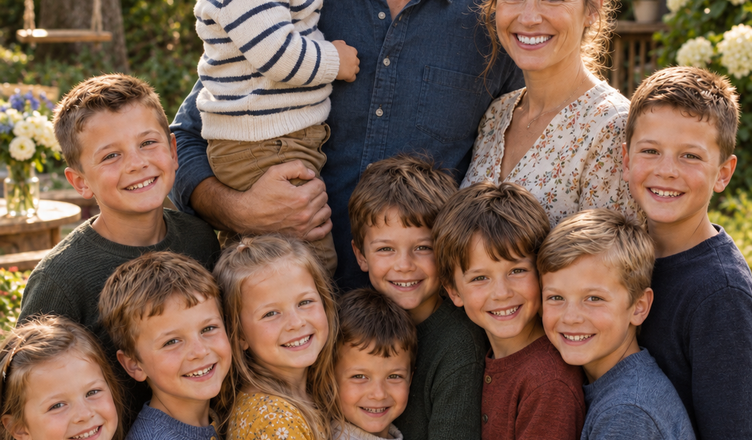
For seven years, I believed the river had taken Anna away.
There had been no funeral in the ordinary sense because there was no body to bury. There was only an investigation, a collection of personal belongings found near the water, weeks of searching, and eventually the terrible conclusion everyone around us learned to accept.
Anna was gone.
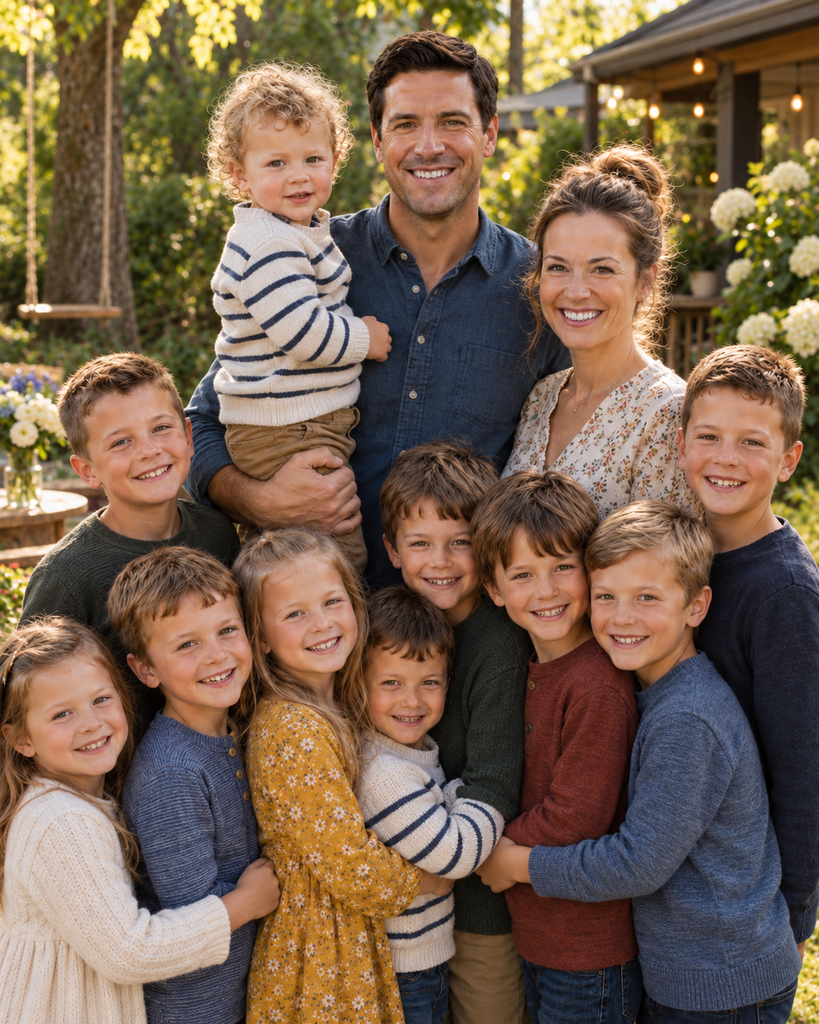
She had left behind ten children.
And somehow, I became the person responsible for keeping their world together.
I had been engaged to their mother, but we had not yet married. Technically, I had not been their father when Anna disappeared. Some of the younger children already called me Dad, while the older ones still used my first name.
None of that mattered after the night by the river.
They needed someone who would stay.
So I stayed.
For seven years, I packed lunches, washed mountains of clothes, learned which child hated tomatoes and which one pretended not to be afraid of thunderstorms. I attended school meetings, treated fevers, settled arguments and tried to stretch every paycheck across a household that never seemed to stop needing something.
Eventually all ten called me Dad.
I thought that was the greatest surprise life had left for me.
Then, one evening, Anna’s oldest daughter sat beside me and said something that made the previous seven years suddenly feel uncertain.
“Dad, I know what really happened to Mom that night.”
The Night Everything Changed
Anna disappeared in early autumn.
She had driven out after dinner, saying she needed some time alone. That was not unusual. Raising ten children meant privacy was rare, and sometimes she drove to a quiet area near the river simply to think.
She promised to be back before the younger children went to sleep.
She never returned.
The following morning, her car was discovered near a riverside path.
Some of her belongings were found nearby.
Search teams spent days examining the area. Police asked questions repeatedly. Friends and relatives joined searches.
Nothing produced the answer we desperately wanted.
The river was dangerous after several days of rain, and the assumption gradually became that Anna had somehow entered the water.
Exactly how remained unclear.
Accident?
A desperate decision?
Something else?
There was insufficient evidence to give us certainty.
That uncertainty became part of our family.
The younger children eventually stopped asking when she was coming home.
The older ones never really stopped wondering.
Neither did I.
Learning to Raise Ten Children
Grief did not suspend ordinary life.
Children still needed breakfast the morning after terrible news.
Shoes still became too small.
Homework still had deadlines.
Electricity bills still arrived.
During the first year, I survived by turning our lives into routines.
Monday was laundry.
Tuesday evening was shopping.
School bags were checked before bedtime.
A large whiteboard in the kitchen became the command center for appointments, sports practices and school events.
Everyone had chores appropriate to their age.
There were days when I failed spectacularly.
I once sent two children to school with each other’s lunches. I forgot a school performance until ten minutes before it began. I destroyed an entire load of clothes because somebody had left something bright red in the washing machine.
The children survived my mistakes.
I survived theirs.
Slowly, we became a family held together not by the life we had planned but by the life we had inherited.
Anna remained present everywhere.
Her photograph stood on the bookshelf.
We celebrated her birthday.
The children were allowed to talk about her whenever they wanted.
I never tried to replace her.
But as years passed, I noticed that Lily, the oldest, almost never joined those conversations.
She had been fourteen when her mother disappeared.
At twenty-one, she still changed the subject whenever that night was mentioned.
I assumed it was simply her way of grieving.
I was wrong.
“I Saw Her That Night”
The evening Lily finally spoke, the younger children were scattered throughout the house.
She sat beside me at the kitchen table.
Her hands were trembling.
“Dad, I need to tell you something.”
I immediately knew this was not an ordinary conversation.
“What happened?”
She looked toward the hallway to make sure nobody was listening.
Then she said, “I saw Mom the night she disappeared.”
For a moment, I thought I had misunderstood.
“What do you mean?”
“I followed her.”
The room seemed to shrink around me.
Lily had never told the police that.
She had never told me.
She explained that on the evening Anna left, mother and daughter had argued.
The argument had concerned Lily’s plans after school. She wanted greater independence; Anna thought she was moving too quickly.
It was the kind of conflict families have every day.
But Lily had been fourteen.
Everything had felt enormous.
When Anna drove away, Lily believed her mother was still angry with her. She borrowed an old bicycle and followed the route she knew Anna often took.
She stopped some distance from the river.
Then she saw her mother.
But Anna was not alone.
The Stranger Beside the Car
According to Lily, a man was standing near Anna’s vehicle.
“I couldn’t hear everything,” she said. “They were arguing.”
“Who was he?”
“I didn’t know.”
“Did you see his face?”
“Not properly.”
“Why didn’t you tell anyone?”
Lily began crying.
“Because Mom saw me.”
That answer made even less sense.
“She saw you?”
Lily nodded.
“She came over to me. She was furious that I’d followed her.”
“What did she say?”
Lily stared at the table.
“She told me to go home immediately. She said I wasn’t supposed to be there.”
“And you left?”
“I started to.”
There was more.
I could see it.
“But?”
“I looked back.”
Lily swallowed.
“The man had opened the passenger door. Mom got into his car.”
I felt cold.
“Willingly?”
“I don’t know. That’s what I’ve been trying to tell myself for seven years. I don’t know.”
That distinction mattered.
Memory, particularly a frightened teenager’s memory of an event from years earlier, could not establish exactly what had happened. Lily had witnessed something important, but neither of us could safely turn what she remembered into a complete explanation.
Still, one fact was impossible to ignore.
Anna had apparently left the riverside area in another vehicle.
If Lily remembered correctly, the assumption that Anna had entered the river that night might have been wrong.
Why She Stayed Silent
I was angry.
I wish I could say my first reaction was perfect compassion, but it wasn’t.
“Why didn’t you tell the police?”
Lily covered her face.
“I was scared.”
“For seven years?”
“At first I thought she’d come back.”
Her voice broke.
“Then everyone started saying she must have gone into the river. I thought maybe I had misunderstood what I saw.”
She had also carried another burden.
The last conversation between mother and daughter had been an argument.
Lily had spent years believing that if she had not argued with Anna, perhaps her mother would never have driven away.
It was the irrational arithmetic of childhood guilt: if event A happened before tragedy B, then A must somehow have caused B.
“You were fourteen,” I told her.
“I still lied.”
“You were fourteen.”
“I should have said something.”
“Yes,” I said quietly. “You should have.”
She looked at me, surprised.
I wasn’t going to tell her that hiding something so important had been harmless.
But neither was I going to allow a decision made by a frightened fourteen-year-old to define the rest of her life.
“And now,” I continued, “we’re going to tell someone.”
Opening the Case Again
The next morning, we contacted the authorities.
We did not attempt to investigate the mystery ourselves.
That mattered.
Seven years had passed. Memories could be incomplete. Records needed to be checked by people capable of distinguishing evidence from assumptions.
Lily gave a detailed account.
Investigators asked her to describe the second vehicle, the stranger and everything she remembered about the location.
She could not answer every question.
Some details were surprisingly clear.
Others had disappeared completely.
But her account gave investigators a reason to revisit the timeline.
Old records were reviewed.
People connected to Anna were reconsidered.
Investigators examined whether someone known to her might have been in the area.
Then came another discovery.
A camera from a business several kilometers from the river had been mentioned in the original investigation, but its relevance had apparently never been established. Archived documentation indicated that a vehicle broadly matching Lily’s description had traveled away from the area during the period in question.
It was not proof of who was inside.
But it was enough to deepen the mystery.
The story we had accepted for seven years was no longer the only plausible one.
The Hardest Possibility
The children eventually had to be told.
We did not tell them that their mother was alive.
We had no evidence of that.
We did not tell them that someone had harmed her.
We had no evidence of that either.
We told them only what we knew:
Lily had remembered and disclosed information suggesting Anna might have left the river area with another person.
The reaction was immediate.
Hope entered the house like a storm.
One child wanted to search social media.
Another asked whether Anna might be living in another country.
One became furious.
“If she’s alive, why didn’t she come back?”
I had no answer.
And that was the danger of hope without evidence.
For seven years, we had grieved a death we could not completely prove.
Now we faced the opposite temptation: imagining a reunion we could not prove either.
I gathered them around the same kitchen table where we had survived countless family crises.
“We don’t know what happened,” I said. “Until we do, we don’t invent answers.”
It was one of the hardest things I had ever told them.
What Lily Had Really Been Carrying
Later that night, I found Lily sitting alone.
“You hate me,” she said.
“No.”
“You should.”
“No.”
She looked at me.
“I kept this from everyone.”
“You were a frightened child carrying information you didn’t know how to handle.”
“That doesn’t make it okay.”
“No. But understanding why something happened isn’t the same as pretending it didn’t matter.”
She started crying again.
Then she asked the question beneath every other question.
“If I’d told you then, would we have found her?”
I wanted desperately to give her an answer.
But there wasn’t one.
“Maybe,” I said. “Maybe not.”
That was the truth.
And sometimes truth is less comforting than forgiveness.
Seven Years Later
The investigation did not suddenly produce a miraculous answer.
Real mysteries rarely resolve themselves in a single dramatic revelation.
There were leads.
There were interviews.
There were possibilities that initially seemed important and later led nowhere.
But Lily’s disclosure changed one essential thing: the family no longer treated an uncertain conclusion as unquestionable fact.
We learned to live with a new kind of uncertainty.
Was Anna dead?
Possibly.
Had she deliberately left?
Possibly.
Had something happened after she entered the stranger’s vehicle?
Possibly.
Anything more would have been speculation.
For the children, that was difficult.
For me, it was almost unbearable.
But our lives could not stop again while we waited.
The youngest child had barely remembered Anna when she disappeared. Now he was old enough to understand why everyone became quiet whenever her name appeared in official correspondence.
The older children were beginning adult lives of their own.
And Lily finally began putting down the guilt she had carried since fourteen.
What Makes Someone a Father
One evening, months after Lily’s confession, she came into the kitchen while I was washing dishes.
“You know something?” she said.
“What?”
“You never had to stay.”
I turned off the water.
Technically, she was right.
Seven years earlier, I had been a man engaged to a woman with ten children.
Then Anna disappeared.
I could have convinced myself that responsibility belonged to someone else.
Instead, I had stayed because by then those children were already part of my life.
Over time, responsibility became something deeper.
“You called me Dad,” I said.
Lily smiled.
“That wasn’t why you stayed.”
“No.”
“Why, then?”
I thought about seven years of lunches, illnesses, arguments, bills, birthdays and bedtime conversations.
“Because leaving wasn’t something I could imagine doing.”
For years, our family story had centered on the person who vanished.
Eventually, I understood that it was also about the people who remained.
We still wanted to know what happened to Anna.
We still hoped that somewhere, somehow, evidence would provide an answer.
But until that day, life continued.
Ten children had lost their mother under circumstances none of us fully understood.
A fourteen-year-old girl had carried a secret far too heavy for her.
And I had spent seven years learning something I never expected to learn:
Fatherhood had not begun for me with biology, marriage or a document.
It had begun with a decision repeated every morning.
Whatever happened next, I would still be there.