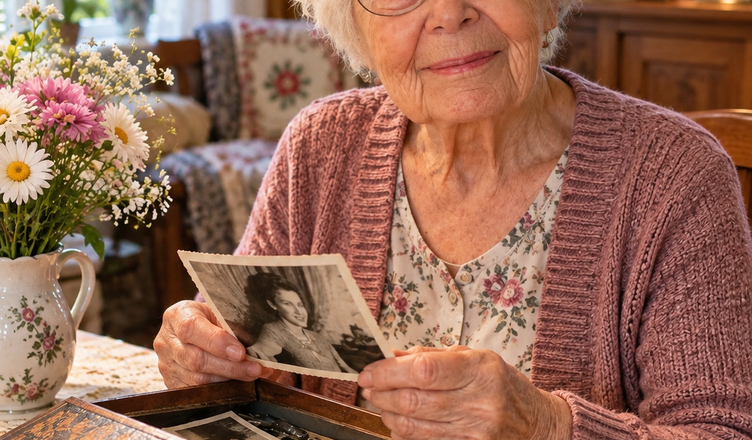
At ninety-seven, Arthur had learned that silence could have many meanings.
There was the peaceful silence of early morning, when the neighborhood had not yet awakened. There was the comfortable silence of sitting beside someone who knew you so well that conversation was unnecessary. And then there was another kind—the silence created by waiting for a telephone that never rang.
On the morning of his ninety-seventh birthday, Arthur woke shortly after seven.
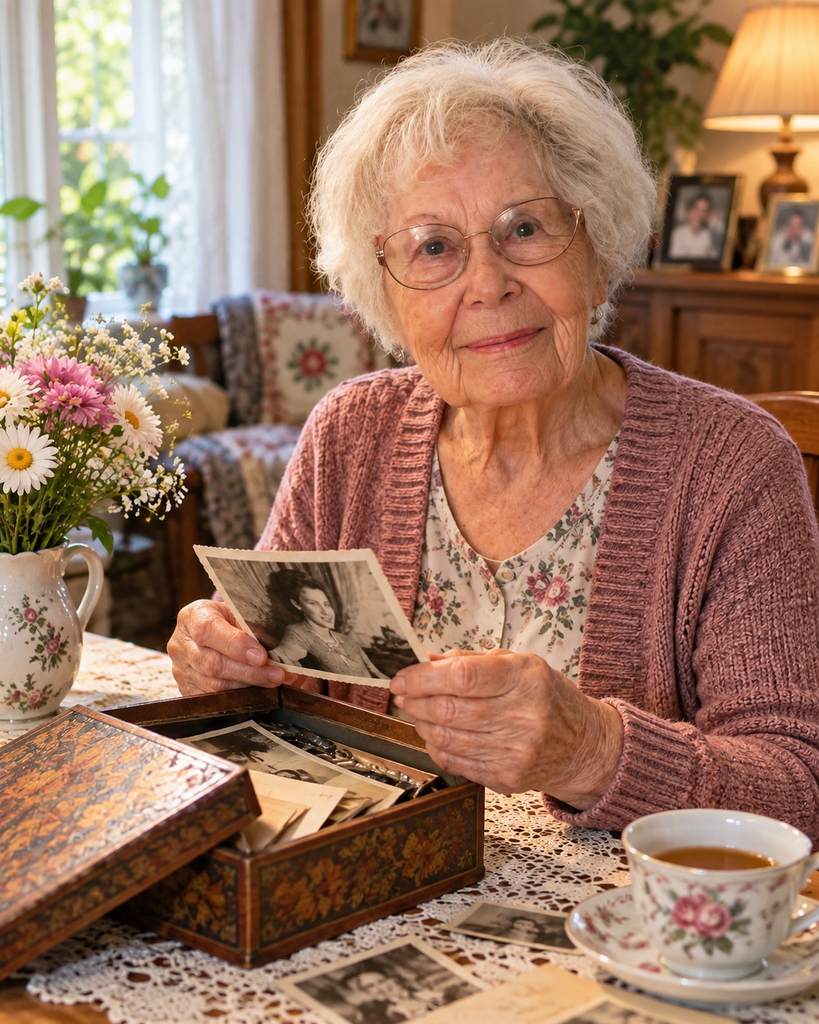
For several seconds he remained beneath the blankets, listening to the old clock in the hallway. Nothing about the room looked different from the day before. Sunlight entered through a narrow gap in the curtains, illuminating the chair where he placed his clothes each evening.
Then he remembered the date.
His birthday.
Years earlier, birthdays had meant noise. His wife would begin preparations before breakfast. There would be food covering the kitchen table, relatives arriving too early, grandchildren racing through the rooms and someone inevitably asking where the candles had been hidden.
Those celebrations belonged to another life now.
His wife, Margaret, had been gone for almost twelve years. Friends had disappeared gradually too. Some had died; others had moved into care homes or closer to their children. The circle that once seemed permanent had become smaller with every passing year.
Arthur had learned to accept much of that.
There was only one absence he had never truly accepted.
His son, Daniel.
The Argument That Lasted for Years
Arthur could no longer remember exactly when disagreement had become distance.
That was perhaps the saddest part.
There had been no single dramatic betrayal, no moment when one of them announced that their relationship was over. Instead, there had been a succession of arguments, stubborn silences and conversations that ended too quickly.
Daniel believed his father had interfered too much in his life.
Arthur believed he had only been trying to help.
Both men had said things they regretted. Neither had been particularly good at admitting it.
After Margaret died, their relationship deteriorated further.
At first Daniel called occasionally. Then months passed between conversations. Eventually Arthur realized he could no longer remember the last time they had spoken properly.
Years went by.
He told people it did not bother him.
“My son has his own life,” he would say.
But every birthday, Christmas and Father’s Day, Arthur kept his telephone close.
Hope, he discovered, could survive long after pride insisted there was nothing left to hope for.
A Cake for One
That afternoon Arthur put on his coat and walked slowly to a small bakery several streets away.
The woman behind the counter asked what he wanted.
He pointed to one of the smallest cakes in the display.
It was barely large enough for two people.
“Birthday?” she asked while placing it into a box.
Arthur nodded.
“Whose?”
“Mine.”
She smiled and wished him a happy birthday.
It was the first time anyone had said those words to him that day.
He thanked her and carried the box home carefully.
In the kitchen he found an old packet of candles in a drawer. There were not enough for ninety-seven, of course, and he would not have used that many even if there had been.
One candle was enough.
He placed it in the center of the cake.
Then he sat down.
The Phone Stayed Silent
Arthur had received no birthday cards in the mail.
There were no messages waiting for him.
No knock came at the door.
He made tea, although by the time he remembered to drink it, it had gone cold.
Every so often he looked toward the telephone.
He knew what he was doing, and he disliked himself slightly for doing it.
Daniel had not called the previous year.
Or the year before that.
Why should ninety-seven be different?
Yet birthdays have a strange way of making people measure time. At ninety-seven, Arthur could not comfortably tell himself that there would always be another opportunity.
He wondered whether Daniel understood that.
Then another thought came, one he had avoided for years:
Perhaps Daniel was waiting too.
Perhaps both of them had spent years expecting the other person to make the first move.
The Cost of Pride
Family estrangement is rarely as simple as outsiders imagine. Sometimes separation is necessary, particularly when a relationship is harmful or unsafe. In other cases, families drift apart through unresolved conflict, incompatible expectations, accumulated resentment or repeated misunderstandings.
Time does not automatically repair those wounds.
Sometimes it makes them harder to address.
After several years, making contact can feel more difficult than it did after several weeks. People begin wondering what they could possibly say. They fear rejection. They rehearse old arguments. They convince themselves that silence is proof the other person no longer cares.
Arthur had done all of those things.
He had written Daniel’s number on a piece of paper even though it was already stored in his telephone.
Several times over the years, he had picked up the receiver.
Several times, he had put it down again.
He always found a reason.
Daniel was probably working.
It was too late.
It was too early.
Perhaps next Sunday would be better.
Eventually, “next Sunday” became years.
One Candle
As evening approached, Arthur turned on the kitchen light.
The little cake was still sitting untouched on the table.
He found a box of matches and lit the candle.
The flame flickered in front of him.
For a moment he closed his eyes.
He did not wish for money or more possessions. At his age, there was very little he wanted to acquire.
He wanted a voice.
One familiar voice saying, “Happy birthday, Dad.”
Arthur opened his eyes and blew out the candle.
A thin trail of smoke curled toward the ceiling.
The telephone had still not rung.
He cut himself a small piece of cake but ate only two bites.
Then he looked at the phone again.
This time something felt different.
Perhaps it was the absurdity of sitting alone waiting for another person to perform an act he himself was equally capable of performing.
Perhaps it was the candle.
Perhaps it was simply the realization that ninety-seven years had taught him many things, yet he was still allowing pride to make decisions for him.
Arthur reached for the telephone.
The Number He Had Never Forgotten
He entered Daniel’s number slowly.
His finger hovered over the final button.
What if Daniel did not answer?
What if the number had changed?
What if he answered but did not want to speak?
Arthur suddenly felt more frightened than he had expected.
Then another possibility occurred to him.
What if Daniel did want to speak?
That possibility frightened him too.
He pressed the button.
The phone rang once.
Twice.
Three times.
Arthur nearly ended the call.
Then someone answered.
“Hello?”
Arthur recognized his son’s voice immediately.
For a few seconds, he could not speak.
“Hello?” Daniel repeated.
Arthur swallowed.
“It’s Dad.”
Silence.
Not the cold silence Arthur had feared, but something uncertain and startled.
Then Daniel said quietly, “I know.”
Arthur gripped the telephone with both hands.
Neither man seemed to know how to begin.
So Arthur abandoned the speech he had unconsciously rehearsed for years.
“It’s my birthday,” he said.
“I know that too.”
Arthur looked at the extinguished candle.
“I thought you might call.”
Another pause followed.
When Daniel finally answered, his voice sounded different.
“I thought about it all day.”
“Why didn’t you?”
The question came out more sharply than Arthur intended.
Daniel did not respond immediately.
Then he said, “Probably for the same reason you didn’t call me all these years.”
Arthur had no answer.
Because his son was right.
When Being Right Stops Mattering
They did not solve everything during that first conversation.
There was no miraculous apology capable of erasing years of resentment.
Daniel still remembered things differently from his father. Arthur still believed some accusations against him were unfair.
But for the first time in years, neither of them seemed interested in winning.
Arthur apologized for some things.
Daniel apologized for others.
At one point they both became quiet.
Then Daniel asked the simplest question imaginable.
“Did you get yourself a cake?”
Arthur laughed.
It surprised him how unfamiliar the sound felt in the quiet kitchen.
“Yes.”
“What kind?”
“Chocolate.”
“You always hated chocolate cake.”
“It was the smallest one they had.”
Daniel laughed too.
That tiny exchange did more to soften the distance between them than any grand declaration could have done.
Before ending the call, Daniel asked whether he could visit.
Arthur stared at the empty chair across the table.
“When?”
“Tomorrow, if that’s all right.”
Arthur wanted to say that tomorrow was far too late.
Instead he said, “Come for lunch.”
The Second Piece of Cake
After the call ended, Arthur remained at the table.
Nothing in the house had physically changed.
The dishes still needed washing. The hallway clock continued ticking. The birthday candle remained bent slightly in the middle.
But the silence no longer felt the same.
Arthur cut another piece of cake.
He ate it slowly.
For years, he had imagined reconciliation as a dramatic moment in which one person would finally admit that the other had been right.
Instead, it had begun with five ordinary words:
“It’s Dad. It’s my birthday.”
There was something humbling about that.
People often postpone difficult conversations because they are waiting for the perfect opening. They want certainty that an apology will be accepted or that a phone call will be welcomed.
Life rarely offers such certainty.
And reconciliation is not always possible or appropriate. Some relationships need firm boundaries, and forgiveness does not require returning to circumstances that caused harm.
But when the obstacle is primarily pride, fear or years of accumulated silence, waiting carries its own cost.
Arthur understood that more clearly at ninety-seven than he had at seventy.
The Knock at the Door
The following afternoon, shortly after noon, someone knocked.
Arthur had been waiting since ten.
He walked toward the door slowly, telling himself not to expect too much.
When he opened it, Daniel stood on the step.
He looked older than Arthur remembered.
Of course he did.
Years had passed for both of them.
Daniel held a paper bag in one hand.
For a moment, father and son simply looked at each other.
Then Daniel lifted the bag.
“I brought a cake.”
Arthur glanced toward the kitchen, where half of yesterday’s chocolate cake remained.
“I already have one.”
Daniel smiled.
“I brought your favorite.”
Arthur stepped aside and opened the door wider.
“Then you’d better come in.”
It was not a perfect ending.
It was something more useful: a beginning.
And on the day after his ninety-seventh birthday, Arthur finally understood that sometimes the call we spend years waiting to receive is the call we must be brave enough to make ourselves.