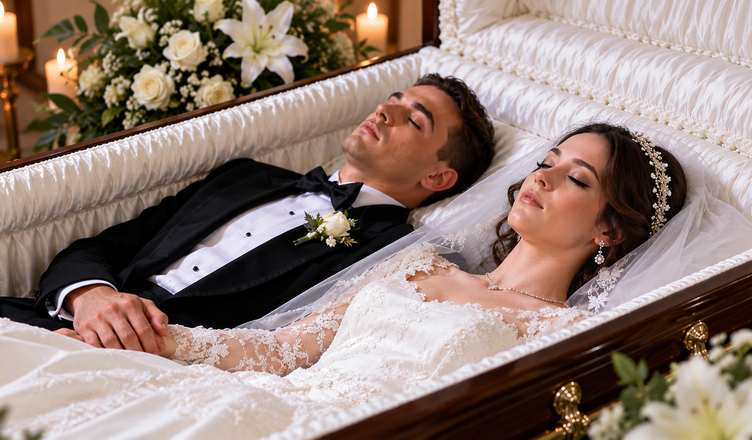
Thirty minutes earlier, everyone had been smiling.
Laura Bennett and James Miller had exchanged vows in a small country chapel surrounded by family and friends. There had been photographs on the stone steps, congratulations from relatives and the familiar confusion of guests trying to decide who was traveling with whom to the reception.
Then the bride and groom left together.
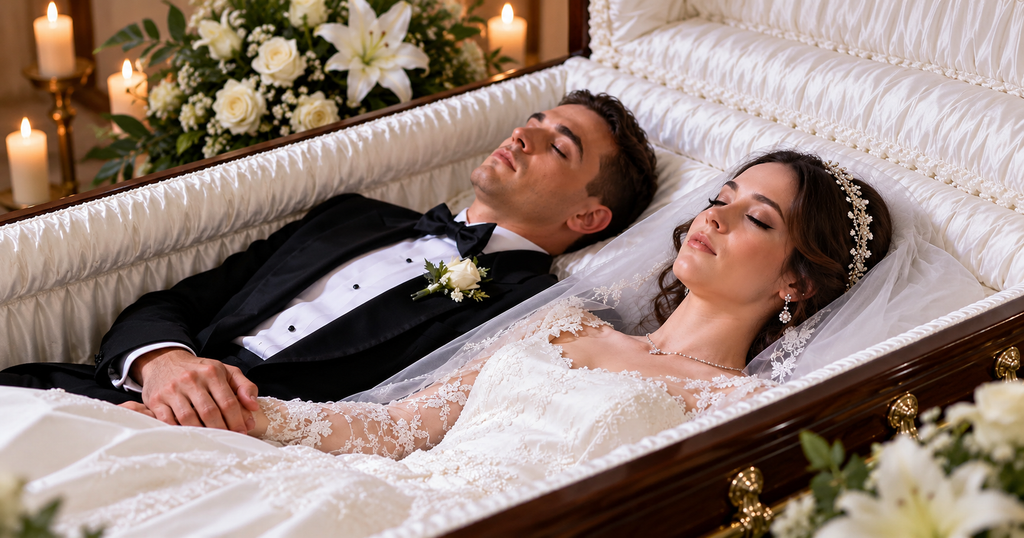
They never arrived.
By evening, the flowers were still waiting on the reception tables, the cake remained untouched, and two families were trying to understand how a wedding day could become a day of mourning so quickly.
But the tragedy would soon acquire another mystery.
When investigators examined the belongings recovered after the accident, they discovered that both newlyweds had been holding pieces of the same object shortly before they died.
At first, nobody could explain why.
This is a fictional story inspired by the original premise. The characters and circumstances are invented and are not presented as a documented real-life case.
A Wedding Without Anything Extravagant
Laura and James had known each other for six years.
They were not interested in an elaborate wedding. They wanted a short ceremony, dinner with the people closest to them and enough music afterward to keep everyone dancing.
The reception venue was about twenty minutes from the chapel.
Most guests traveled there immediately after the ceremony.
Laura and James left several minutes later in James’s restored blue sedan.
The car mattered to him.
It had originally belonged to his grandfather, and James had spent years repairing it.
Before leaving, he tied a small white ribbon to the antenna.
Laura laughed when she saw it.
“That is your contribution to the decorations?”
“It’s tasteful.”
“It’s one ribbon.”
“Exactly. Understated elegance.”
Those were among the last ordinary words anyone remembered them saying.
They Never Reached the Reception
At first, nobody worried.
Newlyweds often disappear briefly after a ceremony for photographs.
Ten minutes passed.
Then twenty.
Laura’s sister tried calling.
No answer.
James’s father called next.
Nothing.
The first real alarm came when another guest arrived at the reception and said there had been emergency vehicles on the old river road.
James had planned to use that road.
Several relatives immediately left the venue.
Police stopped them before they reached the scene.
There had been a serious collision near a narrow bridge.
The blue sedan was involved.
The Celebration Fell Silent
News traveled through the reception hall in fragments.
First, there had been an accident.
Then someone said both Laura and James were injured.
Finally came the information nobody was prepared to hear.
Neither had survived.
The music was turned off.
Food remained untouched.
Guests who had been raising glasses less than an hour earlier now sat silently at decorated tables.
The wedding cake remained in the center of the room.
Laura’s mother later asked staff to remove it because she could not bear to look at the figures of a bride and groom standing together on top.
Two families had arrived expecting a marriage celebration.
Instead, they began making funeral arrangements.
Investigators Still Had Questions
The initial evidence suggested a road accident.
It had rained earlier, leaving portions of the route wet. The road near the bridge curved sharply and had limited visibility.
Investigators examined the vehicle, the road surface and other available evidence to reconstruct what had happened.
There was no reason to create a supernatural explanation for the deaths.
Accidents can happen within seconds.
But one discovery inside the damaged car confused everyone.
A small object had broken apart.
One portion was found close to Laura.
Another was near James.
It appeared they had both been handling it shortly before the collision.
The object was a small wooden box.
Nobody Recognized It
Police returned the recovered pieces to the family after they were no longer required.
James’s father had never seen the box.
Neither had Laura’s mother.
It was old and handmade, with a simple brass clasp.
The impact had split one corner, but the interior had survived surprisingly well.
Inside was a folded sheet of paper and an old photograph.
The photograph showed a young couple standing beside the same blue car James had driven on his wedding day.
The man was James’s grandfather, William.
The woman beside him was not James’s grandmother.
That immediately created questions.
Who was she?
Why was the photograph hidden in the box?
And why had Laura and James apparently opened it while driving away from their wedding?
The Letter Provided Part of the Answer
The paper inside had been written by William many years earlier.
It was not a confession of a crime or evidence of some hidden danger.
It was a personal letter.
Before marrying the woman who later became James’s grandmother, William had been engaged to another young woman named Eleanor.
According to the letter, Eleanor died unexpectedly before their planned wedding.
The blue car had belonged to William at the time.
He had kept the photograph because it represented a period of his life he never wanted to pretend had not existed.
Years later, William married, raised a family and loved his wife.
But he had apparently preserved that earlier memory privately.
At the end of the letter, he wrote about something broader than Eleanor.
He wrote about how quickly life could change and how foolish it was to postpone affection, apologies or happiness simply because people assumed there would always be more time.
But How Did the Box Get Into the Car?
That question remained.
Then James’s younger brother, Nathan, remembered something.
Several months earlier, while helping clear their grandfather’s old workshop after his death, James had found the box inside a locked cabinet.
He had not opened it.
James believed it might contain something intended for his father and decided to keep it safe until the family had time to go through the remaining possessions together.
On the morning of the wedding, Nathan had seen the box again.
James had placed it in the glove compartment.
Why?
Nobody knew for certain.
Perhaps he had simply moved it while cleaning the car.
Perhaps he intended to give it to his father later that evening.
Anything beyond that would have been speculation.
A Photograph Changed the Interpretation
Weeks after the funeral, the wedding photographer delivered the final images.
Laura’s sister almost could not open them.
The photographs showed everything the family had lost: Laura adjusting James’s tie, James laughing during the ceremony, their parents embracing them outside the chapel.
Then one photograph caught Nathan’s attention.
It had been taken just before Laura and James drove away.
Laura was sitting in the passenger seat.
The glove compartment was open.
The wooden box was visible in her hands.
Suddenly, the mystery became much simpler.
Laura had apparently discovered the box while getting into the car.
She and James had likely opened it together.
That explained why pieces were later found near both of them.
It did not explain the accident.
And investigators found no reliable basis for claiming that the box itself caused the collision.
The timing was eerie.
But eerie timing is not evidence.
The Family Refused to Turn It Into a Legend
As the story spread among acquaintances, people began embellishing it.
Someone claimed the photograph showed a woman who looked exactly like Laura.
It did not.
Another person suggested William’s fiancée had died on the same road.
There was no evidence of that either.
Someone else described the letter as a warning never to marry.
It said nothing of the kind.
Laura’s family eventually became frustrated.
Two people had died.
That tragedy was real enough.
It did not need ghosts, curses or invented coincidences to make it meaningful.
What remained extraordinary was the contrast.
On the happiest day of Laura and James’s lives, they had accidentally opened a message written decades earlier about the uncertainty of life.
Then, within a remarkably short period, both were gone.
The coincidence was heartbreaking without being supernatural.
The Funeral Was Held Together
The families decided on a joint funeral.
Laura was buried wearing her wedding ring.
James wore his.
The wooden box was not placed in either coffin.
Instead, James’s father kept it.
For a long time, he could not bring himself to read William’s letter again.
When he finally did, one idea stayed with him.
People behave as though time is an account with an unlimited balance.
They postpone visits.
They remain angry for years.
They wait to say thank you.
They assume another Christmas will come, another birthday, another ordinary Tuesday.
Usually, there is another day.
Sometimes there isn’t.
The Last Photograph
Laura’s mother eventually chose one wedding photograph for her living room.
It was not the formal portrait.
It was a candid image taken immediately after the ceremony.
Laura and James were walking toward the car.
Neither was looking at the camera.
James had said something that made Laura laugh.
Her head was tilted toward him.
One hand held her bouquet.
The other held his arm.
There was no tragedy in the photograph because, at that moment, tragedy had not happened yet.
There were only two newly married people heading toward what they assumed would be the rest of their lives.
Perhaps that is why the picture became more important to the family than the mysterious box.
The box encouraged questions about the final minutes.
The photograph reminded them of everything that came before.
What the Mystery Really Meant
There is a natural human desire to find meaning when tragedy and coincidence collide.
We search for warnings.
Patterns.
Signs.
Explanations that make sudden loss feel less random.
But not every strange detail is a hidden message.
Sometimes a wooden box is simply an old family keepsake.
Sometimes a decades-old letter happens to be read at an unimaginably poignant moment.
And sometimes the most responsible conclusion is also the hardest one:
We do not get to know why every event happens when it does.
Laura and James had been married for barely half an hour.
Their marriage was tragically short, but its length did not determine whether the love preceding it mattered.
They had spent years choosing one another before they ever stood in front of an officiant.
The most haunting detail of their final journey was not what investigators found in their hands.
It was what William’s old letter had already understood.
Human beings are very good at imagining tomorrow.
We are much less comfortable remembering that tomorrow is never guaranteed.
That does not mean living in fear.
It means recognizing the value of ordinary moments while they are still ordinary—before photographs, possessions and unfinished plans become the things other people use to remember us.