By the time my grandmother’s will was read, grief had already turned into arithmetic.
My uncle wanted to know what the house was worth. My aunt was interested in the jewelry. My cousins whispered about furniture, savings and whether the small piece of land behind the house might someday be valuable.
I sat at the end of the table listening to people divide the remains of a life that had taken eighty-four years to build.
Then the lawyer mentioned Nuka.
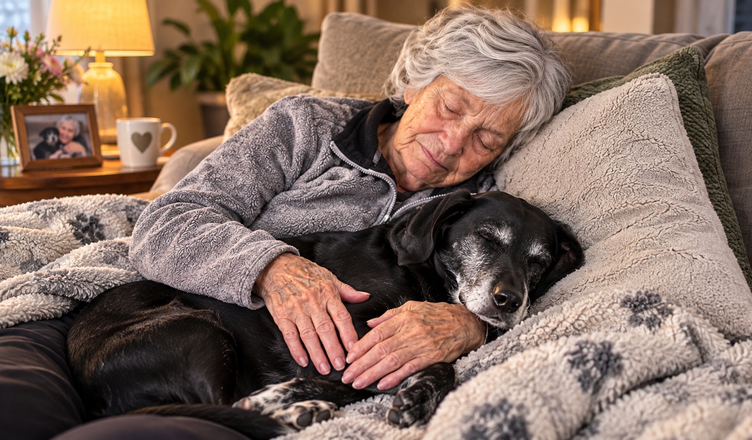
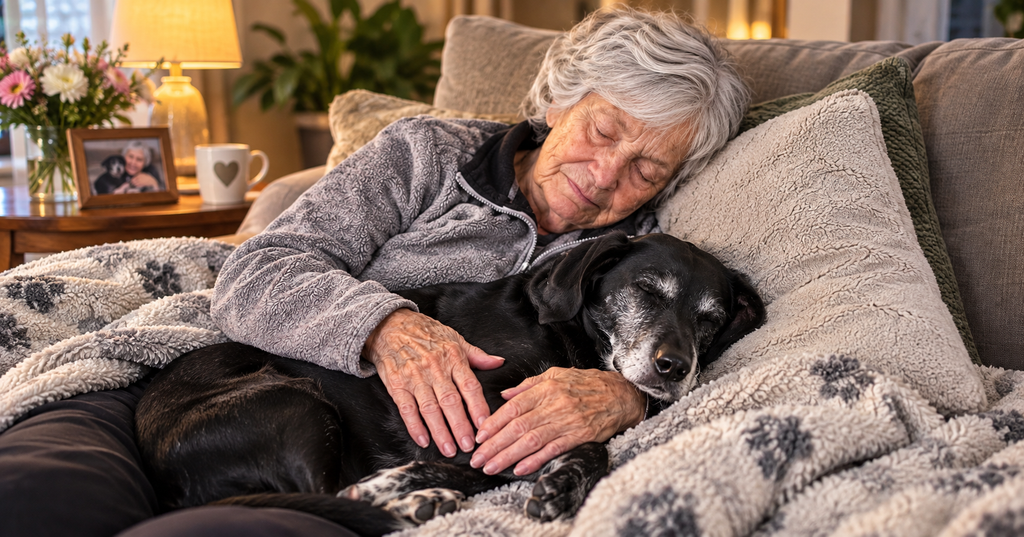
My grandmother’s old dog was thirteen, gray around the muzzle and increasingly slow on his back legs. He had slept beside her chair for years and followed her through the garden every morning.
Nobody wanted him.
“I’ll take Nuka,” I said.
Several relatives looked relieved.
I thought I was leaving with the least valuable part of the inheritance.
That evening, I discovered Grandma had arranged things very differently.
The One Thing Nobody Could Divide
Nuka had been with my grandmother since my grandfather died.
She had adopted him from a local shelter when he was already several years old. After that, the two were almost inseparable.
Whenever I visited, Grandma would sit in her kitchen drinking tea while Nuka rested beneath the table.
“He knows when people are pretending,” she once told me.
I assumed she was joking.
After her funeral, however, Nuka seemed lost.
He walked from room to room searching for her. Every time a car stopped outside, his ears lifted.
Watching him made the arguments over furniture seem even uglier.
When I offered to take him, my aunt warned me that an elderly dog could become expensive.
I knew that.
I also knew Grandma would have hated the idea of Nuka spending his final years back in a shelter.
So I put his blanket in my car, opened the passenger door and told him we were going home.
Something Inside the Collar
My apartment was unfamiliar to him.
He spent the first hour walking cautiously from room to room before finally settling beside the sofa.
Later that evening, I noticed his collar was sitting awkwardly against his neck.
It was an old brown leather collar Grandma had bought years earlier. The lining had begun to separate.
When I adjusted it, my fingers touched something hard beneath the fabric.
At first, I thought part of the buckle had broken.
I removed the collar.
There was a small stitched section on the inside that did not match the original seam.
Someone had opened the lining and sewn it closed again.
I found a pair of scissors.
Inside was a tiny brass key wrapped in plastic.
With it was a folded strip of paper.
My name was written on the outside.
“Daniel.”
I stared at it for several seconds before opening it.
There was only one sentence:
“If Nuka is with you, then I was right about what mattered.”
Underneath was the name of a bank.
I Almost Called My Family
My first thought was that I should telephone my mother.
My second was that I should call the lawyer.
I chose the lawyer.
The next morning, I showed him the key and note.
He looked genuinely surprised.
Nothing in Grandma’s will mentioned a key hidden in Nuka’s collar.
He advised me not to make assumptions and helped determine what the bank information referred to.
The key belonged to a safe-deposit box.
Grandma had maintained it separately from the accounts listed in her estate documents.
That did not automatically mean whatever was inside belonged to me. Ownership and inheritance rules are legal matters, and a hidden key cannot simply override a valid will.
So we followed the proper process.
Several days later, with the required documentation in place, the box was opened.
I had spent the entire week imagining money.
What I found was far more complicated.
The Box Contained a Family History
There were no stacks of cash.
No diamonds.
No secret fortune.
Instead, the box contained envelopes, photographs, copies of documents and a small wooden case.
On top was a letter addressed to me.
Grandma had written it several months before her death.
She explained that she had watched the family become increasingly interested in what would happen to her possessions as her health declined.
Questions about the house had started while she was still living in it.
People who rarely visited suddenly wanted to know whether she had updated her will.
She did not condemn them.
She simply noticed.
Then she wrote about Nuka.
She worried that after her death everyone would want something valuable, while nobody would want responsibility.
So she had created a private test.
Not a legal trick.
Not a way to secretly transfer her estate.
A test of character.
She believed the person who willingly took Nuka without expecting anything in return was the person she could trust with something more personal.
A Story I Had Never Been Told
The photographs inside the box were decades old.
One showed Grandma as a young woman standing beside a man I did not recognize.
Another showed a small farmhouse.
There were letters between Grandma and her older sister, Margaret, whose name I had heard only a few times growing up.
As I read, a forgotten family story emerged.
Margaret had left home after a serious disagreement with their parents. For years, the sisters exchanged letters secretly.
Later, Margaret became ill.
She had no children.
Before she died, she entrusted Grandma with several family documents and a collection of photographs belonging to their mother.
Grandma had kept everything.
Why hide it?
Her letter explained that certain relatives had wanted the old papers destroyed because they documented an uncomfortable part of the family’s history: disputes over property, estrangements and decisions people preferred not to discuss.
Grandma disagreed.
She believed family history should not be edited simply because later generations found parts of it embarrassing.
She wanted someone to preserve the collection rather than sell it, discard it or use it as ammunition in another argument.
That person, apparently, was me.
Then I Opened the Wooden Case
Inside was a pocket watch.
It had belonged to my great-grandfather.
I recognized it from an old photograph.
There was also a handwritten note identifying previous owners and explaining how it had passed through the family.
The watch had some monetary value, but probably nowhere near what my relatives were arguing about.
Its importance was historical.
Grandma had not hidden treasure.
She had hidden memory.
That realization changed the way I understood her strange little test.
She did not want to reward the person clever enough to find the key.
She wanted to choose someone willing to care for something that could not repay them.
Nuka was the proof.
The Family Eventually Found Out
Secrets rarely remain secret in families.
When I told my mother about the documents, she was fascinated.
My aunt was less pleased.
“So she left you something extra?”
“Not exactly.”
I explained that the materials still had to be handled consistently with the estate and applicable legal requirements. I was not claiming ownership merely because my name appeared on a private letter.
That answer disappointed anyone hoping for another inheritance battle.
The old photographs were digitized.
Copies were offered to relatives.
The original letters and documents were stored properly.
The pocket watch remained part of the family collection rather than disappearing into a drawer.
For the first time since Grandma’s death, we were discussing her life rather than the price of her belongings.
Nuka Didn’t Care About Any of It
While the adults debated history, Nuka adjusted to my apartment.
He discovered the warm patch of sunlight near the balcony door.
He learned exactly where I kept his treats.
He began waiting beside the entrance when I came home from work.
Caring for him was not always easy.
His joints needed attention. He required veterinary visits. Some nights he wandered restlessly.
My aunt had been right about one thing: an elderly dog was a responsibility.
But responsibility was precisely the point.
Grandma had understood something the rest of us temporarily forgot.
An inheritance is usually described in terms of what someone receives.
Sometimes the more revealing question is what someone is willing to take care of.
What Grandma Actually Left Me
Months later, I reread her letter.
One sentence stood out:
“People tell you who they are by what they value when nobody is watching.”
I thought about the afternoon after the will was read.
Nobody in my family was evil.
They were grieving imperfectly.
Money can make grief complicated, especially when old resentments and expectations are involved.
But Grandma had anticipated that.
So she left behind one final lesson.
The house would eventually belong to someone else.
The jewelry would be distributed.
Furniture would be moved.
Money would be spent.
But the stories in that safe-deposit box could survive if someone bothered to protect them.
And Nuka needed someone for the same reason.
Neither the dog nor the photographs could compete with property in financial value.
Yet they contained the parts of Grandma’s life that money could not measure.
The Last Evening
Nuka lived with me for almost two more years.
Near the end, he moved slowly and slept more than he was awake.
One evening, I sat beside him with Grandma’s old photographs spread across the floor.
There she was at twenty.
At thirty-five.
At sixty.
In one picture, taken years later, Nuka sat beside her in the garden.
I looked down.
The same dog was sleeping with his head against my foot.
That was when I finally understood what Grandma had done.
The key in the collar had never been the real secret.
The secret was that she knew exactly how her family would behave after she was gone—and she had chosen to entrust her most personal memories not to the person who demanded the largest share, but to the person who accepted the responsibility everyone else considered worthless.
I had walked away from the inheritance meeting thinking I had received nothing.
In reality, I had taken home the one living piece of Grandma’s world that still needed me.
And hidden beneath his old collar was her final reminder that the most valuable things we inherit are not always the things we can sell.