For many people, changing their appearance begins with something small. A different hairstyle, a new way of applying makeup, or a change in clothing can create a sense of confidence and renewal. Cosmetic procedures can serve a similar purpose. Yet for some people, the desire for change develops into something far more ambitious: a long-term attempt to create an entirely new appearance.
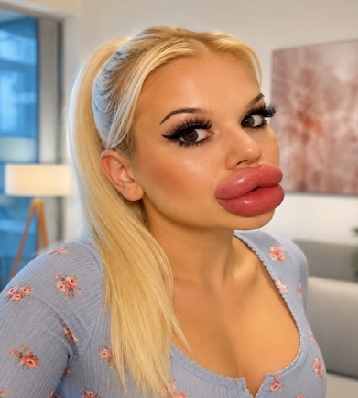
One young woman attracted attention after undergoing a dramatic transformation inspired by an idealized, doll-like image of beauty. Over approximately five years, she reportedly underwent a number of cosmetic procedures, including treatments intended to make her lips fuller and her cheekbones more prominent. The total amount she was reported to have spent was close to $10,000.
Her story became interesting to the public not simply because she had changed her appearance, but because of the contrast between the person she had been before the procedures and the image she eventually created.
A Transformation That Happened Gradually
Dramatic before-and-after photographs can make cosmetic transformations appear almost instantaneous. In reality, substantial changes usually happen gradually.
In this case, the transformation developed over several years rather than through one single procedure. Fuller lips and more pronounced cheekbones became important elements of the look. As those changes accumulated, the woman’s appearance moved increasingly toward the exaggerated facial proportions often associated with dolls and heavily stylized beauty imagery.
This distinction matters. A person rarely wakes up one morning looking completely different. Instead, one modification can alter the proportions of the face and influence decisions about what should be changed next.
Enhancing the lips, for example, can make other facial features appear smaller or less prominent by comparison. Increasing the definition of the cheekbones can change how the jaw, eyes and lower face are perceived. Makeup, hairstyles, lighting and photography can intensify those effects even further.
The final appearance therefore represents more than the result of individual procedures. It is the cumulative effect of many decisions made over time.
Why the Doll-Like Look Has Such Appeal
The desire to resemble a doll may sound unusual, but it reflects a broader fascination with highly controlled forms of beauty.
Dolls traditionally represent an appearance that does not age, become tired or develop ordinary imperfections. Their features are deliberately stylized: smooth skin, symmetrical proportions, prominent eyes, carefully shaped faces and exaggerated lips are common characteristics.
Of course, human faces do not naturally operate according to those rules.
Real faces move. They change with age, expression, weight, health and countless other factors. Small asymmetries are normal. A face that looks striking in a carefully posed photograph may look completely different while speaking, laughing or simply walking through everyday life.
For someone pursuing a doll-inspired appearance, however, realism may not be the objective. The purpose can instead be to create a distinctive visual identity.
That makes such transformations different from cosmetic procedures intended to produce subtle results. One person might want a treatment that nobody notices. Another may specifically want people to notice.
Neither motivation can be understood solely by looking at the procedure itself.
The Power of the Before Photograph
Whenever a dramatic transformation becomes popular online, one question appears almost immediately: What did the person look like before?
That curiosity explains why old photographs often become more fascinating than pictures showing the finished transformation.
The «before» image provides a reference point. Without it, viewers simply see a person with an unusual appearance. With it, they can understand how extensive the transformation has actually been.
Sometimes the contrast is so substantial that viewers say they would not have recognized the same person.
Yet before-and-after comparisons should also be treated carefully. Photographs are not neutral measurements of appearance. Camera lenses, angles, facial expressions, makeup, hairstyles and lighting can dramatically influence how a face looks.
An older photograph taken casually on an ordinary camera may be compared with a professionally styled image created years later. That comparison can exaggerate the apparent difference.
Even so, photographs remain powerful because they compress years of personal decisions into two images placed side by side.
Cosmetic Procedures and Personal Identity
The most interesting part of a major appearance transformation may not be the procedures themselves. It is the question of identity behind them.
People have always modified their appearance. Hair, clothing, jewelry, tattoos and makeup have been used for centuries to communicate status, personality, culture and belonging. Modern cosmetic treatments simply provide additional methods of changing the body.
The difference is that some contemporary procedures can alter facial proportions in ways that were previously difficult to achieve without surgery.
That creates possibilities previous generations did not have.
A person who dislikes a particular feature no longer necessarily has to accept it permanently. At the same time, having more options can create new pressures. Once changing one feature becomes possible, it can be tempting to reconsider another.
The boundary between self-expression and dissatisfaction is not always obvious from the outside.
A dramatic appearance does not automatically prove that someone is unhappy with themselves. Some people genuinely enjoy experimentation and intentionally create unconventional looks. Others may be responding to insecurity, social pressure or an evolving personal beauty standard.
Without direct evidence from the individual, outsiders should be cautious about assigning psychological motives.
Social Media Changed the Beauty Landscape
Transformations of this kind have become especially visible during the social-media era.
In earlier decades, most people compared themselves primarily with people they encountered in everyday life and with celebrities appearing in professionally produced media. Today, anyone with a smartphone can encounter thousands of carefully selected faces in a matter of hours.
Those images are frequently optimized.
Lighting improves skin texture. Makeup changes facial proportions. Filters enlarge eyes, smooth skin and reshape features. Editing applications can modify a face before the photograph is published.
The result is a strange reversal: digital tools can first create an unrealistic face on a screen, and cosmetic treatments can then be used in an attempt to reproduce elements of that appearance in real life.
Repeated exposure can also change perception. A feature that initially appears unusually large may eventually begin to look normal after someone sees similar images every day.
This phenomenon helps explain why beauty trends can escalate. When fuller lips become common, even fuller lips may be required to produce the same visual impact. When strongly defined cheekbones become familiar, more dramatic contouring may attract attention.
Online attention can reinforce that cycle because unusual appearances tend to generate reactions.
The Cost Is More Than a Single Number
The reported figure of nearly $10,000 makes the transformation sound like one large purchase, but cosmetic changes accumulated over years are better understood as an ongoing expense.
Some procedures are temporary and require maintenance. Results can fade, preferences can change, and additional treatments may be considered necessary to preserve a particular appearance.
The true financial commitment therefore depends on much more than the initial cost.
There are also medical considerations. Cosmetic procedures vary greatly in complexity and risk, and even minimally invasive treatments should be performed by appropriately qualified professionals. Potential complications depend on the specific procedure, the substances or devices involved, the person’s health and the practitioner’s technique.
That part of the story can disappear when transformations are reduced to spectacular photographs.
The internet sees a before picture and an after picture. It does not necessarily show consultations, recovery periods, maintenance, discomfort or complications if they occur.
Beauty or Excess?
Public reactions to extreme transformations are rarely neutral.
Some viewers admire the confidence required to create such a distinctive appearance. They see cosmetic modification as an extension of personal freedom: if an adult understands the consequences and chooses to change their appearance, the decision belongs to them.
Others find highly modified faces unsettling or excessive. They may prefer features that appear natural and wonder why someone who looked attractive before would want such extensive changes.
Both responses reveal something about how subjective beauty actually is.
There is no universal point at which fuller lips become «too full» or prominent cheekbones become «too prominent.» Cultural expectations, fashion and personal taste influence those judgments.
Beauty standards also change remarkably quickly.
Features criticized during one generation can become fashionable during another. Thin eyebrows disappear and return. Body shapes move in and out of fashion. Hairstyles once considered outdated suddenly become desirable again.
Permanent or semi-permanent changes, however, can outlast the trends that inspired them.
That is one reason significant cosmetic decisions deserve more consideration than temporary fashion choices.
What the Transformation Really Reveals
It is easy to look at a dramatic before-and-after comparison and focus exclusively on which version of the woman appears more attractive. But that question misses the larger significance of the story.
Her transformation illustrates how much control modern people can exercise over their appearance and how strongly beauty can become connected with identity.
Over roughly five years, a woman who reportedly wanted a doll-like appearance gradually altered prominent features of her face and invested thousands of dollars in that goal. The visible result attracted attention precisely because it represented such a substantial departure from her earlier appearance.
Whether someone considers the transformation beautiful, excessive, fascinating or unnecessary is ultimately a matter of personal judgment.
The more important lesson may be that appearance is increasingly becoming something people can actively design rather than simply inherit.
Modern cosmetic technology has made that freedom greater than ever before. Social media has simultaneously made the pressure to create a distinctive appearance more intense.
Between those two forces lies a deeply personal question: when we change the face the world sees, are we simply changing our appearance, or are we also changing the way we understand ourselves?
There is no single answer. For some people, transformation can be an expression of confidence and individuality. For others, the pursuit of an ideal can become a constantly moving target.
And perhaps that is why dramatic transformations continue to fascinate millions of people. The most striking difference is not always between the first photograph and the last. It is the series of choices, expectations and changing ideas about beauty that exist between them.