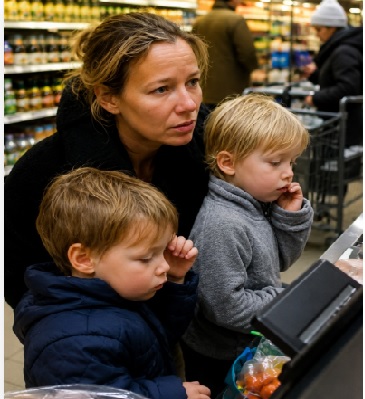
Saturday mornings at the grocery store were rarely quiet.
By nine o’clock, every checkout lane seemed to have its own small crisis. Parents tried to keep children from grabbing candy from the displays. Elderly customers searched through wallets for coupons. Someone was always asking for a price check, and there was usually at least one customer staring impatiently at the line as though the cashier had personally created it.
I had worked there long enough to stop noticing most of the noise.
That morning, however, one family caught my attention.
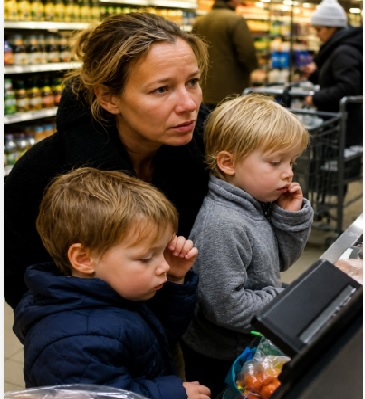
A woman joined my line with two children. The older child looked about seven, while the younger one was probably four. Their mother appeared exhausted. Her coat was slightly too thin for the cold weather outside, and she kept checking the contents of her shopping cart while waiting.
There wasn’t much in it.
Milk. Bread. A box of cereal. Pasta. A few canned vegetables. Eggs. And a large bag of red apples.
The older child kept looking at the apples.
When their turn came, the mother greeted me politely and began placing everything on the conveyor belt. The children stood close beside her.
I scanned the groceries.
As the total climbed, I noticed the woman’s expression changing.
She opened her wallet, looked inside and then checked the screen.
For a moment she didn’t say anything.
Then she asked me to remove the apples.
I set the bag aside.
She looked at the total again.
«Could you take off the cereal too?»
Her voice had become quieter.
The older child lowered his eyes. His little brother didn’t complain either.
That silence affected me more than crying would have.
Children usually protest when something they want is taken away. These two didn’t. They seemed to understand that their mother simply didn’t have enough money.
I removed the cereal.
She counted the bills in her wallet again.
She was still short.
Now she looked embarrassed.
She apologized to me, although there was absolutely nothing for her to apologize for. Behind her, the line was growing, and I could sense people becoming impatient.
She reached for another item.
Before she could remove it, I made a decision.
«Don’t worry about the apples,» I said.
She looked confused.
I picked up the bag and added it back to her groceries.
Then I paid for it myself.
It wasn’t a dramatic gesture. I wasn’t trying to rescue anyone, and I certainly didn’t imagine it would matter beyond that moment. It was simply a bag of fruit.
But the woman’s reaction surprised me.
She stared at me for several seconds.
«You don’t have to do that.»
«I know.»
Her eyes filled with tears.
She tried to refuse, but I told her it was fine. Eventually she nodded, whispered thank you and quickly gathered her groceries.
The older child looked back before leaving.
«Thank you for the apples,» he said.
Then they disappeared through the automatic doors.
Within minutes, I was serving the next customer.
By lunchtime, the moment had already become part of the background of another exhausting shift.
I assumed I would never see them again.
I was wrong.
The Officer at My Register
Three days later, I was working another morning shift when a police officer entered the store.
Police officers occasionally came in to buy coffee or lunch, so nobody paid much attention.
But this officer wasn’t carrying a shopping basket.
He walked past the entrance displays and came directly toward the checkout area.
Then he stopped in front of my register.
«Are you the cashier who paid for a woman’s apples on Saturday?»
My stomach tightened.
There are certain questions that immediately make you wonder whether you’ve accidentally done something wrong.
I replayed Saturday morning in my mind.
Had there been a problem with the payment?
Had I broken some store policy?
Had the woman complained?
I cautiously said yes.
The officer nodded.
«Could you call your manager?»
That made everything worse.
My manager came from the office looking equally confused.
The officer asked whether we could speak somewhere away from the customers.
We stepped near the customer-service desk.
Then he explained why he was there.
The woman from Saturday was his younger sister.
Her name was Rachel.
For months, she had been struggling financially after separating from her husband. She worked part-time while caring for her children, and although relatives tried to help, she often refused because she hated feeling dependent on anyone.
Her brother knew things had been difficult.
He hadn’t realized how difficult.
On Saturday evening, during a family dinner, one of the children apparently began talking about the grocery store.
He told his uncle that «the lady at the store bought our apples.»
At first, the officer didn’t understand what he meant.
Then Rachel explained.
She told her brother that she had reached the checkout and discovered she couldn’t afford everything. She had started removing groceries when the cashier quietly paid for the apples.
According to him, she had been deeply embarrassed by what happened.
But she had also been moved by it.
The officer reached into his pocket.
For a second, I expected him to hand me money.
Instead, he gave me a folded piece of paper.
It was a note from Rachel.
She had asked him to deliver it because she was too embarrassed to return herself.
The note wasn’t long.
She thanked me for helping her without making her feel humiliated. She wrote that the hardest part of struggling financially wasn’t always going without things. Sometimes it was watching her children notice that they were going without.
She said her oldest son had asked that evening why a stranger had helped them.
Rachel told him, «Because sometimes people are kind when they don’t have to be.»
Her final sentence stayed with me:
«I needed my children to see that this week.»
I read the note twice.
My manager stood beside me without saying anything.
Then the officer handed me an envelope.
Inside was enough money to cover the apples several times over.
I immediately tried to return it.
«Please give this back to her.»
He shook his head.
«She knew you’d say that.»
Apparently Rachel had anticipated my reaction. The officer told me the money wasn’t really repayment. She simply wanted the kindness to continue.
Her request was simple: if another person came through my checkout someday and couldn’t afford something small, I should use the money to help that person.
That changed everything.
Now the envelope wasn’t a reimbursement.
It was a responsibility.
The Envelope Behind the Register
My manager could easily have ended the situation there.
Instead, after hearing the story, she suggested an idea.
We placed the envelope in the office and started a small informal fund for customers who found themselves a few dollars short at checkout.
Nobody advertised it.
There was no sign.
There was no social media post.
It wasn’t meant to become a publicity campaign.
It was simply there.
A few employees heard what had happened and added a dollar or two. Someone contributed five dollars. Another coworker dropped in the change from her lunch.
Within a week, there was more money in the envelope than Rachel had originally sent.
We began using it carefully.
Once, it covered milk for an elderly man whose card was declined.
Another time, it paid for diapers when a young father’s grocery total exceeded the cash he had brought.
We didn’t pay for entire carts.
That wasn’t the point.
The fund was for those small moments when a few dollars stood between someone and something ordinary but necessary.
Something interesting happened.
People who received help often returned later wanting to replace the money.
When we explained that they didn’t have to, some insisted on contributing anyway.
A woman who had received help buying bread came back two weeks later and left ten dollars.
«Use it for somebody else,» she said.
The envelope kept circulating.
It never contained a huge amount of money.
It didn’t need to.
Its value came from movement.
One person helped another, who helped someone else.
What Poverty Looks Like Up Close
Working at a grocery store changes the way you understand financial hardship.
From a distance, poverty can become an abstract subject discussed through statistics, policies and economic reports.
At a checkout counter, it becomes painfully specific.
It looks like someone calculating whether they can afford both milk and laundry detergent.
It looks like a parent putting back fruit while keeping cheaper processed food because calories have to come before nutrition.
It looks like an older customer removing one item at a time while strangers wait behind them.
And often, it doesn’t look the way people expect.
Many struggling customers are employed.
They wear clean clothes.
They drive cars.
They have phones.
They may appear completely ordinary because financial difficulty doesn’t always announce itself.
A medical bill, reduced working hours, a rent increase, a divorce or an unexpected repair can turn an already tight household budget into a crisis.
Sometimes the difference between managing and not managing is remarkably small.
That doesn’t mean every stranger should pay for another person’s groceries. Generosity has limits, and nobody should feel guilty for protecting their own financial security.
But small acts matter precisely because they are small enough to be possible.
You don’t have to solve someone’s life.
Sometimes you can simply make one difficult afternoon slightly easier.
Rachel Returned
Several weeks later, I saw Rachel again.
She entered the store without her children and came toward my register.
This time she wasn’t avoiding eye contact.
She smiled.
I told her what had happened with the envelope.
At first she thought I was joking.
Then I explained how coworkers had contributed and how several customers who received help later returned money for other people.
She covered her mouth and started crying.
I nearly did too.
She said something I still remember.
She had thought she was accepting a bag of apples.
She hadn’t realized she was starting anything.
Neither had I.
That was probably why it worked.
Nobody planned it.
Nobody organized a campaign.
There was no grand speech about generosity.
One person was short of money.
Another person happened to notice.
A bag of apples changed hands.
That should have been the end of the story.
Instead, kindness moved quietly from one stranger to another.
And months later, the envelope was still in the office.
Sometimes it was almost empty.
Sometimes someone unexpectedly filled it again.
But somehow there was usually enough when someone needed a little help.
I used to think generosity had to be significant to matter.
Now I think the opposite may often be true.
The moments people remember are frequently the ordinary ones: someone holding a door when your hands are full, a stranger helping with a flat tire, a neighbor bringing dinner during a difficult week, or a cashier quietly putting the apples back into your cart.
Most of us will never know what happens after we help someone.
Usually there is no police officer arriving three days later.
There is no letter.
There is no explanation.
The person simply walks away, and life continues.
But that doesn’t mean the moment disappears.
Perhaps kindness works less like a transaction and more like an example.
Someone experiences compassion when they need it, remembers how it felt and recognizes an opportunity to offer the same thing to somebody else.
Rachel thought she owed me for a bag of apples.
She didn’t.
What she did instead was far more valuable.
She passed the gesture forward.
And because she did, one small decision at a crowded grocery-store checkout became something neither of us could have predicted.