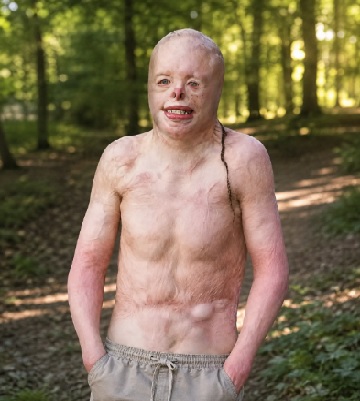
At four years old, most children are only beginning to understand the world around them. Their days are filled with games, family routines, new discoveries and the small adventures of childhood. But for one young boy, life changed in a matter of moments when a devastating fire left him with severe burns across approximately 95 percent of his body.
Such extensive injuries can affect nearly every part of a person’s life. The immediate struggle is survival, but recovery does not end when someone leaves intensive medical care. Severe burns may require repeated procedures, rehabilitation and years of adjustment. Scarring can restrict movement, alter appearance and make ordinary activities more difficult. There is also another challenge that cannot be measured as easily: learning how to live in a society where people often react instinctively to visible differences.
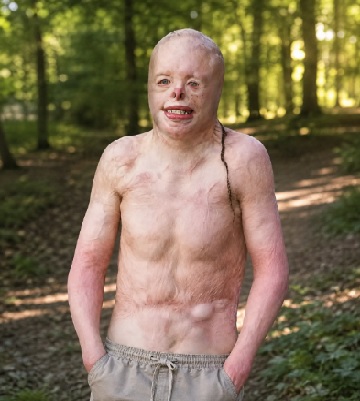
Yet the most remarkable part of this story is not simply what happened during the fire. It is what came afterward.
A Childhood Changed in an Instant
A serious burn injury at such a young age can divide life into two distinct periods: before and after. At four, a child cannot fully understand the long-term consequences of an accident. Doctors and family members may be focused on survival and treatment, while the child gradually discovers that life has changed permanently.
With burns affecting such a large percentage of the body, recovery can become an ongoing process rather than a single chapter. Medical treatment may address immediate physical injuries, but growing up with extensive scars presents new challenges at different ages.
As childhood turns into adolescence, appearance often becomes increasingly important. Children become more aware of how others see them. Teenagers compare themselves with friends, classmates and images presented by popular culture. Someone whose appearance is noticeably different may have to deal with questions, staring or assumptions before people even learn his name.
That social experience can sometimes be as difficult as the physical recovery itself.
People who encounter someone with extensive burn scars may not know how to react. Some stare out of curiosity. Others quickly look away because they feel uncomfortable. Children may ask direct questions. Adults sometimes behave awkwardly because they are afraid of saying the wrong thing.
None of these reactions necessarily tells us anything meaningful about the person being observed. They reveal how strongly society is accustomed to judging people visually.
For the boy at the center of this story, withdrawing from social life might have seemed understandable. According to the account, however, that was not the path he chose.
Refusing to Disappear
One of the easiest assumptions to make about someone who has survived a catastrophic injury is that the experience must determine everything that follows. People may imagine a future dominated entirely by hospitals, isolation and memories of the accident.
But a serious injury does not erase ordinary human ambitions.
Growing older meant confronting the same questions faced by countless young people: What should I study? What kind of life do I want? Who will become my friends? Where do I belong?
Instead of hiding from these questions, he moved toward them.
He enrolled at university.
That decision may sound ordinary until it is considered in context. University means entering unfamiliar spaces filled with strangers. It means classrooms, corridors, cafeterias, group projects and social gatherings. For someone whose appearance immediately attracts attention, every introduction can involve an additional layer of uncertainty.
Will the other person stare?
Will they ask about the scars?
Will they treat him normally?
Will they see the individual first, or only the injuries?
Avoidance can protect a person from uncomfortable reactions, but it can also shrink life dramatically. By choosing education and social contact, he rejected that shrinking world.
University represented more than academic progress. It was participation in ordinary life on his own terms.
The Difference Between Appearance and Identity
There is an important distinction between what happened to a person and who that person is.
Burn scars may become one of the first things strangers notice, but they do not describe someone’s intelligence, humor, interests, loyalty, ambitions or personality. They cannot tell us what someone hopes to accomplish or what kind of friend that person might become.
The problem is that human beings naturally process visual information quickly. We form impressions before we have enough information to make fair judgments. Usually those first impressions are harmless and temporary. But when someone’s appearance differs dramatically from what society considers typical, superficial judgments can become a serious barrier.
A visible scar can therefore produce an unusual social burden: a person may repeatedly have to move beyond other people’s first reaction.
This is one reason stories of people living with significant physical differences resonate so strongly. They expose something uncomfortable about everyday behavior. We often say that appearance does not matter, while simultaneously allowing appearance to influence our assumptions about strangers.
The lesson is not that physical appearance is irrelevant. It clearly affects how people experience the world. The deeper point is that appearance is incomplete information.
It tells us very little about character.
Building Relationships Instead of Avoiding Them
Meeting new people became another important part of his life.
For anyone with a visible difference, social situations can contain uncertainties that others rarely need to consider. Even a simple introduction may create anxiety because there is no way to predict another person’s reaction.
But repeated social contact can change the dynamic.
The longer people interact, the less dominant an unusual physical feature often becomes. A scar that seemed impossible not to notice during the first few seconds can eventually become just one characteristic among many.
Conversation replaces curiosity.
Personality replaces assumptions.
Familiarity replaces discomfort.
That transformation matters because genuine inclusion is not achieved by pretending differences do not exist. It happens when differences stop being treated as the most important thing about a person.
By continuing to meet people and participate in everyday life, the young man gave others the opportunity to know more than the visible evidence of his childhood accident.
At the same time, he was building something equally important for himself: a future that was not organized around avoiding judgment.
Resilience Is More Complicated Than Fearlessness
Stories like this are frequently described using words such as «inspiring,» «brave» and «strong.» Those descriptions may be appropriate, but they can also create a misleading picture if they suggest that resilient people never struggle.
Courage does not require the absence of insecurity.
A person can feel uncomfortable and still enter the room. He can remember painful experiences and still make new plans. He can dislike being stared at while refusing to let strangers determine where he goes.
Resilience is often less dramatic than people imagine. It can consist of ordinary decisions repeated over many years: attending class, introducing yourself, making friends, pursuing education, planning a career and showing up again after an uncomfortable experience.
Those choices gradually construct a life.
This perspective also prevents the survivor from being reduced to a symbol. People who have experienced catastrophic injuries should not be expected to demonstrate extraordinary courage every moment simply because they survived. They are entitled to ordinary frustrations, ambitions, failures and successes.
The real achievement is not becoming permanently fearless. It is maintaining the freedom to live despite fear, uncertainty or other people’s reactions.
A Lesson About the Way We See Others
There is another side to this story that has nothing to do with the survivor’s decisions. It concerns everyone who encounters people whose bodies or faces look different.
Curiosity is natural. Respect is a choice.
A person with scars does not automatically owe strangers an explanation. A wheelchair does not summarize someone’s life. A birthmark does not define a personality. A physical difference should not become permission to reduce a human being to a medical history.
One of the simplest forms of dignity is allowing someone to introduce themselves before deciding who they are.
This sounds obvious, yet everyday interactions show how difficult it can be.
The young man’s story challenges the assumption that a dramatically altered appearance must produce a dramatically limited life. His injuries were real, and the consequences of such injuries should never be minimized. But limitations imposed by other people’s expectations do not have to become permanent boundaries.
More Than Survival
Surviving a devastating childhood fire is extraordinary in itself. But survival is only the beginning of this particular story.
The years afterward involved something different: constructing an identity beyond the accident.
Education became part of that identity. Relationships became part of it. Independence, curiosity and plans for the future became part of it as well.
The fire may have left permanent marks on his body, but permanent marks are not the same as a predetermined destiny.
That distinction is perhaps the most important lesson in his experience.
We cannot always choose what happens to us. Accidents, illness and unexpected events can alter a life without warning. Some consequences cannot be reversed. Yet even when the past remains visible, the future is not automatically decided by it.
A four-year-old boy survived injuries that changed his appearance forever. Years later, instead of disappearing from public life, he entered university, formed new connections and continued building a future.
His scars remained visible.
But so did something far more important: his determination to be known for the life he was creating rather than only for the tragedy he had survived.
And perhaps that is why his journey has such power. It does not ask us to pretend that appearance never affects people’s lives. It asks us to recognize that appearance is only the beginning of what we see—and never the whole story.