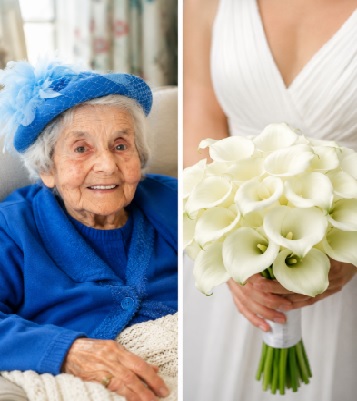
Most brides spend months thinking about the details of their wedding day: the dress, the flowers, the music, the photographs and the people who will stand beside them when they exchange their vows. But for one bride, there was another date on the calendar that mattered just as much as the wedding itself.
Her grandmother was about to celebrate her 100th birthday.
Instead of seeing the two occasions as competing celebrations, the bride decided to bring them together. She chose to marry on the very day her grandmother reached the remarkable milestone of a full century of life.
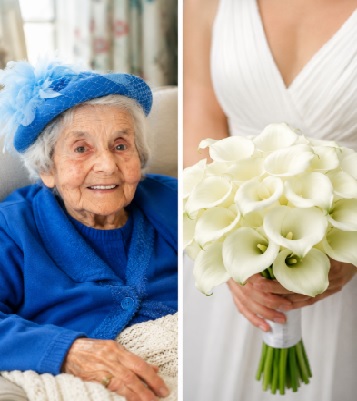
What the guests did not know was that the date was only the beginning of the surprise.
Two Milestones on One Day
A 100th birthday is extraordinary on its own. It represents far more than a number. A person who reaches that age has witnessed decades of change, watched generations grow and often become a living connection between different periods of a family’s history.
For the bride, her grandmother’s birthday therefore carried special meaning. Holding the wedding on the same day transformed the celebration into something larger than the beginning of a marriage. It became a gathering of generations.
Family members arrived expecting the familiar traditions of a wedding: congratulations, photographs, speeches and a festive meal. At the same time, they were celebrating a woman whose life had already stretched across an entire century.
The grandmother was not simply another guest seated somewhere among the relatives. Her presence represented the family’s past, while the bride and groom were beginning a new chapter of its future.
Yet the bride had prepared an additional gesture.
A Question That Changed the Celebration
During the festivities, the bride approached her grandmother.
Instead of presenting her with an ordinary birthday gift, she reached for her hand and asked a deeply personal question: would her grandmother be her bridesmaid?
It was an unexpected reversal of what people normally imagine when they hear the word «bridesmaid.» Wedding parties are often associated with sisters, cousins or close friends of roughly the same generation as the bride. Here, however, age was irrelevant.
The bride was choosing someone because of what that person meant to her.
For the grandmother, who was celebrating her 100th birthday, the invitation placed her at the heart of one of the most important days in her granddaughter’s life.
The emotional weight of the moment quickly became apparent to everyone around them.
The grandmother’s reaction, together with the significance of the bride’s request, moved the wedding guests to tears. What had started as a joyful celebration became one of those rare family moments in which people suddenly become conscious of time itself.
There stood a young woman preparing for married life beside a woman who had already lived for a century.
Between them were decades of family history.
More Than a Wedding Tradition
The gesture carried a meaning that went well beyond wedding etiquette.
Traditionally, bridesmaids help and support the bride before and during the ceremony. But modern weddings increasingly allow couples to interpret those roles in their own way. There is no emotional rule saying that an important member of the wedding party must be a certain age.
In this case, asking the grandmother to become a bridesmaid turned a familiar wedding custom into a tribute.
The bride was effectively saying that her grandmother belonged beside her, not simply somewhere in the audience.
That distinction matters.
At large family celebrations, elderly relatives can sometimes become observers while younger generations occupy the center of attention. The bride chose the opposite approach. On a day when she herself could naturally have expected everyone to focus on her, she deliberately shared that attention.
It made the grandmother part of the story rather than merely a witness to it.
Why the Moment Was So Powerful
There is another reason scenes like this can affect people so strongly.
Weddings naturally encourage families to think about generations. Parents remember their children’s childhoods. Grandparents see grandchildren begin families of their own. Old photographs are brought out, stories are repeated and relatives who may rarely meet find themselves together again.
A 100th birthday intensifies those emotions.
Few families have the opportunity to celebrate such a milestone with a loved one. Combining it with a wedding created an unusual bridge between two very different stages of life.
One woman was celebrating a century behind her.
Another was standing at the beginning of a new marriage.
Neither moment diminished the other. Instead, each gave the other additional meaning.
For the wedding guests, that contrast was impossible to ignore. They were not simply watching a bride honor her grandmother. They were witnessing the continuity of a family compressed into a single celebration.
The Value of Being Included
There is also a broader lesson in the bride’s decision.
Growing older can sometimes mean being quietly pushed toward the edges of social occasions. People may assume an elderly relative is too tired to participate, uninterested in traditions or happier simply watching from a comfortable chair.
Those assumptions are not always fair.
Inclusion does not necessarily require physical effort or complicated responsibilities. Sometimes it means asking someone to stand beside you. Sometimes it means giving them a role. Sometimes it is simply making clear that their presence is important rather than ceremonial.
By inviting her grandmother to be a bridesmaid, the bride gave her something that cannot easily be purchased: recognition.
The message was simple but powerful. Age had not reduced her grandmother’s place in the family.
If anything, reaching 100 made that place even more meaningful.
A Photograph With a Different Meaning
Wedding photographs are normally created for the future. Couples know that years later they may look through them with children or grandchildren and remember people who were present on that day.
A photograph of a bride with her 100-year-old grandmother carries an especially powerful relationship with time.
Years from now, details such as decorations, flowers or table settings may be difficult to remember. The emotional significance of having several generations together is likely to remain far stronger.
For younger relatives, such images can eventually become part of family history. They show more than what people looked like. They preserve relationships.
A future family member who never met the grandmother may one day see those photographs and learn that, on her 100th birthday, she did not simply attend her granddaughter’s wedding.
She was given a place of honor in it.
When Celebration Becomes Memory
Large celebrations are often planned around perfection. Couples worry about schedules, weather, seating arrangements and countless small details. Yet the moments people remember most clearly are frequently the ones that cannot be measured by how expensive or carefully arranged they were.
They remember a look.
A hand being held.
An unexpected question.
A room suddenly becoming quiet because everyone understands that something important is happening.
That is what made this wedding different.
The bride could have separated the two occasions. She could have celebrated her grandmother’s birthday privately before or after the wedding. Instead, she allowed the two milestones to become part of the same family story.
And by asking her grandmother to stand beside her as a bridesmaid, she turned a birthday tribute into something even more personal.
The guests’ emotional response was understandable. They were witnessing affection expressed not through a grand speech, but through inclusion.
A Century Behind Her, a New Chapter Ahead
At its heart, the story is not really about an unusual bridesmaid.
It is about what families choose to honor.
A wedding looks toward the future, while a 100th birthday naturally invites people to look back. Bringing those occasions together created a rare moment in which past and future seemed to meet in the same room.
The grandmother’s century of memories could not be summarized in a wedding ceremony, nor could anyone know what the bride’s new marriage would bring in the decades ahead. But for one day, those two journeys touched.
That is why the celebration became unforgettable.
Long after the music ended and the wedding decorations were taken down, the most valuable part of the day was unlikely to be anything that could be packed into a box.
It was the memory of a granddaughter taking her grandmother’s hand on her 100th birthday and showing, in front of everyone she loved, that there was still a very special place for her by her side.