There is an unwritten rule that many women begin to notice as they grow older. No one signs it, no official institution publishes it, and yet it appears everywhere: in casual remarks, family conversations, advertisements, social media comments, and even in the way clothing is marketed.
The rule suggests that after a certain age, a woman should become less visible.
Her dresses should become longer. Her colors should become quieter. Her choices should attract less attention. Certain cuts are suddenly described as “too young,” while confidence can be mistaken for an attempt to deny the passage of time.
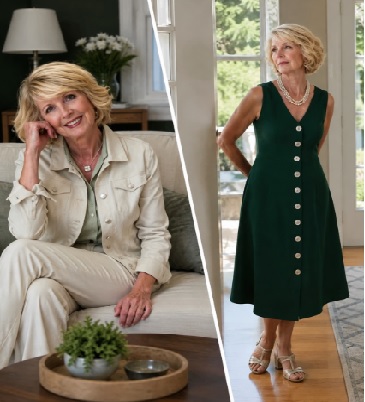
For one 75-year-old woman, those expectations became impossible to ignore when people began criticizing the way she dressed.
Some believed that her clothing was inappropriate for someone of her age. The message behind the criticism was simple: there are things a woman of 75 supposedly should no longer wear.
Her response challenged that assumption.
She made it clear that choosing what to wear remained her decision.
That simple position raises a much larger question: why does society still feel entitled to decide what older women should look like?
When Clothing Becomes an Age Test
Fashion has always carried social meaning. Clothes can communicate profession, culture, mood, status, personality and belonging. But they can also become a way of enforcing expectations.
Age is one of the clearest examples.
A teenager wearing an outfit associated with an older generation may be called sophisticated. A young adult choosing an unconventional style may be praised for individuality. But older women often encounter a different standard.
A dress can suddenly be described as “too short.” Bare arms can attract comments. Bright colors may be considered excessive. Modern cuts are sometimes dismissed as unsuitable.
None of these judgments are based on a universal rule.
They come from cultural habits about how aging is supposed to look.
The contradiction is striking. Society frequently tells people to remain active, independent and confident as they grow older. Yet when an older person expresses that confidence visibly, the reaction is not always supportive.
In other words, people are encouraged to feel young at heart while sometimes being discouraged from looking too bold.
Why Her Answer Matters
The significance of the 75-year-old woman’s reaction was not that she claimed everyone should dress like her. She did not need other women to make the same choices.
Her point was about ownership.
What someone wears is ultimately a personal decision.
That distinction is important because freedom of style does not mean that everyone must approve of every outfit. People naturally have different tastes. One person may prefer conservative clothing, another may enjoy bright dresses, and someone else may choose comfort above everything.
The problem begins when personal taste becomes a rule imposed on another person.
Saying, “I wouldn’t wear that,” expresses a preference.
Saying, “You are too old to wear that,” expresses something very different. It suggests that age itself removes a person’s permission to make certain choices.
That is why her refusal to change her style resonated beyond fashion. It became a statement about autonomy.
The Double Standard of Aging
Men and women can both face age-related stereotypes, but appearance has historically been judged especially harshly in women.
Signs of aging that may be interpreted as maturity or distinction in men are often marketed to women as problems requiring correction. Gray hair, wrinkles, changing body shape and other normal parts of aging have supported enormous industries promising youthfulness.
Fashion can become part of the same pressure.
Older women may receive contradictory instructions: age naturally, but do not look old; remain stylish, but do not dress too young; be confident, but do not attract too much attention.
There is almost no way to satisfy every expectation simultaneously.
The more useful alternative is to question the expectations themselves.
Reaching 75 does not erase someone’s personality. A person who enjoyed elegant dresses at 45 does not necessarily stop enjoying them at 70. Someone who loved colorful clothes throughout adulthood may not suddenly develop a preference for beige simply because another birthday has passed.
Style can evolve with age, but evolution is different from surrender.
Social Media Has Made Judgment Louder
Public criticism of appearance is not new, but digital platforms have changed its scale.
Before social media, an unwanted opinion might have come from a relative, neighbor or stranger. Today, a photograph can be viewed by thousands of people, each able to comment immediately.
That creates an unusual situation. People who would never approach a 75-year-old stranger in a restaurant and criticize her dress may feel comfortable writing the same criticism beneath her photograph.
The screen creates distance.
And because negative comments often attract responses, disagreement can quickly become more visible than support.
This can create the false impression that there is widespread agreement about what someone should or should not wear. In reality, a loud group of commenters does not necessarily represent society as a whole.
There is another side to online culture as well.
Social media has allowed older women to become more visible on their own terms. Instead of appearing only in advertisements designed by younger marketers, they can present themselves directly: traveling, working, exercising, discussing relationships, sharing fashion, starting businesses or simply documenting ordinary life.
That visibility challenges stereotypes precisely because it shows that there is no single correct way to be 60, 70, 80 or older.
Clothes Do Not Have Birth Certificates
The idea of “age-appropriate” fashion is worth examining carefully.
There are certainly practical reasons why people’s wardrobes change over time. Comfort matters. Climate matters. Health, work, lifestyle and personal preferences matter.
But those are individual considerations.
A sleeveless dress does not become objectively inappropriate when its owner celebrates a particular birthday. A bright jacket does not know whether the person wearing it is 35 or 75.
The meaning is assigned by observers.
Fashion history also demonstrates how unstable such rules can be. Clothing once considered shocking can later become ordinary. Styles associated with one generation are regularly rediscovered by another. Hemlines rise and fall. Colors move in and out of fashion. What one decade considers elegant, another may consider outdated.
If fashion itself constantly changes, rigid age restrictions deserve skepticism.
Confidence Does Not Require Permission
Perhaps the most interesting part of this story is not the criticism but the refusal to be defined by it.
Many people change their behavior because they fear judgment. That fear is understandable. Human beings are social creatures, and approval matters to us.
But there is a cost to constantly adjusting ourselves to satisfy strangers.
If someone reaches 75 after decades of experiences, responsibilities, successes, disappointments and changes, it seems strange to suggest that strangers should suddenly have greater authority over her wardrobe than she does.
Aging can bring physical limitations, but it can also bring something valuable: perspective.
By that stage of life, many people understand more clearly that universal approval is impossible.
Dress conservatively and someone may call you old-fashioned. Dress boldly and someone may call you inappropriate. Wear makeup and you may be accused of trying too hard. Wear none and someone may say you have stopped caring about your appearance.
When every choice can be criticized, criticism becomes a poor compass.
Respecting Choice Works Both Ways
There is also an important nuance in conversations about older women and fashion.
Freedom should not create a new expectation.
Celebrating a 75-year-old woman who enjoys fashionable or revealing clothes should never imply that another 75-year-old woman must do the same to prove that she is confident.
One woman may love sleeveless dresses. Another may feel happiest in a long skirt and cardigan. Someone else may care very little about fashion.
All three choices deserve the same respect when they are freely made.
The goal is not to replace the old rule — “older women must dress modestly” — with a new rule telling older women they must demonstrate youthfulness.
The better principle is simpler: adults should have room to decide how they present themselves.
Aging Without Becoming Invisible
The debate surrounding one woman’s clothing reflects something deeper than fashion.
It concerns visibility.
Growing older should not require a person to slowly disappear from public life. Older people continue to have tastes, ambitions, humor, relationships and opinions. They remain individuals rather than representatives of an age category.
Clothing is only one visible expression of that individuality.
The 75-year-old woman’s response therefore carries meaning beyond her wardrobe. She did not ask everyone to admire her style. She simply defended her authority to choose it.
That may be the most reasonable standard of all.
We do not need to love another person’s clothes to respect the person wearing them.
And perhaps the question should no longer be whether a particular dress is appropriate for a 75-year-old woman.
A better question is whether she feels comfortable, confident and genuinely herself while wearing it.
If the answer is yes, her age does not need to make the decision for her.