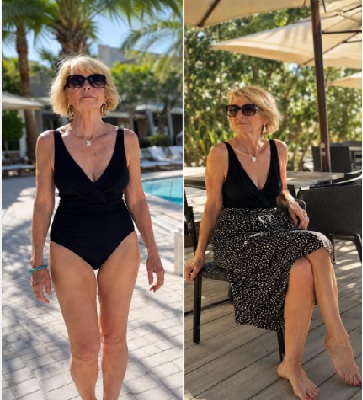
At 76, a woman should not have to justify showing her arms.
She should not need permission to choose a dress she likes, explain why she still cares about fashion, or prove that confidence has an acceptable age limit. Yet a simple photograph of an older grandmother wearing a sleeveless dress was enough to provoke exactly that kind of debate online.
The image itself was unremarkable in the best possible way. She was simply an older woman wearing an outfit that made her feel comfortable and confident. There was no attempt to disguise her age. Her arms showed the natural signs of a long life, and she appeared perfectly at ease with that reality.
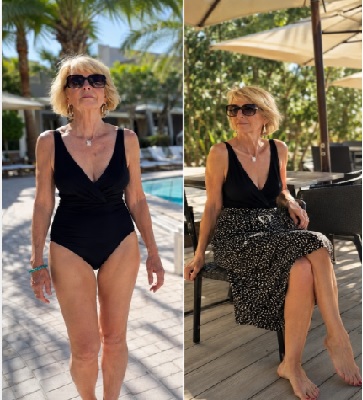
But once the photograph reached social media, attention quickly shifted away from the dress itself.
Some people began commenting on her age.
Others focused on her body.
A number of critics argued that sleeveless clothing was inappropriate for a woman in her seventies. The implication behind many of these reactions was difficult to miss: certain styles, they seemed to believe, belonged only to younger bodies.
What might have been an ordinary fashion choice suddenly became a much larger conversation about aging, appearance and the expectations society places on women.
When Clothing Becomes an Unwritten Rule
There is no universal rule saying that women must stop wearing sleeveless dresses after a particular birthday. Nevertheless, cultural expectations often operate as though such rules exist.
Women are frequently told to «dress their age,» but the meaning of that phrase is rarely defined clearly.
At 20, a woman may be criticized for dressing too provocatively. At 40, she may be told that certain styles are becoming inappropriate. At 60 or 70, the pressure can become even stronger: cover more skin, choose quieter colors, avoid drawing attention and accept that fashion is primarily a young person’s territory.
These expectations reveal something deeper than a disagreement about clothing.
They suggest that aging should gradually make a woman less visible.
That assumption is precisely why the reaction to a 76-year-old grandmother in a sleeveless dress matters. The controversy was never really about sleeves. It was about who society believes has the right to be seen confidently.
The Internet Can Turn Confidence Into a Target
Social media has made appearance more public than ever before.
A photograph that would once have been seen by relatives and friends can now reach thousands or even millions of strangers. Those strangers can judge a person’s clothing, body, hairstyle and age within seconds.
Older women face a particularly difficult contradiction.
They are encouraged to age naturally, but natural signs of aging are frequently criticized. If they undergo cosmetic procedures, they may be accused of desperately trying to look younger. If they embrace wrinkles and changes in their bodies, they can be mocked for not hiding them.
There seems to be no universally «correct» way to grow older.
The grandmother’s sleeveless dress exposed this contradiction clearly. Her body looked like the body of an older woman because she was an older woman. There was nothing unusual about that. What was unusual was the idea that those natural changes somehow disqualified her from wearing a particular piece of clothing.
The harshest comments therefore said more about the critics’ expectations than about the woman herself.
Why Ageism Often Targets Women Differently
Men and women both experience age discrimination, but appearance-related ageism often affects them in different ways.
Older men can be described as distinguished, experienced or authoritative. Gray hair may even strengthen that image. Women, meanwhile, are often confronted with a cultural message that links beauty much more closely to youth.
That message appears everywhere: advertising, entertainment, fashion and social media.
As women grow older, the pressure does not necessarily disappear. Instead, it changes.
They may be expected to look youthful while simultaneously being criticized if they appear to be trying too hard to remain youthful. They are supposed to care about their appearance, but not attract too much attention. They should remain stylish, but only within boundaries other people consider appropriate.
It is an impossible standard because the boundaries constantly move.
A sleeveless dress becomes controversial not because the garment itself changes after age 70, but because some observers believe an older woman’s relationship with her own body should change.
Confidence Does Not Require a Perfect Body
One of the most damaging ideas surrounding fashion is that confidence must be earned through physical perfection.
People are often encouraged to wear certain clothes only after losing weight, building muscle, hiding scars or correcting whatever feature happens to fall outside current beauty standards.
Age adds another supposed requirement.
Wait until you are thin enough.
Wait until your skin looks better.
Wear it before you become too old.
But if confidence depends on meeting every external expectation, very few people will ever feel completely entitled to it.
Aging makes this especially obvious because no one can permanently avoid physical change. Skin changes. Hair changes. Body shape changes. These are not personal failures. They are ordinary parts of being alive.
The more useful question is not whether a 76-year-old woman’s arms satisfy the expectations of strangers.
It is whether she feels comfortable wearing the dress.
If the answer is yes, the opinions of people scrolling through a screen should have remarkably little authority over that decision.
Refusing to Disappear
The most meaningful response to criticism is sometimes surprisingly simple: continuing to live normally.
An older woman does not need to launch an argument with every stranger who dislikes her clothing. She does not need to convince everyone that she is attractive. She does not even need universal approval.
Refusing to retreat can make a stronger statement.
By continuing to dress according to her own preferences rather than hiding because of hostile comments, a woman challenges the assumption that aging should be accompanied by embarrassment.
That does not mean criticism cannot hurt. Online comments can be cruel precisely because people often write things they would never say face-to-face.
But allowing anonymous criticism to determine everyday choices gives strangers extraordinary power.
The alternative is not pretending that judgment does not exist. It is deciding that judgment does not automatically deserve obedience.
The Supportive Reactions Matter Too
Stories about online criticism can sometimes create the impression that everyone is hostile. That is rarely the whole picture.
When older people are attacked for refusing to conform to stereotypes about aging, supportive voices often appear as well. Some defend the individual’s right to choose what to wear. Others recognize something of their mothers, grandmothers or future selves in the situation.
That response is important because aging is not an experience belonging to a distant group of people.
If we are fortunate, it is where all of us are heading.
Someone mocking a 76-year-old person’s wrinkles today is effectively mocking a possible version of themselves decades from now.
Seen from that perspective, respect for older people is not merely generosity toward another generation. It is an acknowledgment of the human lifespan.
Fashion Has No Expiration Date
Clothing serves practical purposes, but it also communicates personality.
Some people love bright colors. Others prefer black. Some enjoy elegant dresses, while others are happiest in jeans and a simple shirt. Personal style can evolve with age, but evolution is different from surrender.
There is nothing wrong with a woman deciding that she personally prefers more conservative clothing as she grows older.
The problem begins when preference becomes obligation.
A 76-year-old woman who enjoys long sleeves should wear them.
A 76-year-old woman who prefers a sleeveless dress should be equally free to choose it.
Neither woman owes the public an explanation.
This distinction matters because genuine empowerment is not about telling every older woman to dress boldly. It is about allowing her to decide what «boldly» means for herself.
What This Debate Is Really About
A photograph of a grandmother in a dress may appear trivial compared with the larger problems associated with discrimination. Yet everyday moments often reveal cultural attitudes more clearly than abstract discussions do.
The criticism surrounding an older woman’s clothing raises uncomfortable questions.
At what age is a person expected to stop enjoying fashion?
Who gets to decide which parts of an aging body should remain covered?
Why does visible confidence sometimes become less acceptable when it belongs to an older woman?
There are no convincing answers because the restrictions themselves are largely artificial.
Aging changes many things. It can change health, priorities, relationships and the way a person experiences the world. But reaching a certain birthday does not automatically erase individuality.
A grandmother remains a person with preferences, humor, memories, tastes and opinions. She does not become merely «an elderly woman» the moment strangers notice her wrinkles.
Perhaps that is why a sleeveless dress can provoke such strong reactions. It quietly rejects the idea that older people should become invisible.
At 76, confidence may look different from confidence at 26, but it is not less legitimate.
The most important lesson is therefore not really about fashion.
It is about ownership.
A person’s body changes throughout life, but it remains their body. Their clothing remains their choice. And growing older should not require surrendering the freedom to decide how they wish to present themselves to the world.
The grandmother at the center of this discussion did something completely ordinary: she wore a dress she liked.
The extraordinary part was how many people believed her age gave them the right to object.
Perhaps the strongest answer to that criticism requires no argument at all.
Sometimes it is enough to put the dress on again.