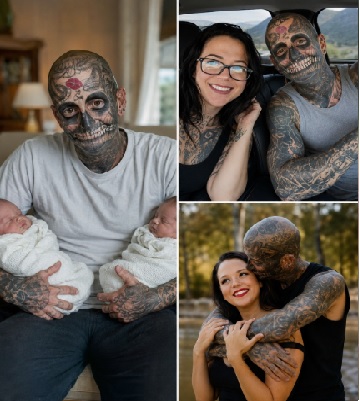
At first glance, Daniel Mercer seemed designed to attract attention. Tattoos covered his arms, neck, hands and most of his face. Dark lines curved around his eyes, while elaborate patterns stretched from his shoulders to his fingertips. Over more than three decades, he had collected over two hundred individual designs.
To strangers, however, they were rarely seen as pieces of art. People stared at him in supermarkets, moved away from him on buses and sometimes whispered insults loudly enough for him to hear. A photograph of Daniel posted online once attracted thousands of cruel comments. Some users called him dangerous. Others said that a man who looked like him should never have become a father.
The most painful word was “monster.”
Daniel pretended that such comments did not affect him. He had learned to smile, lower his head and continue walking. Yet every insult followed him home.
What strangers could not see was the ordinary life hidden behind his extraordinary appearance.
Every morning, Daniel prepared breakfast for his two children before driving them to school. He packed their lunches, checked their homework and made sure his youngest daughter never forgot the inhaler she needed for sports. In the evenings, he cooked dinner while his wife, Claire, finished her shift at a local medical clinic.
He repaired bicycles in a small workshop behind their house and occasionally designed tattoos for old friends. He was patient with nervous customers and frequently refused to tattoo anyone who seemed intoxicated, uncertain or pressured by someone else.
His appearance suggested rebellion, but his daily life was built around responsibility.
A Life Recorded on Skin
Daniel had received his first tattoo at eighteen. It was a small black star on his shoulder, chosen without much thought. The second came a year later, after his grandfather died. That design carried meaning: an old compass resembling the one his grandfather had kept in a wooden drawer.
As the years passed, Daniel began using tattoos to preserve important memories. Some represented people he had lost. Others marked the births of his children, places he had visited or periods of hardship he had survived.
Not every design had a profound story. Daniel openly admitted that several were simply images he liked at the time. A few had been mistakes, and he no longer remembered the reason for choosing others. Together, however, they formed a visual record of his life.
The tattoos spread gradually. His arms were covered first, followed by his chest, legs and back. The decision to tattoo his hands and face came much later. Daniel understood that crossing that boundary would change how society treated him, but he underestimated how dramatic the change would be.
Before his facial tattoos, strangers occasionally complimented his artwork. Afterward, many stopped seeing the art and began seeing only a threat.
Parents pulled children closer when he approached. Store employees watched him carefully. Once, while waiting outside a school, Daniel was questioned by a security guard who assumed he had no legitimate reason to be there. His daughter eventually ran out and hugged him, ending the uncomfortable conversation.
She was too young to understand why the guard looked embarrassed.
Daniel understood perfectly.
The Questions Children Ask
Inside the Mercer home, tattoos were not mysterious. Daniel’s children had grown up seeing them. They sometimes asked what particular pictures meant, and he answered honestly. To them, the ink was simply part of their father, like his brown eyes or his habit of singing badly while washing dishes.
The situation changed when his eldest son, Noah, began secondary school.
One afternoon, Noah returned home unusually quiet. He left his backpack near the stairs and went directly to his room. Daniel assumed he was tired, but Claire noticed that something was wrong.
After some gentle questioning, Noah admitted that classmates had found photographs of his father online. They had passed a phone around during lunch, laughing at the comments beneath the pictures. One student asked whether Daniel had been in prison. Another called him a monster.
Noah had defended his father, but he had also felt humiliated by the attention.
Daniel listened from the hallway.
The words struck him more deeply than any insult directed at him personally. He had accepted that his choices would affect the way people treated him. He had not fully considered that his children might also be forced to carry the consequences.
That evening, he stayed in the workshop long after finishing his work. For the first time, he seriously investigated tattoo removal. The process would be expensive, painful and incomplete, especially because of the number and density of the designs. Even so, he wondered whether he owed it to his family to try.
Over the following weeks, Daniel began changing his routine. He wore long sleeves even in warm weather. He used makeup to cover parts of his face before school events. He stopped attending some public activities altogether, telling Claire that he had too much work.
In reality, he was afraid of embarrassing his children.
The Unexpected Announcement
Claire watched the change in her husband without confronting him immediately. She saw him studying removal clinics late at night and noticed the unopened invitation to a school performance on his desk.
Finally, one evening, she entered the workshop carrying two cups of tea. She placed them beside him and asked a direct question.
“Are you planning to erase yourself?”
Daniel tried to laugh, but Claire did not.
He explained what had happened at Noah’s school. He admitted that he felt selfish. The tattoos had been his decision, but his children were paying part of the price. If removing or covering them could make life easier for the family, perhaps that was what a responsible father should do.
Claire listened quietly. Then she told him something he had not expected.
She had already spoken to Noah.
Their son was not ashamed of his father. He was angry because Daniel had started hiding. Noah had been preparing a presentation for school about judging people by appearance. He wanted to include his father’s story, but he feared Daniel would refuse to stand in front of the class.
Claire had also spoken to their daughter. She had drawn a family picture for an art project, carefully copying several of Daniel’s facial tattoos with a blue marker. When her teacher asked why her father looked different, she answered that his skin carried pictures of the people he loved.
Then Claire revealed her own decision.
She had arranged a meeting with the school about a community event on stereotypes and discrimination. She wanted Daniel to participate, not as a spectacle and not as an apology, but as a parent willing to discuss how quickly appearances become assumptions.
Daniel was stunned. He had expected Claire to ask him to remove the tattoos. Instead, she was asking him to stop disappearing.
“You don’t have to love every decision you made,” she told him. “But our children should not learn that cruelty wins whenever a good person hides.”
Standing Before the Room
Daniel nearly refused.
Speaking to a room filled with parents, teachers and students frightened him more than hours under a tattoo needle. He knew some people would remain uncomfortable. He also knew that one speech would not erase years of prejudice.
Still, he agreed.
On the evening of the event, Daniel arrived wearing a plain black shirt with the sleeves rolled up. He did not cover his face. The room grew quieter when he entered, and several people stared.
When it was his turn to speak, he avoided grand declarations. He did not claim that every tattoo represented wisdom or that every choice had been perfect. He simply described how people treated him before and after his face was tattooed.
He explained that appearance could influence first impressions but could not reveal whether someone was kind, dependable or safe. Those qualities had to be discovered through behaviour.
Daniel also took responsibility for his decisions. He acknowledged that extreme body modification could create practical difficulties and that young people should think carefully before making permanent changes. His message was not that choices have no consequences. It was that consequences should not include the loss of basic human dignity.
Noah then presented his school project.
He displayed two lists on a screen. The first contained assumptions strangers had made about his father: violent, irresponsible, unemployed and dangerous. The second listed facts from Daniel’s real life: parent, husband, bicycle mechanic, volunteer and the person who made breakfast every morning.
The contrast required no dramatic explanation.
What Really Changed
The event did not transform everyone. Some parents remained distant, and anonymous insults continued to appear online. Daniel understood that prejudice rarely disappears after one conversation.
But smaller changes followed.
A teacher invited him to help repair bicycles for a student charity project. Parents who had previously avoided him began greeting him outside the school. One of Noah’s classmates apologized for sharing the photograph.
More importantly, Daniel stopped excluding himself from his children’s lives.
He attended performances, sports days and parent meetings without covering his tattoos. When people stared, he no longer automatically interpreted every glance as hatred. Some were curious. Some were surprised. A few genuinely wanted to understand.
Daniel also abandoned his plan to remove all the tattoos. This did not mean he suddenly loved every mark on his body. He began consulting a specialist about modifying several older designs and removing one that no longer reflected who he was.
The distinction mattered. He was making those decisions for himself, not as payment for being accepted.
The experience also changed the way Daniel spoke about tattoos with younger people. He never encouraged anyone to imitate him. Instead, he emphasized permanence, employment considerations, health risks and the emotional reasons behind body modification.
“Make sure you are choosing something,” he would say, “and not merely running away from something else.”
More Than a First Impression
Daniel’s story does not prove that appearance is meaningless. Clothing, body art and personal style communicate something about the choices people make. But they never communicate everything.
A heavily tattooed person can be generous or cruel, just as a conventionally dressed person can be trustworthy or dishonest. Character is not visible from a distance. It emerges through repeated actions: how someone treats a frightened child, keeps a promise, responds to failure or helps another person when there is nothing to gain.
For years, Daniel believed strength meant ignoring insults. Later, he discovered that silence had slowly turned into shame. Claire’s unexpected words forced him to recognize the difference between accepting responsibility and accepting humiliation.
His tattoos remained impossible to overlook. Yet to the people who truly knew him, they became only one part of a much larger picture.
He was not the monster strangers imagined, nor was he a flawless hero. He was a man shaped by impulsive decisions, painful memories, loyalty, regret and love. Above all, he was a father who almost hid himself to protect his children, only to learn that they needed something else from him.
They needed him to stand beside them exactly as he was.