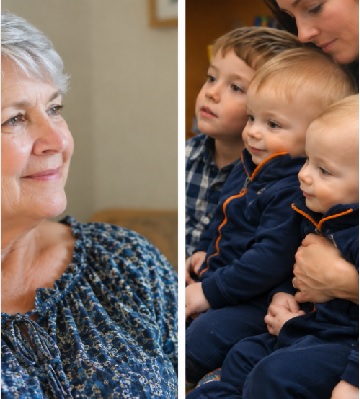
When Margaret learned that she was going to become a mother again at the age of 59, she knew the news would surprise people. She expected questions, worried looks, perhaps even criticism. What she did not expect was that the pregnancy would threaten one of the most important relationships in her life.
Her eldest daughter, Laura, was already an adult with a family of her own. Instead of celebrating the announcement, she reacted with disbelief. Their first difficult conversation turned into another, and then another. Eventually, the disagreement became so bitter that Laura stopped speaking to her mother.
The most painful consequence came later: Margaret was no longer allowed to see her granddaughter.
What had begun as news of a new life had created a deep division between two generations of the same family.
A Decision That Changed Everything
Margaret had never imagined that she would be preparing for a baby so close to her 60th birthday. Her older children had grown up years earlier, and she had already experienced the familiar stages of parenthood: sleepless nights, school mornings, teenage arguments and the strange quiet that arrives when children finally build independent lives.
Yet her circumstances had changed.
She had entered a new chapter of her life and, after careful consideration, decided that she wanted another child. She understood that motherhood at her age would be very different from what she had experienced when she was younger.
She also knew there were legitimate medical concerns.
Pregnancy at an advanced maternal age generally requires closer medical supervision because the likelihood of complications increases with age. For women approaching 60, those concerns can become especially significant. Doctors may monitor blood pressure, cardiovascular health, blood sugar and fetal development more carefully, among other factors.
Margaret did not dismiss those realities. To her, accepting a risk was not the same thing as ignoring it.
But Laura saw the situation differently.
The Daughter’s Fear Looked Like Anger
At first, Margaret believed her daughter simply needed time to absorb the news.
Laura’s questions, however, quickly became more confrontational.
Why would someone start again at 59? What would happen when the child was a teenager and Margaret was in her seventies? Who would take responsibility if Margaret’s health deteriorated? Had she considered what her decision might eventually demand from the rest of the family?
These were uncomfortable questions, but they were not entirely unreasonable.
That was precisely what made the conflict so difficult.
Margaret heard condemnation. Laura believed she was expressing concern.
Neither woman felt heard.
Laura also struggled with another emotional complication: her mother was becoming a new parent at a time when Laura herself was raising a child. Suddenly, their traditional roles seemed less clear. The new baby would technically be Laura’s sibling while being much closer in age to Laura’s own daughter.
Margaret considered that unusual but manageable. Laura experienced it as a profound disruption to the family she understood.
Their conversations became increasingly personal.
A disagreement about one decision gradually collected old resentments that had little to do with the pregnancy itself. Arguments that should have lasted minutes reopened wounds that had existed for years.
Eventually, Laura said she needed distance.
Margaret assumed the separation would last a few days.
Days became weeks.
When a Grandchild Became Part of the Conflict
The situation became much more painful when Laura stopped bringing her daughter to visit.
Margaret had always been close to her granddaughter. Their relationship had existed independently of the disagreement between the two adults, or at least Margaret had believed it did.
Now she was losing both relationships at once.
She tried calling. Messages received short answers or no answer at all. Attempts to explain herself were interpreted as pressure. Attempts to give Laura space were interpreted as indifference.
Both women became trapped in a pattern familiar to many families in conflict: almost every action was understood in the worst possible way.
Margaret considered appearing at her daughter’s home without warning but decided against it. Forcing a confrontation, she realized, could make reconciliation even harder.
Instead, she wrote a letter.
She did not try to persuade Laura that becoming a mother at 59 was the correct choice for everyone. Nor did she demand an apology.
She explained something simpler.
She understood that Laura was frightened. She understood that her daughter might worry about the future. But she also wanted Laura to understand that concern and control were not the same thing.
Margaret’s decision had consequences, but it was still hers to make.
Then she addressed the issue that hurt most: her granddaughter.
Whatever disagreement existed between mother and daughter, Margaret hoped the child would not permanently become a barrier or bargaining tool in an adult conflict.
She sent the letter and waited.
There was no immediate answer.
The Baby Arrived
The final months of pregnancy forced Margaret to focus on practical matters rather than family arguments.
She prepared the nursery, arranged help for the weeks after delivery and made plans for emergencies. She knew that determination alone would not make the challenges of late motherhood disappear.
When the baby was finally born, Margaret experienced a mixture of exhaustion, relief and joy.
But one absence remained impossible to ignore.
Laura was not there.
Margaret sent her daughter a simple message announcing that the baby had arrived safely. She included a photograph but avoided adding any emotional demand.
Hours passed without a response.
Then, late that evening, her phone lit up.
Laura had written only a few words.
She was glad that both mother and baby were safe.
It was not reconciliation, but it was the first warmth Margaret had felt from her daughter in months.
She answered briefly and resisted the temptation to turn that small opening into a long conversation.
Sometimes damaged relationships do not recover because of one dramatic apology. They begin to recover because someone finally leaves a door open without forcing the other person through it.
A Meeting Neither Could Avoid Forever
Several weeks later, Laura agreed to visit.
She arrived alone.
The conversation was awkward at first. Margaret made coffee. Laura asked practical questions about the baby. Neither mentioned the months of silence.
Then the baby began crying.
Margaret picked her up, and something in the ordinary simplicity of the moment changed the atmosphere. Laura was no longer discussing an abstract decision she strongly opposed. She was looking at a child who already existed and who happened to be her sister.
She asked if she could hold her.
Margaret handed over the baby.
That gesture did not erase the conflict. Laura still believed her mother’s choice had involved serious risks. Margaret still believed her daughter had crossed a line by cutting her off and keeping her granddaughter away.
But for the first time, they were able to hold two ideas at once: they could disagree profoundly and still care about each other.
Their first meeting ended without a perfect resolution.
The second was easier.
Eventually, Laura brought her daughter with her.
For Margaret, seeing her granddaughter walk through the door again was almost as emotional as meeting her newborn child.
Reconciliation Did Not Mean Forgetting
The family did not return to exactly what it had been before.
In some ways, that was impossible.
Trust had been damaged. Words spoken during angry conversations could not simply be removed from memory. Margaret had learned how quickly access to someone she loved could disappear. Laura had learned that fear for a parent could turn into an attempt to control that parent’s choices.
They began rebuilding their relationship with clearer boundaries.
Margaret accepted that Laura did not have to approve of every decision she made. Laura gradually accepted that disagreement did not give her authority over her mother’s life.
Most importantly, they tried to keep the children outside their disputes.
The unusual family structure also became less shocking with time. What had once seemed almost impossible to Laura slowly became part of everyday life: her daughter had an aunt who was younger than many of her classmates.
There were still awkward explanations and curious questions from strangers. But inside the family, the novelty gradually faded.
The baby was no longer «the baby born to a 59-year-old woman.»
She was simply a daughter, sister and aunt.
Why Families Break Over Decisions Like This
Conflicts surrounding late parenthood often appear to be about age, but age may only be the visible part of a much larger argument.
Adult children may worry that they will eventually become responsible for younger siblings. Parents may feel insulted by the suggestion that they are incapable of making decisions for themselves. Questions about health, inheritance, caregiving and responsibility can become mixed with unresolved childhood grievances.
Once those issues collide, a practical discussion can quickly become an emotional battle.
There is also an important distinction between concern and punishment.
A family member can believe that a decision is risky and say so. They can establish boundaries if the situation directly affects them. But using children, silence or access to loved ones as leverage can deepen a conflict far beyond the original disagreement.
Margaret and Laura eventually understood that neither of them had to «win.»
Laura did not need to pretend she had suddenly changed her opinion about late motherhood. Margaret did not need her daughter’s approval to justify the existence of her new child.
What they needed was a way to remain family despite disagreement.
A Family Changed, Not Destroyed
Months after their first reunion, Margaret watched her granddaughter sitting beside the baby’s blanket, fascinated by the tiny girl who was technically her aunt.
The scene would once have seemed strange even to Margaret.
Now it simply looked like family.
Their reconciliation was not a magical return to the past. It was something more realistic: a decision to build a different relationship from the one that had broken down.
Margaret’s experience also carried a lesson that extended beyond the unusual circumstances of becoming a mother at 59.
Families are often tested not when everyone agrees, but when someone makes a life choice the others cannot understand.
Concern can be expressed. Risks can be discussed. Difficult questions should not automatically be avoided.
But love becomes fragile when disagreement turns into a demand for obedience.
Margaret and Laura could not undo the months they had lost. They could, however, decide what happened next.
And eventually, both women discovered that accepting another person’s right to make a different choice did not require approving of that choice.
Sometimes that small distinction is enough to bring a family back into the same room.