There is an unwritten rule that seems to follow people as they grow older: certain clothes are supposedly no longer “appropriate.” Skirts should become longer, heels should become lower, colors should become quieter, and fashion itself should gradually fade into the background.
But why?
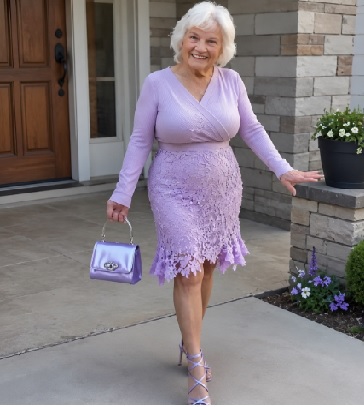
At 92, one remarkably confident woman has chosen a very different approach. She continues to wear miniskirts and high heels, not as an attempt to look younger, but because they reflect the way she wants to present herself. For her, fashion is not determined by a birth certificate. It is a form of personality, pleasure and self-expression.
Her attitude raises a much larger question about aging: at what point did society decide that getting older should mean becoming less visible?
Fashion Does Not Come With an Expiration Date
Most people begin developing their personal style long before they think seriously about aging. Some prefer elegant dresses, others love jeans and sneakers. Some feel their best in bright colors, while others choose understated clothing.
These preferences do not automatically disappear when someone turns 60, 70, 80 or 90.
Yet expectations often change.
An outfit that attracts compliments on a younger woman may suddenly be described as “too bold” when worn by an older person. High heels can be viewed as inappropriate. Short skirts may provoke criticism. Bright makeup, unusual hairstyles or fashionable accessories can attract comments that have little to do with the clothes themselves.
The underlying message is often the same: older people are expected to become more restrained.
The 92-year-old woman at the center of this story challenges that expectation simply by refusing to organize her wardrobe around other people’s opinions.
If she enjoys wearing a miniskirt, she wears one. If high heels make her feel elegant, she chooses them. Her age does not disappear when she gets dressed, but neither does her personality.
That distinction matters.
Dressing Young and Dressing Like Yourself
There is an important difference between desperately trying to appear younger and continuing to enjoy a style that feels authentic.
The two are frequently confused.
A person can be completely comfortable with their age while still enjoying contemporary fashion. Wearing fashionable clothes does not necessarily mean rejecting aging. In many cases, it means refusing the assumption that aging requires abandoning everything playful, glamorous or daring.
Someone who loved beautiful shoes at 30 may still love them at 80. A person who enjoyed colorful dresses throughout adulthood does not suddenly develop an obligation to wear beige simply because decades have passed.
Personal taste can evolve, but it does not need to surrender.
That is perhaps what makes this woman’s approach so striking. The important element is not the length of her skirt or the height of her heels. It is the confidence behind those choices.
She dresses according to what she likes rather than according to what strangers believe a 92-year-old woman should look like.
Why Older Women Face Particular Pressure
Aging affects everyone, but cultural expectations surrounding appearance have historically placed particularly strong pressure on women.
Women are frequently encouraged to look youthful while simultaneously being criticized if they appear to be trying “too hard” to remain young. They can therefore find themselves caught between contradictory expectations.
Show visible signs of aging, and someone may suggest they should make more effort with their appearance. Dress boldly or fashionably, and someone else may tell them to “act their age.”
There is almost no way to satisfy both demands.
Perhaps the more useful solution is to stop treating public approval as the goal.
Fashion is personal. Clothing has practical purposes, of course, but it also communicates identity. A favorite jacket, pair of shoes or dress can be associated with confidence, memories, independence or simply the pleasure of looking in the mirror and liking what you see.
None of those experiences belongs exclusively to younger people.
Confidence Can Change With Age
Youth is commonly associated with confidence, but real life is often more complicated.
Young people can spend enormous amounts of energy worrying about how they are perceived. They may follow trends not because they genuinely enjoy them, but because they want to fit in.
Growing older can sometimes produce the opposite effect.
After decades of experience, other people’s opinions may begin to carry less weight. The desire to satisfy everyone can weaken. A person may become more comfortable saying, in effect, “This is who I am.”
That freedom can be visible in something as ordinary as clothing.
At 92, wearing high heels or a short skirt can therefore represent more than a fashion preference. It can become a declaration of independence from expectations that say older adults should become quieter and less noticeable.
There is no need to romanticize aging. Growing older can bring physical limitations, changes in health and practical considerations that naturally influence clothing choices. Comfort and safety matter, especially when it comes to footwear and mobility.
But practical adaptation is very different from surrendering personal identity because of social pressure.
Style Is More Than Looking Young
Modern discussions about fashion and aging often focus too heavily on the idea of appearing younger.
Articles promise clothes that can “take ten years off.” Advertisements sell products designed to hide age. Compliments such as “You don’t look your age” are often treated as the highest praise an older person can receive.
But perhaps there is another possibility: looking your age and feeling wonderful anyway.
A 92-year-old woman does not need to resemble a 42-year-old woman to be stylish. The goal does not have to be creating an illusion of youth.
Style can simply mean choosing clothing intentionally and enjoying the result.
Seen from this perspective, wrinkles, gray hair and fashionable clothing are not contradictions. They can exist together naturally.
Aging does not erase someone’s interest in beauty. It does not remove humor, curiosity or creativity. And it certainly does not automatically remove the desire to feel attractive.
The Meaning of Being Visible
Clothing also affects the way older people are perceived in public.
Popular culture frequently presents aging through a narrow range of images. Older adults are portrayed as grandparents, retirees or people needing care, while far less attention is given to their individuality.
But a person does not become only “an elderly woman” after reaching a certain age.
She still has preferences. She still has memories, habits, opinions and tastes developed over an entire lifetime. She may enjoy music, travel, cosmetics, jewelry or fashion just as she did decades earlier.
Seeing an older woman confidently wearing something unexpected can challenge assumptions precisely because it forces people to recognize that individuality remains.
The outfit becomes a reminder that age describes how long someone has lived; it does not provide a complete description of who that person is.
There Is No Universal Way to Age
Of course, the lesson should not be that every older woman ought to wear miniskirts and high heels.
That would simply replace one restrictive expectation with another.
Someone who prefers loose trousers, comfortable shoes and simple clothing is no less confident. Another person may stop wearing heels because they are uncomfortable or impractical. Someone else may become less interested in fashion altogether.
All of these choices are equally legitimate when they are genuinely personal.
The point is freedom.
People should be able to adapt their appearance as they age without being told that there is one correct way to look at 50, 70 or 90.
For one woman, freedom might mean choosing comfortable sneakers. For another, it might mean stepping outside in high heels at 92.
Neither needs permission.
Growing Older Without Becoming Invisible
Perhaps the most interesting thing about this woman’s style is not that she breaks fashion rules. It is that she exposes how arbitrary many of those rules are.
Who decided when a skirt becomes too short for someone’s age? At what birthday does a particular pair of shoes suddenly become unacceptable? Why should a color, hairstyle or dress belong exclusively to one generation?
There are practical considerations in fashion, but many supposed age restrictions have little to do with practicality. They survive because people repeat them.
Every person who ignores such expectations makes them slightly less powerful.
Aging is unavoidable for anyone fortunate enough to experience it. Losing individuality is not.
At 92, this woman continues to choose clothes that make her feel confident and alive. She is not asking fashion to make her younger. She is using it to remain unmistakably herself.
And perhaps that is the most timeless definition of style: not dressing according to the number of years behind you, but having the confidence to decide for yourself what belongs in the years still ahead.